

The group recorded revenue of Dh66.2 billion in the first half of the 2026-27 financial year, despite regional tensions and rising fuel costs.
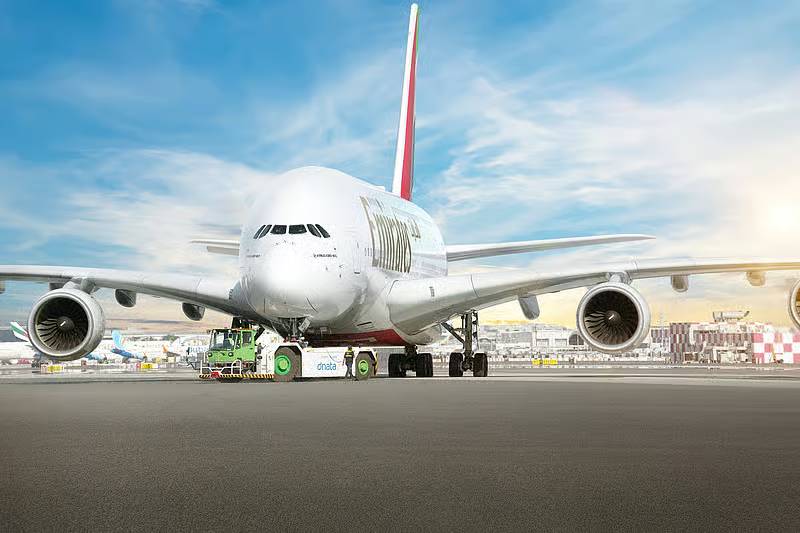
The Emirates Group remained profitable in the first half of the 2026-27 financial year despite regional challenges and higher fuel costs, demonstrating the resilience of its business model and operational efficiency.
After accounting for income tax, the Group reported a profit of Dh3.6 billion, down 66 per cent from the same period last year.
Sheikh Ahmed bin Saeed Al Maktoum, Chairman and Chief Executive of Emirates Airline and Group, credited the performance to the efforts of employees and their ability to navigate difficult operating conditions.
“I would like to commend the exceptional efforts exerted by the government of the UAE and its ongoing support, which played a pivotal role in overcoming challenges and ensuring the continuity of operations in the aviation sector,” he said.
He added that Emirates and dnata continued to invest with a long-term vision, focusing on customer experience, developing future capabilities and strengthening their readiness to capitalise on growth opportunities. These efforts, he said, would support sustainable success and reinforce the Group’s position in the global aviation industry.
A demanding six months
Since the outbreak of the regional conflict involving the US, Israel and Iran, aviation across the GCC has faced disruption from airspace restrictions, flight diversions and rising operating costs.
Airlines have had to contend with longer flight routes, increased fuel consumption, higher insurance premiums and uncertainty among passengers.
“It has been a demanding six months, and once again our business model and our people stood up to the test. Against unprecedented regional challenges and high fuel prices, the Group has delivered a profit before tax of Dh4.1 billion. Customer demand held firm and our cargo operations made a strong contribution, keeping revenue and cash levels healthy even as global jet fuel prices doubled against the same period last year, impacting our costs and profitability,” Sheikh Ahmed said.
“I’d like to thank the UAE government for its decisive response and its co-ordination of all stakeholders to enable the safe resumption of air transport in the aftermath of military activity across the Gulf region. The government’s measures have also led to the easing of travel advisories to and through the UAE. This has allowed us to restore our operations with confidence and to keep serving our customers and communities,” he said in a statement on Thursday.
Revenue falls 12%
Sheikh Ahmed said the Group had maintained its investment plans, continuing to expand its fleet and develop its capabilities despite the challenging environment.
The Group recorded EBITDA of Dh12.5 billion, down 41 per cent from Dh21.1 billion in the same period last year.
Revenue for the first six months of 2026-27 stood at Dh66.2 billion, a 12 per cent decline from Dh75.4 billion in the corresponding period last year.
The Group ended the first half of the financial year with cash reserves of Dh54.1 billion as of September 30, 2026, compared with Dh59.6 billion on March 31, 2026.
It said its strong cash reserves had helped fund business requirements, including aircraft pre-delivery payments and existing debt obligations. The Group also paid the remaining Dh2 billion dividend to its owner, the Investment Corporation of Dubai (ICD), out of the Dh3.5 billion declared for the 2025-26 financial year.

Employee numbers decline
Sheikh Ahmed said the Group entered the second half of 2026-27 with “measured optimism”, while continuing to monitor costs and geopolitical developments closely.
“We’ve weathered challenges before, and with our strong cash position and solid foundation built up over the years, the Group is well-placed to navigate the headwinds of volatility and high fuel prices,” he said.
The Emirates Group’s workforce fell by 2 per cent to 128,237 employees as of September 30, 2026, compared with March 31, 2026.
Emirates airline profit falls 66%
The first half of 2026-27 presented significant operational challenges for Emirates, as intermittent airspace restrictions and closures across the region tested the airline’s ability to adapt. Government travel advisories also influenced passenger choices and travel patterns.
Emirates recorded a profit before tax of Dh3.7 billion, compared with a record Dh11.4 billion in the same period last year.
The airline’s profit after tax declined 66 per cent to Dh3.3 billion.
Revenue, including other operating income, fell 13 per cent to Dh56.9 billion from Dh65.6 billion a year earlier. The airline attributed its revenue performance to sustained travel demand across its markets, particularly in premium cabins, as well as a solid contribution from its cargo business.
Emirates’ operating costs, including fuel, declined by 2 per cent in line with reduced operations. However, despite a 12 per cent drop in fuel uplift, fuel costs before hedging gains increased by 60 per cent compared with the previous half-year.
Gains of Dh7.1 billion from the airline’s fuel price risk management strategy helped offset the impact of higher prices, limiting the net increase in fuel costs to 13 per cent. Fuel remained the largest component of operating expenses, accounting for 34 per cent.
Emirates recorded EBITDA of Dh11.5 billion, down 41 per cent from Dh19.7 billion in the same period last year.
As of September 30, the airline had restored operations across 91 per cent of its pre-disruption network. Its passenger and cargo services covered 150 airports in 78 countries and territories.
Between April 1 and September 30, Emirates expanded the availability of its Premium Economy seats and introduced its latest cabin products in additional markets. It also received nine new A350 aircraft and completed full cabin refurbishments on 12 aircraft — nine A380s and three Boeing 777s.
The airline continued its Starlink installation programme, equipping another 36 aircraft with high-speed in-flight Wi-Fi during the first half of the year. This brought the total number of Starlink-equipped aircraft to 57 as of September 30.
Overall capacity declined by 10 per cent to 28.2 billion Available Tonne Kilometres (ATKM) during the first six months, reflecting a reduced flying schedule.
Capacity measured in Available Seat Kilometres (ASKM) fell 17 per cent, while passenger traffic, measured in Revenue Passenger Kilometres (RPKM), declined 25 per cent. The average passenger seat factor stood at 72 per cent, compared with 79.5 per cent in the same period last year.
Emirates carried 21.8 million passengers between April 1 and September 30, a 22 per cent decrease from the corresponding period last year.
Emirates SkyCargo and dnata
Emirates SkyCargo transported 1.2 million tonnes of cargo during the first half of the financial year, down 1 per cent from the same period last year.
However, cargo revenue rose 52 per cent as the regional conflict reduced available airfreight capacity and disrupted maritime transport, prompting more shippers to turn to air cargo.
During the first half of 2026-27, Emirates SkyCargo increased its capacity with the delivery of five new Boeing 777 freighters and the deployment of its first passenger-to-freighter converted aircraft.
dnata recorded revenue, including other operating income, of Dh11 billion, down 7 per cent from Dh11.7 billion in the same period last year.
Its profit before tax stood at Dh410 million, a 51 per cent decline from the previous year. Profit after tax fell 56 per cent to Dh309 million.
dnata’s EBITDA was Dh939 million, down 31 per cent from Dh1.4 billion a year earlier.
Airport operations remained dnata’s largest revenue contributor, generating Dh5.4 billion, a 3 per cent decrease compared with the same period last year. The company said growth across its international operations helped offset reduced activity among customer airlines at its UAE hub during the period.

