

Abu Dhabi looks to harness AI to accelerate government transformation across key sectors.
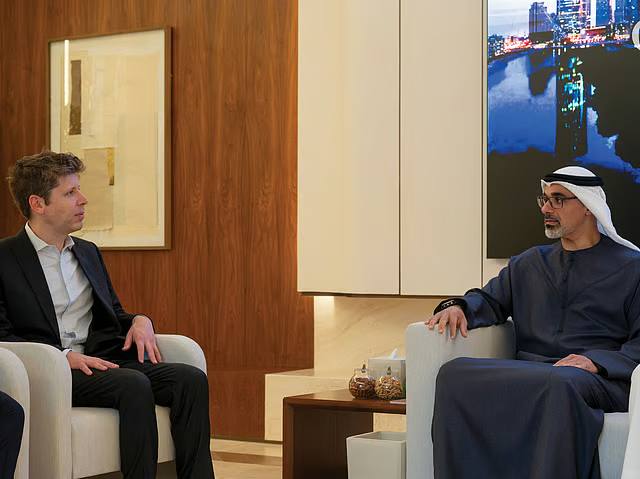
Abu Dhabi: Sheikh Khaled bin Mohamed bin Zayed Al Nahyan, Crown Prince of Abu Dhabi and Chairman of the Abu Dhabi Executive Council, has met OpenAI CEO Sam Altman to discuss opportunities to strengthen cooperation in artificial intelligence (AI).
The discussions centred on using advanced AI technologies to accelerate government transformation and support innovation across Abu Dhabi’s strategic sectors, in line with the emirate’s economic and development priorities. They also reflected Abu Dhabi’s ambition to establish itself as a global hub for AI innovation and deployment.
The meeting highlighted the emirate’s progress in incorporating AI into government services and key economic sectors, backed by continued investment in digital infrastructure and the development of national talent. These efforts form part of Abu Dhabi’s ambition to become the world’s first fully AI-native government.
Following the meeting, Sheikh Khaled witnessed the signing of four agreements between Abu Dhabi-based entities and OpenAI, covering the government, energy and investment sectors.
Sam Altman, CEO of OpenAI, said: “Abu Dhabi and the UAE are setting a bold, global standard for AI integration across both the public and private sectors to make sure the benefits of AI reach everyone. We are proud to support the UAE’s ambition, anchored in a shared commitment to safety, accessibility and responsible innovation.”
In the energy sector, ADNOC, G42 subsidiary Inception42 and OpenAI signed an agreement that will make ADNOC the first company in the energy sector to deploy OpenAI’s frontier technology.
The partnership will integrate advanced AI capabilities across ADNOC’s operations, supporting more connected operational, investment and commercial decision-making while improving efficiency and productivity.
The technology will run on OpenAI’s GPT models using in-country inference infrastructure in the UAE. The agreement marks another step towards ADNOC’s ambition to become the world’s most technology- and AI-enabled energy company.
In the government sector, Abu Dhabi Government and OpenAI have launched the world’s first AI-native Machine-Readable Government (MRG) initiative, marking a significant step towards the emirate’s ambition to become the world’s first AI-native government.
The initiative converts selected government policies and regulations into machine-readable formats, allowing AI-powered systems to support officials with routine regulatory compliance assessments, including those involved in issuing permits and certificates. Each assessment can be traced back to the relevant governing rule, while government officials retain oversight and responsibility for final decisions.
Led and governed by the Department of Government Enablement – Abu Dhabi (DGE), the initiative’s first pilot is already operational at the Abu Dhabi Agriculture and Food Safety Authority (ADAFSA), focusing on food imports. AI processing is supported by OpenAI’s UAE-based inference infrastructure, with models running in real time on GPUs located in UAE data centres.
In the investment sector, Mubadala, Inception42 and OpenAI have signed an agreement to use advanced AI capabilities for investment analysis, identifying opportunities and assessing risks. The partnership aims to support better-informed investment decisions and long-term value creation.
Separately, Inception42 and OpenAI have entered into a five-year agreement to accelerate the adoption of advanced AI across government, enterprise and education.
Under the agreement, the two organisations will work together to expand AI adoption across these sectors in the UAE. Their collaboration will include developing enterprise solutions for major UAE organisations, combining OpenAI’s advanced models and AI engineering expertise with Inception42’s applied AI capabilities and consultancy-led professional services.
Together, the agreements underscore Abu Dhabi’s ambition to move beyond adopting AI towards deploying it at scale across strategic sectors. The initiative is expected to support productivity, enhance economic competitiveness and advance the emirate’s transition towards a knowledge-based, innovation-driven economy.

