

In an interview with, a senior Dubai Police officer reveals how the command centre responds to emergencies, pinpoints callers’ locations and uses AI to analyse incidents.
How Dubai Police uses drones, GPS and AI to respond to emergencies
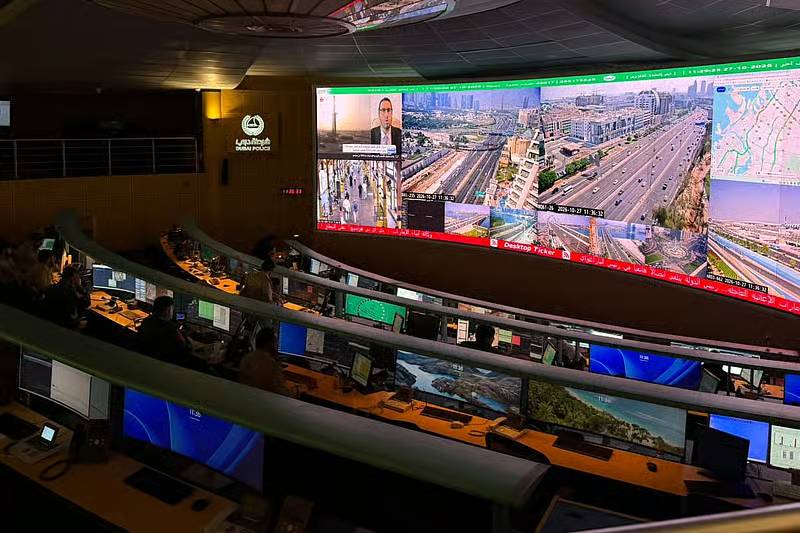
A Dubai Police patrol may still be on its way to an emergency when officers at the force’s command and control centre are already monitoring the scene.
When surveillance cameras do not cover the location, a drone can be deployed automatically to provide an early view of the situation. The live information helps officers assess the incident and determine whether additional emergency resources are needed before the first patrol arrives.
This is part of a wider network of technologies Dubai Police uses to manage emergency calls, pinpoint incidents and coordinate responses across the emirate.
In an interview with Khaleej Times, Captain Abdullah Rashid Al Maamari, head of the Command and Control Section at Dubai Police, explained how the systems work together — from the moment someone calls 999 to the analysis of incident reports after each shift.
What happens when a caller cannot explain their location?
One of the first challenges facing emergency operators is establishing exactly where help is needed.
Some callers may be unfamiliar with their surroundings, while others may be unable to provide complete information.
Al Maamari said the operations room uses GPS and other location-based technologies to identify incident locations. Once a location is established, the system can display the nearest available surveillance camera, helping officers assess the surrounding area.
The importance of this capability became evident in an incident reported by police in August. At around 3.30am, a woman called Dubai Police but managed to provide only a few words about being at an intersection before falling silent.
Officers traced her phone to the Nad Al Sheba area and alerted nearby patrols. They eventually found her unconscious inside a locked car and rescued her.
Even when callers can provide only limited details, operators can use the available information to guide the response. Al Maamari explained that details as basic as a vehicle registration number can help specialised teams locate a vehicle through police systems and available surveillance cameras.
How drones can reach an emergency before patrols
Surveillance cameras do not cover every location. To address these gaps, Dubai Police uses its Drone Box system.
“If there is no camera at the location, we have a system called Drone Box. The drone can be deployed automatically to the scene without direct intervention,” Al Maamari explained.
The technology allows officers to assess an incident remotely rather than relying solely on information provided over the phone.
“Even before the patrol arrives, the drone provides us with information about the incident and whether additional resources are required,” he said.
Introduced in 2021, the Drone Box initiative enables aircraft to transmit live footage to the command centre, helping officers assess emergencies before response teams reach the scene.
The system has also been deployed in high-rise communities, including Jumeirah Lake Towers and Uptown Dubai, to support emergency response and remote monitoring.
How AI helps analyse emergencies
The use of technology continues after an incident has been resolved. Artificial intelligence helps Dubai Police analyse and categorise incident reports at the end of each shift, identifying areas where emergencies occur more frequently.
“At present, artificial intelligence does not directly intervene in receiving calls. However, we use it to analyse reports and identify areas where incidents are concentrated,” Al Maamari said.
Officers discuss the findings during daily briefings, helping them identify patterns and prepare for upcoming shifts.
AI therefore supports the analysis of emergency reports and helps officers understand incident trends, while operators continue to handle calls from the public.
How Dubai Police prepares for thousands of calls
Technology is only one part of managing the operation. Ensuring that enough personnel are available to answer emergency calls throughout the day is another challenge.
Al Maamari said Dubai Police studies incoming call patterns and adjusts staffing levels accordingly.
During the second quarter of 2025, 99.8 per cent of emergency calls were answered within 10 seconds.
Dubai Police also recorded an average response time of two minutes and 27 seconds for the most critical emergency incidents in 2025.
“Our goal is not to miss a single emergency call. We want to respond to every emergency call we receive,” Al Maamari said.
Why every call to 999 matters
Not every call to the emergency number concerns an immediate threat or requires police intervention. Al Maamari said operators regularly receive enquiries about traffic, everyday problems and matters that fall under the responsibility of other authorities.
Previous cases reported by have included people calling 999 to ask for directions, enquire about traffic fines and, in one unusual instance, invite police officers to lunch.
Although these calls may appear harmless, they add to the workload of a system designed to handle urgent situations. Keeping the emergency line available for genuine emergencies remains an important part of ensuring that those who need immediate assistance can reach the police.
Residents are urged to use 999 for emergencies and 901 for non-emergency police enquiries. For tourists unfamiliar with the UAE’s emergency numbers, Al Maamari said Dubai’s emergency system can also receive calls made to international emergency numbers, including 911 and 112, enabling visitors to contact emergency services.
Further upgrades planned for Dubai Police operations room
Dubai Police is also preparing to modernise its operations room over the next two years, with plans for greater integration of artificial intelligence and advanced technologies, Al Maamari said.
The transformation aims to enhance the systems that support emergency response at every stage — from answering the initial call to coordinating resources and ensuring officers reach those in need.

