

Over 220 speakers and experts discuss 14 key topics at the World Police Summit, highlighting the need for greater global law enforcement cooperation to tackle emerging threats.
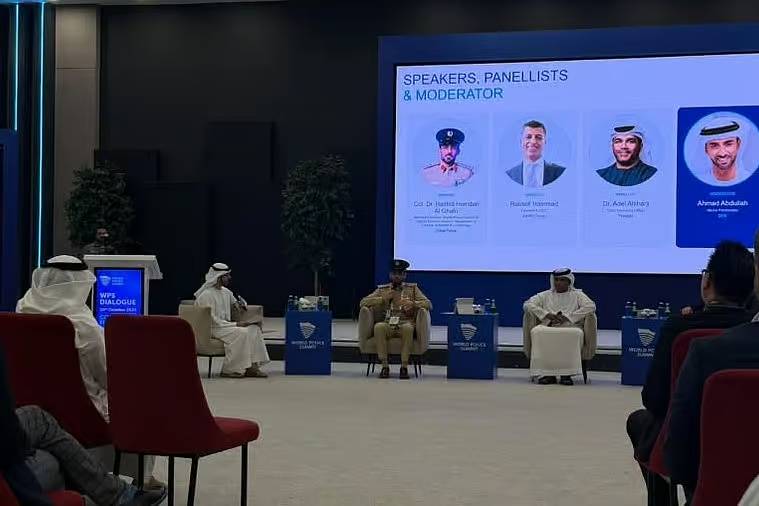
Artificial intelligence is transforming the way criminals operate, prompting law enforcement agencies around the world to reassess how they identify threats, exchange intelligence and tackle increasingly complex forms of crime.
From cyberattacks and financial fraud to organised criminal networks operating across borders, police forces must embrace advanced technologies while strengthening international collaboration to stay ahead of emerging security challenges, experts said during a World Police Summit discussion hosted by Dubai Police on Friday.
The session brought together senior law enforcement officials and technology specialists, including Col. Dr Rashid Hamdan Al Ghafri, Deputy Director General of the General Department of Forensic Science and Criminology; Russell Hammad, Founder and CEO of Zenith Group; and Dr Adel Alsharji, Chief Operating Officer of Presight.
The experts explored how artificial intelligence, interconnected security platforms and real-time intelligence sharing could enhance police capabilities, improve threat detection and support faster responses to criminal activity.
The World Police Summit features more than 150 exhibitors and sponsors, alongside over 220 speakers and experts, with discussions covering 14 major topics addressing the evolving challenges facing law enforcement agencies worldwide.
The event provides a platform for police authorities, government officials and technology professionals to share knowledge, strengthen partnerships and examine innovative approaches to tackling emerging security threats.
A key takeaway from the discussion was that emerging security threats cannot be addressed by any one nation acting independently. Closer collaboration among law enforcement agencies, governments, technology providers and academic institutions is crucial to bridging operational gaps and tackling criminal activities that extend across international borders.
Strengthening international police cooperation
Col. Dr Rashid Hamdan Al Ghafri stressed the value of bringing together law enforcement leaders from different countries and sectors to find collective solutions to common security challenges.
He highlighted how international partnerships enable police organisations to exchange practical experience, adopt proven approaches and develop strategies suited to different operational environments.
With criminals increasingly using digital technologies and cross-border networks, sharing information between agencies can help investigators uncover suspicious patterns and connect incidents that may initially appear unrelated.
Speakers emphasised that effective cooperation must go beyond discussions and knowledge exchange. Law enforcement organisations need interoperable systems, timely intelligence sharing and coordinated operational strategies to ensure technological innovations deliver measurable security benefits.
Collaboration between government agencies and private technology companies was also identified as a major priority. Such partnerships can accelerate the development and deployment of tools that support criminal investigations, enhance intelligence processing and improve policing capabilities.
Bridging physical surveillance and cybersecurity
Another major focus of the discussion was the growing relationship between physical security and cyber intelligence, with experts examining how connected surveillance technologies and integrated intelligence systems can improve threat identification.
Russell Hammad drew attention to the difficulties of securing extensive geographical areas, particularly in locations where traditional surveillance networks and communications infrastructure have limited reach.
Although major cities often have sophisticated monitoring systems, remote and less-developed areas can face significant coverage limitations. These gaps may restrict authorities’ ability to track suspicious activities and respond promptly to security incidents.
AI-powered surveillance technologies and digitally connected patrol vehicles could help overcome these limitations by allowing officers to identify individuals, vehicles and locations while bringing together intelligence from multiple sources.
By combining these capabilities, law enforcement agencies can develop a clearer understanding of potential security risks and uncover connections between people, vehicles and incidents that might otherwise remain undetected.
The broader aim is to replace fragmented security tools with an integrated ecosystem capable of processing information and supporting operational decisions in real time.
Experts also stressed that intelligence must be accessible to frontline officers when it is needed most. Bringing together physical surveillance data and digital intelligence can support more informed decision-making and enable faster, more effective responses to developing threats.
AI creates opportunities but requires responsible oversight
As artificial intelligence plays a growing role in modern policing, speakers cautioned that adopting advanced technology alone is not enough.
Law enforcement agencies must also invest in workforce training, institutional readiness and the infrastructure required to deploy AI effectively.
At the same time, clear accountability mechanisms and appropriate human supervision remain essential to ensuring these technologies are used responsibly in police operations.
Dr Adel Alsharji was among the specialists who examined the growing challenges confronting law enforcement agencies as technology evolves and organisations adjust to increasingly sophisticated capabilities.
Artificial intelligence can assist police forces in analysing vast amounts of data, recognising suspicious patterns and strengthening intelligence assessments. However, the success of these systems relies on accurate information, dependable technology and the ability of officers to understand and apply the insights produced.
Law enforcement organisations must also ensure that emerging technologies are effectively incorporated into existing procedures and meet real-world operational needs.
The speed of technological innovation adds another layer of complexity, requiring police agencies to regularly evaluate their capabilities, upgrade personnel skills and respond to new techniques adopted by criminals.
Experts underscored the need for a balanced approach to AI adoption, ensuring that human judgment, accountability and responsible oversight remain fundamental to policing.
Real-time intelligence sharing emerges as key priority
When asked to identify the most pressing operational gap requiring attention, panelists consistently pointed to the need for better system integration and more effective intelligence exchange.
Linking security platforms and improving collaboration among law enforcement agencies can help authorities maximise existing resources, strengthen operational coordination and tackle crimes involving multiple countries more effectively.
The ability to exchange intelligence quickly becomes especially critical when security threats span several jurisdictions or involve interconnected criminal activities.
Speakers also emphasised that technological investments must produce meaningful operational improvements, ensuring that senior decision-makers and frontline personnel receive accurate, relevant intelligence at the right time.
Even sophisticated security technologies can fall short when systems operate independently and agencies respond without coordination, regardless of how much has been invested in individual platforms.
The discussion reinforced the importance of building a unified security ecosystem in which governments, police authorities and technology companies combine their knowledge, intelligence resources and operational strengths to confront evolving threats.
As artificial intelligence continues to transform the security sector, experts highlighted that effective policing will require more than advanced technology. Success will also depend on stronger institutional partnerships, responsible information sharing and the ability to translate intelligence into swift, coordinated action.

