

UAE Justice Minister Warns of New Crime Threats Driven by AI and Multi-Agent Systems.
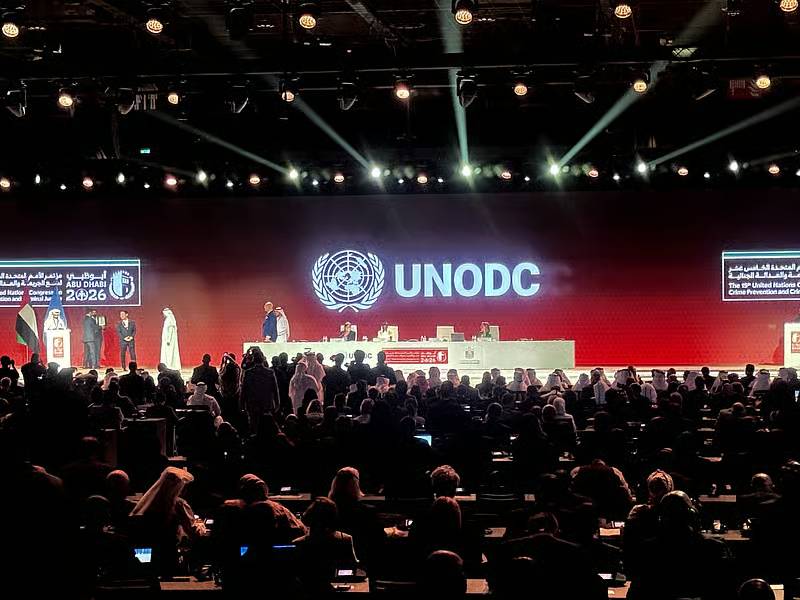
The UAE took over the presidency of the 15th United Nations Congress on Crime Prevention and Criminal Justice on Saturday, as Abu Dhabi welcomed delegates from more than 110 countries for what organisers described as the largest gathering in the congress’s 71-year history.
UAE Minister of Justice Abdullah Sultan bin Awad Al Nuaimi was elected president of the congress, which comes at a time when criminal threats are rapidly evolving and international cooperation mechanisms are facing increasing pressure.
Addressing delegates at the opening ceremony, Al Nuaimi warned about an emerging generation of crime powered by artificial intelligence and multi-agent systems, which he said could carry out sophisticated, high-impact operations across national borders.
He identified cybercrime, human trafficking, money laundering and terrorism financing as some of the most urgent challenges facing the international community. Al Nuaimi also stressed the importance of balancing security priorities with the protection of victims’ rights, while ensuring that offenders have opportunities for rehabilitation and reintegration into society.
The minister said the UAE’s network of judicial partnerships goes beyond legal cooperation, describing such agreements as instruments of diplomacy that can strengthen trust, encourage investment and facilitate the movement of people. He positioned cooperation in criminal justice as an important part of the UAE’s wider international engagement.
Al Nuaimi urged member states to adopt the Abu Dhabi Declaration as a binding strategic framework for collective action over the next five years. He also emphasised the importance of addressing legislative gaps that can be exploited by transnational criminal networks.
More than 5,100 government representatives attended the congress, making it the largest gathering in the event’s history.
Dr Monica Juma, Executive Director of the United Nations Office on Drugs and Crime (UNODC) and Secretary-General of the congress, said the scale of participation demonstrated a shared commitment to tackling evolving global challenges.
“We have not come to Abu Dhabi simply to describe how the world has changed. We have come to decide how we must respond,” she said.
Juma said member states had already submitted more than 40 pledges ahead of the formal sessions. She also called on governments to accelerate the signing and ratification of the UN Convention against Cybercrime.
She described the Abu Dhabi gathering as an opportunity to strengthen confidence in multilateral cooperation at a time when trust in international institutions is facing growing challenges.
Sonja Yee, UNODC Chief of Advocacy, highlighted the congress’s Generation Justice initiative, which aims to bring young people into discussions on the future of criminal justice through a dedicated forum and lab.
“How can you have shared solutions if you don’t involve the young leaders of tomorrow?” she said.
Yee also pointed to the UAE’s role in bringing countries together to address common challenges such as cybercrime, transnational organised crime and human trafficking. She noted that Abu Dhabi previously hosted the Conference of the States Parties to the United Nations Convention against Corruption in 2019.
In a video address, UN Deputy Secretary-General Amina Mohammed congratulated Al Nuaimi on his election as president of the congress and warned that criminal networks are increasingly exploiting digital spaces while taking advantage of widening inequalities and gaps in governance.
She called for justice systems that protect women and girls from technology-facilitated violence while ensuring equal access to justice.
“Justice cannot be a privilege,” she said.
The congress will continue until October 1, with delegates expected to consider the adoption of the Abu Dhabi Declaration. Discussions will also focus on major criminal justice challenges, including AI-enabled crime, cybersecurity, anti-corruption efforts and wildlife trafficking.

