

The Philippines said empowering people closest to a crisis can help communities respond more quickly and effectively to disasters.

Dubai: When disaster strikes, the first responders may not always be those in a command centre. They could be volunteers in villages, community leaders familiar with the area, or local teams trained to act quickly.
For the Philippine Red Cross, empowering these frontline responders to make decisions has become a key part of its disaster response strategy.
This was among the key lessons shared by Philippine Red Cross Secretary General Dr Gwendolyn Pang at the Dubai International Humanitarian Aid and Development (DIHAD) Conference and Exhibition, held at the Dubai World Trade Centre from August 24 to 26.
“The Philippines is always the headline when it comes to disasters. You name it, we have it — whatever disaster you have in mind,” Pang said in her opening remarks as an invited panelist at the discussion, “The Turning Point for Leadership in Times of Change.”
The session brought together Pang, Dr Manal Taryam of Noor Dubai Foundation, Mohamed Al Shareef of Operation Chivalrous Knight 3, and Engineer Salama Mohammed Alfalasi of the Dubai Police Young Leaders Council. The discussion was moderated by Dr Michael Kohler.
The panel examined how leadership in humanitarian organisations is evolving as crises become increasingly complex and unpredictable.
Trust over control
For Pang, one of the most important shifts has been moving from a culture of control to one built on trust. This involves giving local community leaders not only responsibilities, but also the confidence and authority to make decisions on the ground.
“In a country like the Philippines, we have ranked the No. 1 riskiest country for four years now. We cannot do everything by ourselves — neither the government nor any single organisation,” Pang said.
Instead, the Philippine Red Cross has worked to distribute decision-making authority among its chapters and branches, while also empowering community members on the ground to take action when crises occur.
Pang noted that decentralising decision-making enables Philippine Red Cross chapters and community leaders to draw on their understanding of local conditions and the needs of affected communities, allowing them to make timely and informed decisions.
Volunteers in every village
The need for localised action is particularly important in the Philippines, given the country’s geography and the challenges it poses for disaster response.
“We are divided by bodies of water. Geographically, it’s so challenging to respond,” Pang said.
The Philippine Red Cross has responded by building a network of village-level volunteers through its Red Cross 143 programme, bringing basic safety and emergency response capabilities closer to communities that need them most.
“It’s really putting safety in the hands of people on the ground because we cannot be there for them at the height of an emergency,” Pang said.
However, having volunteers on the ground is only part of the approach. The Philippine Red Cross also empowers them with the skills and authority needed to act independently during emergencies.
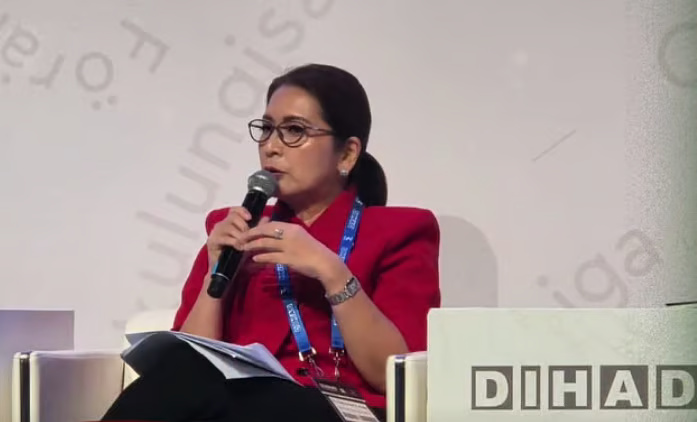
“We also share the vision, responsibility, and authority to them so in the event of a major crisis, they can actually decide and do what is best for the community, from the training we have conducted to them,” Pang said.
Rather than waiting for external assistance or instructions, trained community members can begin responding immediately based on the situation unfolding around them.
Funding quick action
Pang also took part in a second DIHAD panel, “Acting Before Crises: Financing the World’s Fastest Humanitarian Response,” where she highlighted the role of the International Federation of Red Cross and Red Crescent Societies’ Disaster Response Emergency Fund (IFRC-DREF).
The DREF is an IFRC pooled fund that supports locally led humanitarian response and anticipatory action by providing direct, flexible and rapid financial assistance. Pang said the fund has become a reliable resource for the Philippine Red Cross during emergencies.
“With the DREF, it enabled us to mobilise our volunteers and deploy them for first-aid ambulant service, assessment, providing evacuation, giving hot meals, and healthcare to evacuees, and including rescue efforts,” Pang said.
Beyond emergency aid
Pang said the flexibility of the DREF also enables local communities to support livelihood and cash assistance programmes.
These initiatives are designed to help affected residents recover and rebuild their lives after a crisis, extending humanitarian support beyond immediate emergency relief.
The approach reflects a broader shift towards locally led humanitarian action, in which communities are not simply waiting for assistance but are given the resources, responsibility and authority to play a more active role in their own response and recovery.
A first for the Philippines at DIHAD
Notably, this year marked the first time the Philippines participated in DIHAD, providing an opportunity for the Philippine Red Cross to share its experience in community-led disaster response and humanitarian action.
The annual event brings together leaders, policymakers, practitioners, innovators, volunteers and organisations from across the humanitarian sector.
Held under the theme “Humanitarianism in Transition: Shaping the Future of Humanitarian Action,” DIHAD 2026 highlighted the need for a more collaborative model of global solidarity as crisis response, development, peacebuilding and other humanitarian efforts continue to evolve.
For the Philippine Red Cross, that transition is already being put into practice. The key message Pang brought to Dubai was not simply that disaster response requires more resources, but that those resources — along with the authority to use them — must reach people close enough to the crisis to understand what is happening and respond effectively.

