

Gulf carriers are recovering, but the crisis is reshaping how airlines plan for future growth.
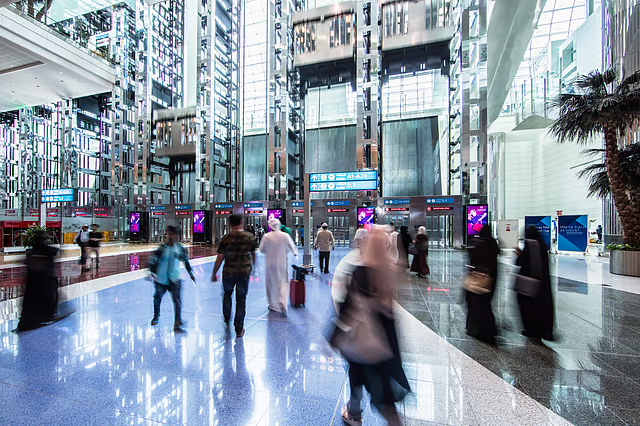
Dubai: Six months after the US-Iran war disrupted Gulf airspace, the region’s aviation sector is recovering, although the rebound has been uneven and has come at a cost.
Aviation analysts told that passenger numbers are recovering faster than expected, major airport projects remain on track and confidence is gradually returning.
However, full-service airlines, hotels and insurers continue to feel the financial impact of a conflict that affected some markets more severely than others. The crisis has also prompted airlines and industry stakeholders to reassess how they manage risk and plan for future growth.
Recovery gathers pace
Dubai is on track to end the year close to its pre-war trajectory, with the aviation recovery progressing faster than many had expected.
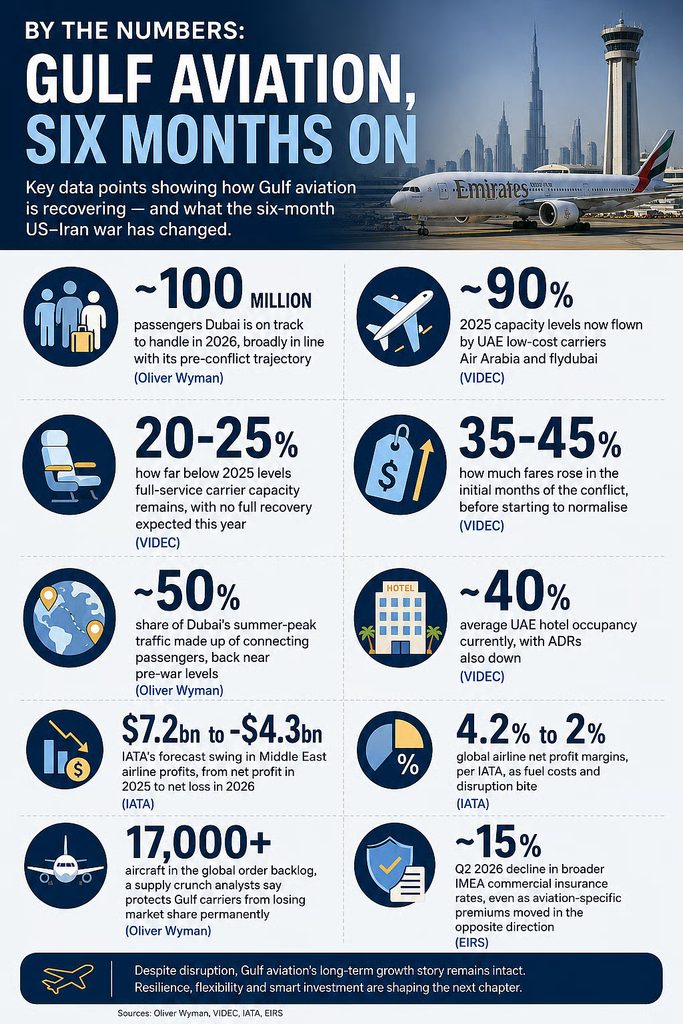
André Martins, Partner and Head of Transportation and Advanced Industrials at Oliver Wyman, said the rebound had been “faster than many expected”. Assuming there is no further major disruption and international tourism continues to recover, he expects Dubai to handle close to 100 million passengers in 2026, broadly in line with its pre-conflict trajectory. Doha and Abu Dhabi have also rebuilt their networks at a remarkable pace
Transfer traffic — the lifeblood of Gulf aviation hubs — took the biggest initial hit but has since rebounded strongly.
“By the summer peak, connecting passengers were once again accounting for around half of Dubai’s traffic,” Martins said. Dubai Airports is expected to release its first-half passenger traffic figures later this week.
Usman Tahir, Head of Aviation at Roland Berger Middle East, also described the recovery as resilient, noting that major Gulf carriers have steadily restored their schedules, with flight volumes now nearing pre-conflict levels on key international routes.
Low-cost carriers bounce back
The recovery has been uneven across Gulf aviation markets. Virendra Jain, Co-Founder and CEO of VIDEC, said it would be wrong to assume all markets were affected to the same extent. Kuwait and Bahrain were among the hardest hit, while the UAE saw a smaller impact. Saudi Arabia, meanwhile, remained largely flat and even recorded growth in some months.
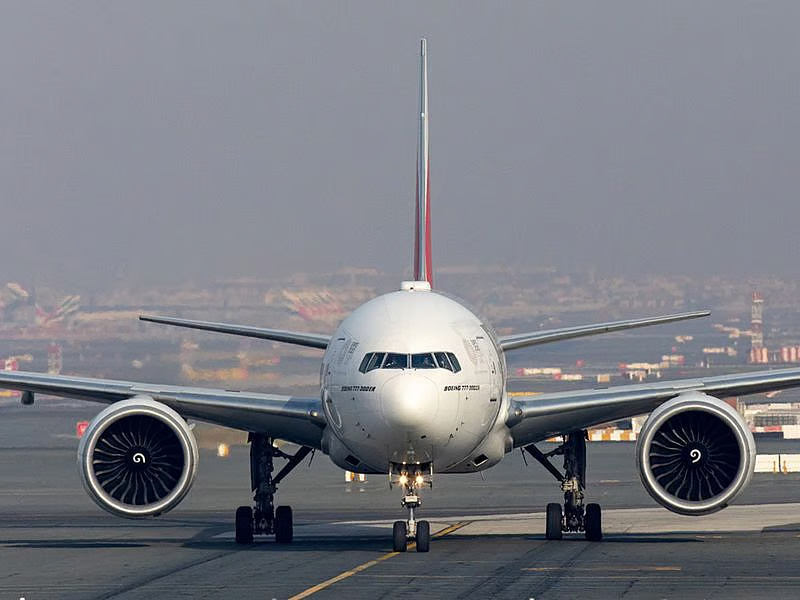
Low-cost carriers have recovered faster, Jain said. Airlines such as Air Arabia and flydubai have restored around 90 per cent of their 2025 capacity, supported by the relatively quick return of regional and intra-Gulf point-to-point travel demand.
Full-service network carriers have faced a tougher recovery. Their capacity remains around 20 to 25 per cent below 2025 levels, and Jain does not expect them to fully restore capacity this year.
He noted that Emirates is larger than the UAE’s other three major carriers combined, meaning any disruption to the airline has a significant impact on the country’s overall aviation market. Jain expects full-service carriers to remain in a net deficit against 2025 levels through 2026.
Fares still elevated
Passengers have also felt the impact, with higher fares helping airlines offset some of the capacity lost during the disruption.
Virendra Jain, Co-Founder and CEO of VIDEC, said fares initially rose by 35 to 45 per cent in the first few months. While prices have since started to ease, they remain above pre-war levels.
Linus Benjamin Bauer, Founder and Global Managing Partner of BAA & Partners, described the conflict as “a significant operational and financial stress test, but not a structural setback for Gulf aviation.”
He estimated that UAE carriers collectively incurred hundreds of millions of dollars in additional costs, including higher fuel expenses, longer flight times, crew costs and operational disruption. However, he said their strong balance sheets, global networks and operational flexibility helped them absorb the shock better than many international competitors.
Bauer said passenger confidence has largely returned and argued that the crisis had “reinforced rather than weakened” investor confidence by demonstrating the ability of Gulf airlines and governments to respond quickly to geopolitical disruption.
His broader takeaway for the industry is that resilience has become as important as efficiency.
Hotels feel the strain
The impact has also been felt across the hospitality sector. Dubai’s hotel occupancy averaged 56 per cent in the first half of 2026, representing a 30 per cent year-on-year decline amid regional conflict and weaker travel demand.
Average daily rates (ADRs) have also fallen, meaning hotels are earning less from the rooms they do fill. “ADRs have also declined, so whatever occupancy you have is coming at lower ADRs,” Jain said.
Saudi Arabia, by contrast, has proved more resilient, supported by strong domestic demand. Jain said the kingdom had “held up much better” and remained broadly positive year on year.
Airports push ahead
Despite the disruption, major airport development projects across the Gulf remain on track.
James Burlumi, Managing Director, EMEA, at Matthews, said there had been no meaningful slowdown in aviation development activity as a result of the conflict. Instead, he said the sector’s resilience had further strengthened the Middle East’s position as a global aviation hub.
While businesses have adopted a more cautious and disciplined approach to spending, particularly on short-term commitments, Burlumi said this had not diminished Gulf states’ ambitions to invest in the long-term expansion of their aviation sectors.
He added that significant and sustained investment is continuing across major international gateways such as Dubai, Riyadh and Jeddah, as well as regional airports including Madinah, Abha and Al Taif, and emerging markets such as Iraq and Syria.
Insurance costs tighten
Behind the scenes, insurers have also been reassessing their approach to aviation risks following the disruption.
Prashant Parthasarathy, Head of Aviation at EIRS, said the aviation insurance market had become more cautious in its underwriting and more selective in the risks it was willing to take on.
He said the focus has shifted towards deductibles, sub-limits and war-risk protection, rather than a broad increase in premiums.
On pricing, Parthasarathy said aviation insurance rates in the Middle East were expected to rise sharply following the conflict, even as the wider commercial insurance market moved in the opposite direction. He noted that global commercial insurance rates fell modestly in the second quarter of 2026, with the IMEA region recording an estimated decline of around 15 per cent.
Winter will tell
Analysts say the winter travel season will provide a clearer test of the Gulf aviation sector’s recovery.
Martins pointed to the global aircraft supply crunch as a potential advantage for Gulf carriers. With the worldwide aircraft backlog exceeding 17,000 planes, competing airlines have limited spare capacity to permanently capture traffic displaced during the conflict.
He said the winter season should offer a much clearer indication of whether passenger bookings have returned to full strength.
He said the winter season “will therefore give us a much clearer indication of whether bookings have returned at full strength.”
Tahir pointed to the broader industry outlook, noting that IATA expects global airline profits to fall by nearly 50 per cent, with net profit margins shrinking from 4.2 per cent to 2 per cent. Middle East airlines are also projected to swing from a $7.2 billion net profit in 2025 to a $4.3 billion net loss in 2026, making the region the only part of the global aviation industry expected to move into the red this year.
Despite the challenging outlook, Tahir said the fundamentals underpinning Gulf aviation remain strong. These include the region’s strategic location between Europe, Asia and Africa, world-class infrastructure, strong government backing and a proven ability to deliver large-scale projects.
Looking further ahead, he expects Gulf carriers to return to growth and potentially emerge from the current disruption with new competitive advantages.
Jain echoed that view, highlighting regional coordination as a key factor in the sector’s recovery. He said cooperation between the UAE and wider Gulf during periods of disruption had helped create a sense of safety, consistency and coordination — an approach he believes should continue.

