

UAE hosts eight seminars to explain zakat rules for dates during the annual harvest season.
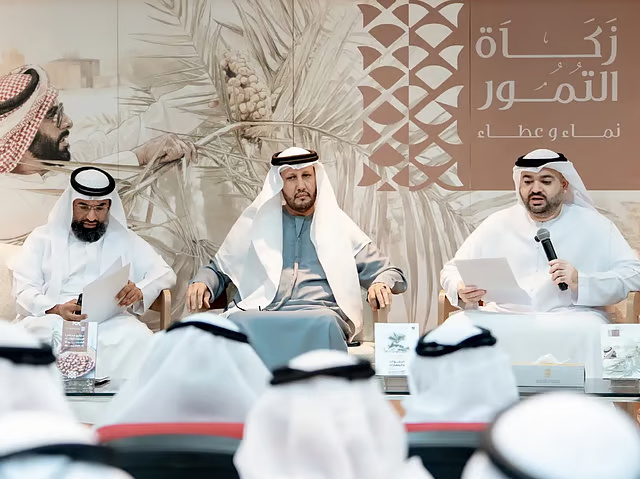
Abu Dhabi: The UAE Council for Fatwa has launched a national awareness campaign, “Zakāt on Dates: Growth and Giving 2026”, in coordination with government entities and strategic partners during the annual date harvest season.
The campaign aims to raise awareness of the rules governing zakāt on dates and provide a unified religious reference on the niṣāb, or minimum threshold at which zakāt becomes due, as well as the amount payable and methods for calculating and paying it.
The campaign includes eight seminars across the UAE, along with field initiatives, digital programmes and community outreach activities targeting palm tree owners, farmers, zakāt payers and the wider public.
The initiatives are designed to provide access to reliable Sharī’ah guidance based on established scholarly principles, while taking into account the practical realities of the agricultural sector and the Sharī’ah principle of making religious practice easier and reducing hardship.
Sheikh Abdullah bin Bayyah, Chairman of the UAE Council for Fatwa, said the campaign is based on the understanding that zakāt on dates is a religious obligation closely linked to the growth and wellbeing of society. He said this requires an institutional framework that ensures both clarity in the rulings and accuracy in their implementation.
He said the council has adopted a unified niṣāb for dates across the UAE of 541kg after drying, based on established Sharīʿah principles as well as field and scientific studies that considered local date varieties and production conditions.
Bin Bayyah said the campaign also highlights the broader objectives of zakāt, including promoting the growth of wealth, strengthening social solidarity and encouraging compassion within society. It also links the religious obligation to the cultural significance of the palm tree in Emirati identity, while helping palm tree owners, farmers and zakāt payers understand the rules and fulfil their obligations under clear guidance from a trusted national fatwa authority.
Dr Sabaa Salem Al Kaabi, Secretary-General of the UAE Council for Fatwa, said the campaign aims to reach people across the emirates through eight seminars, field activities, community programmes, digital content and awareness materials. The initiatives are intended to turn fatwa guidance into practical information that directly addresses public needs.
She said the campaign’s wide range of activities — including seminars, educational sessions, participation in fresh-date and date festivals, children’s programmes, competitions and cultural events — reflects the council’s efforts to engage different segments of society through accessible formats and strengthen the role of institutional fatwa guidance in everyday life.
The seminars cover a range of topics, including an introduction to the UAE Council for Fatwa, its key services and available fatwa channels. They also highlight the palm tree’s status as the “Tree of Life” and its national, economic and cultural importance, while explaining the methodological principles and institutional guidelines governing fatwas on zakāt for dates.
The sessions also address rulings on the niṣāb, the amount of zakāt due, payment timelines and eligible recipients, as well as differences in irrigation and cultivation methods. Other topics include crops grown for personal consumption, sale or trade, the option of paying zakāt in dates or their monetary equivalent, and other contemporary issues relevant to farmers and zakāt payers.
The General Authority of Islamic Affairs, Endowments and Zakat is contributing a dedicated segment on national efforts to calculate zakāt on dates, while introducing the official services and mechanisms available for calculating and paying it. The initiative reflects coordination between the authorities responsible for issuing general fatwas and those facilitating their practical application.
The campaign also includes participation in fresh-date and date festivals, educational sessions at community centres and simplified programmes for children focused on UAE national heritage. Awareness publications and visual materials have also been developed for different segments of the community.
The seminars also feature cultural and interactive activities, including national poetry celebrating the palm tree’s place in Emirati heritage, awareness competitions focused on the niṣāb for zakāt on dates, and live question-and-answer sessions for attendees. Participants can also learn more about the Council’s publications and fatwa services.
The Council urged members of the public to follow its official channels for reliable fatwa guidance and updates on its publications and awareness initiatives.

