

Beyond books: How Sharjah’s House of Wisdom became a vibrant community space.
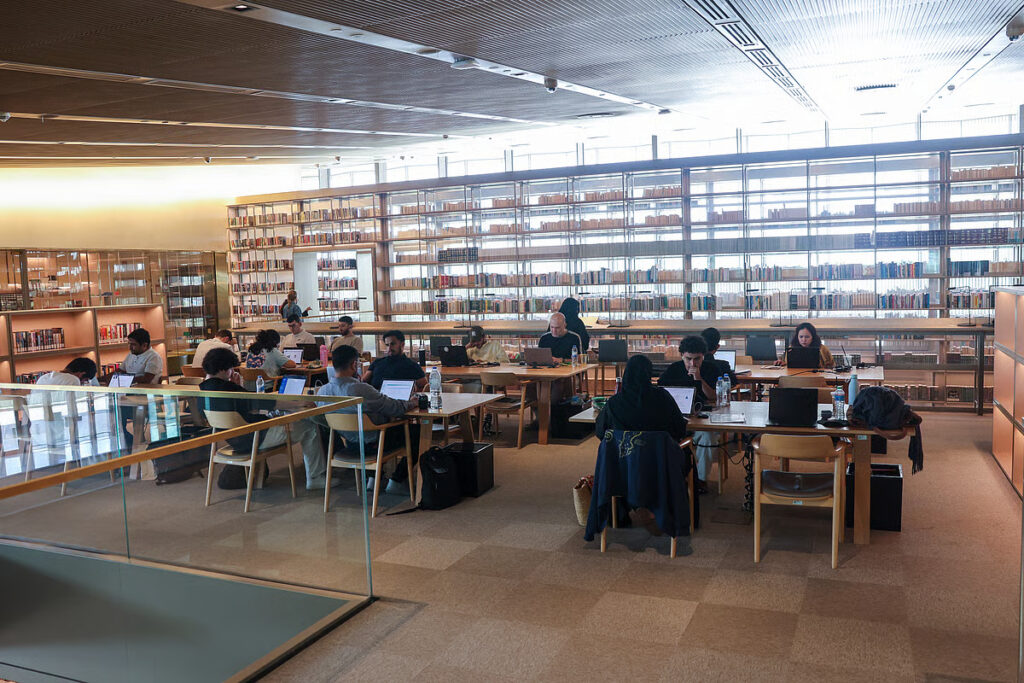
Dubai: Step into House of Wisdom in Sharjah on a weekday this summer and you will find a scene far removed from the traditional image of a quiet, nearly empty library.
Instead, final-year students are focused on coursework, remote workers are working away on laptops, groups of Gen Z readers are browsing the shelves for their next book, and children are emerging from summer workshops. The library, it appears, is not fading away — it is experiencing a revival.
For years, public libraries have often been viewed as spaces in decline, with traditional reading rooms overshadowed by digital platforms and screen-based entertainment. But at House of Wisdom, that narrative tells a different story.
A decade ago, few would have considered a local library a destination or a place to spend time beyond borrowing books. Today, it has evolved into something much broader: a third space where people can gather, work, learn and connect without the expectation to buy anything, subscribe to anything or meet any obligation.
As libraries around the world experience renewed interest, House of Wisdom is emerging as one of the UAE’s leading examples of how these spaces can be reimagined for a new generation.
“I think the biggest challenge learners and creatives faced was connection — the absence of a third space where like-minded people could come together,” said Ali Abdulaziz Alblooshi, Executive, Cultural and Literary at House of Wisdom.
“It is not only about making resources accessible, but also creating opportunities for people to actually use them. That is the approach here — providing a third space where creators, students, artists and writers can come together and simply focus on their work.”
Alblooshi’s relationship with the library is personal. While studying at the American University of Sharjah, he regularly visited House of Wisdom, often spending hours exploring its literature, fiction and poetry collections.
That early passion for books continues to shape how he views the space today. His enthusiasm is evident as he guides visitors through the building, sharing stories about its purpose and evolution. Fittingly, Alblooshi is also a published poet, with a collection of poems to his name — and he says life at House of Wisdom means no two working days are ever exactly the same.
In an age of shrinking attention spans, an ancient idea finds new life
In a world where attention spans are becoming shorter and reading is increasingly moving to digital screens, how does an institution as old as the library — a concept that dates back nearly 5,000 years — continue to remain relevant in 2026 and beyond?
For Alblooshi, the future of libraries depends on changing how people view them. Modern libraries are no longer defined by books alone. They are open, free spaces where people can attend seminars and classes, use meeting rooms, study, collaborate and work — while also offering a rare sense of calm in an increasingly crowded and fast-paced world.
“I find people sketching, start-up founders holding meetings, artists and writers working on drafts, students studying, people reading, and new workshops taking place. These are people who carry passion and drive, and House of Wisdom activates that,” he said.
It is perhaps fitting that House of Wisdom has flourished in Sharjah, an emirate that has long built its cultural identity around books, knowledge and the preservation of literary heritage across the Arab world.
That commitment is most visibly reflected in the Sharjah International Book Fair, one of the region’s most prominent literary events. Sharjah was named the UNESCO Cultural Capital of the Arab World in 1998 and the Capital of Islamic Culture in 2014.
House of Wisdom itself was inaugurated on December 9, 2020, by the Ruler of Sharjah, Sheikh Dr Sultan bin Muhammad Al Qasimi, as part of the emirate’s celebration of being named UNESCO World Book Capital in 2019.
Today, the library represents a continuation of that legacy — not simply preserving books, but creating a space where knowledge, creativity and community can come together.
The name House of Wisdom carries deep historical significance. The original institution, established in 8th-century Baghdad, was a renowned Abbasid-era academy and library that became a global centre for translation, scholarship and advances in science, mathematics and philosophy during the Islamic Golden Age. It was eventually destroyed in 1258.
Alblooshi is careful to distinguish between the two institutions, explaining that Sharjah’s House of Wisdom is not intended to recreate the original, but rather to honour and continue its spirit of knowledge exchange.
“The House of Wisdom in Baghdad sparked a remarkable movement in literary history, translation, civilisation, coexistence and cultural exchange,” he said.
“Sharjah, in today’s world, is almost a reincarnation of that spirit, if not an evolution of it. Sharjah has been recognised repeatedly for its cultural and literary contributions, and it continues to demonstrate that through the authors, researchers and pioneers from around the world who gather at House of Wisdom to share knowledge, inspire one another and advance their work.”
Built to be more than a library
Beyond its history and ambition, House of Wisdom must ultimately prove its value through what it offers visitors today.
The library houses more than 100,000 physical books alongside a digital collection of around 15 million titles. For Alblooshi, staying relevant in the modern era means constantly adapting — and that begins with creating a collection broad enough to serve a diverse audience.
House of Wisdom offers books across almost every genre in Arabic, English and more than 10 other languages, including German, Persian, Japanese, Urdu, French, Spanish, Turkish, Russian and Italian. Its collection also includes specialised formats such as Braille, ensuring access for a wider range of readers.
The collection covers books, journals, magazines, e-books and research papers, with a clear objective: ensuring that every community in Sharjah can find representation and a sense of belonging within its shelves.
A building designed to be lived in
The experience at House of Wisdom extends far beyond its collection. The building itself plays a central role in how visitors use and experience the space.
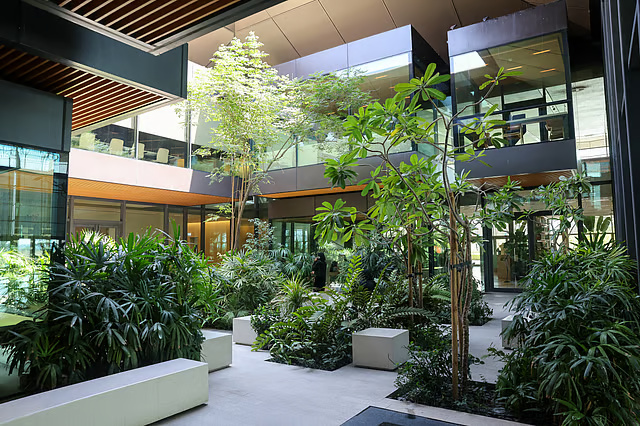
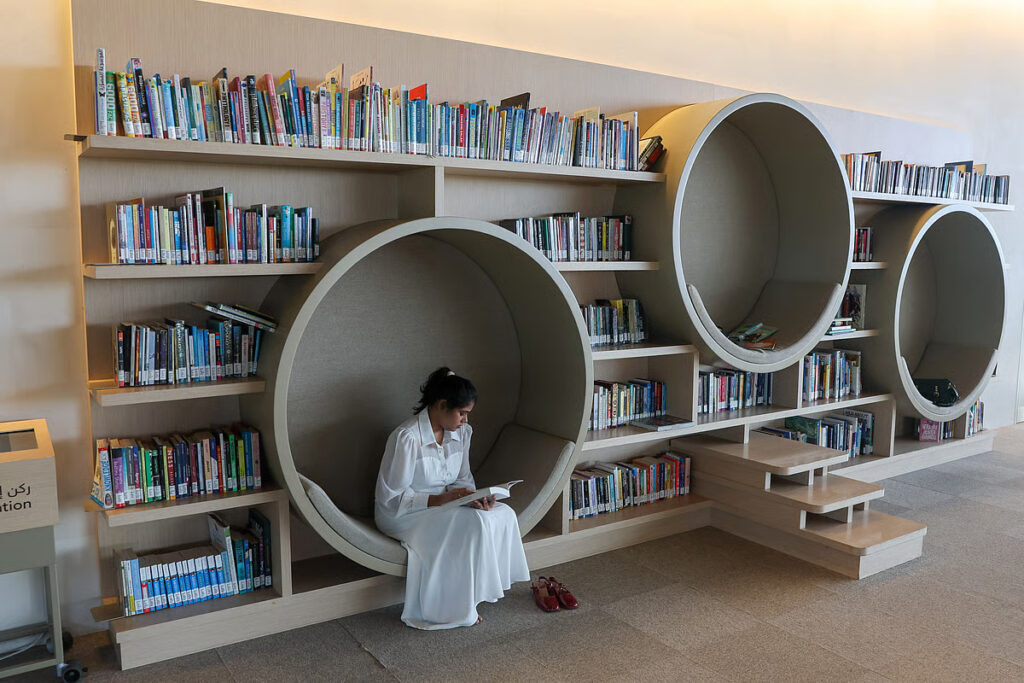
Designed by architectural firm Foster + Partners, the library is filled with natural light and offers a variety of spaces tailored to different needs — from individual desks and group tables to study pods, private rooms and quiet reading corners. Dedicated areas also provide additional privacy for women seeking a more secluded environment.
A coffee shop and café are integrated into the design, encouraging visitors to stay longer rather than simply pass through. At the centre of the 12,000-square-metre structure is a peaceful garden, thoughtfully incorporated into the architecture to blur the boundary between indoor and outdoor spaces.
Alblooshi said the library’s design was created to balance nature, community, productivity and privacy, giving visitors spaces that suit different ways of working and learning.
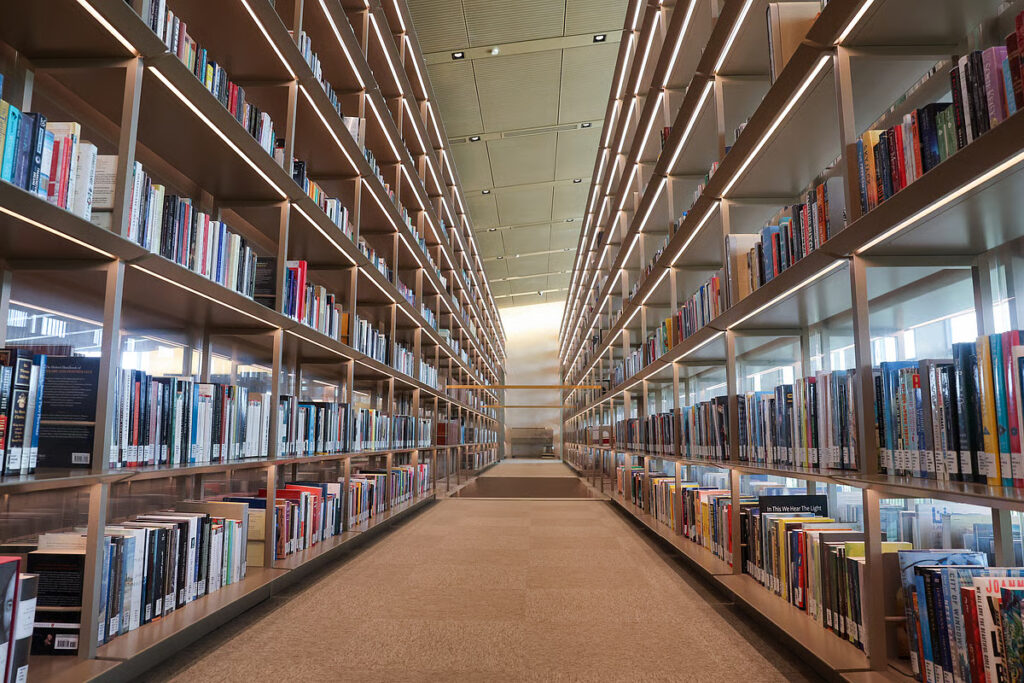
“The way the library is structured — the architecture itself — is designed to blend nature, community and workspaces, while also offering privacy through quiet areas and private rooms,” he said.
“The idea is to create a place where people feel comfortable spending hours — to work, learn, explore the collection, read and return again and again for inspiration. A library should be a space where people feel productive, creative and inspired.”
Among the building’s most distinctive features is a spiral monument resembling an unfurled scroll, created by artist Gerry Judah to commemorate Sharjah’s recognition as UNESCO World Book Capital. Viewed from above, the exterior of the building takes the form of a graduation cap — two design elements that Alblooshi says represent knowledge, education and lifelong learning.
“Both of these elements symbolise knowledge and continuous learning,” he said.
House of Wisdom’s vision also extends far beyond the traditional role of a library. It is designed not simply as a place to borrow books and leave, but as an active centre for learning, creativity and community engagement.
During the summer, the library hosts children’s camps, while throughout the year it offers talks and seminars featuring leading writers from across the region, alongside workshops, classes and cultural events.
Where the rare books live
Hidden inside a temperature-controlled room, House of Wisdom’s most precious treasures are preserved in the Wisdom Vault — a collection of rare books and manuscripts focused on Islamic art and architecture.
The collection was personally donated by Sheikh Dr Sultan bin Muhammad Al Qasimi, Ruler of Sharjah, and includes books, texts and manuscripts dating back as far as the 17th century.
Among the most notable holdings is the private library of Richard Ettinghausen, the German-American historian of Islamic art. The collection features extensive research on artistic traditions from across the Islamic world, including Iran, India, Spain and Turkey, offering a glimpse into centuries of cultural and scholarly exchange.
“We are not trying to compete with malls or attractions”
House of Wisdom measures its success differently from a traditional library. Its impact is not defined only by the number of books borrowed, memberships issued or visitors passing through its doors, but by the role it plays in people’s daily lives.
“We are not trying to compete with malls or attractions,” Alblooshi said plainly.
Public libraries have emerged as some of the most accessible third spaces because they ask for nothing in return beyond a willingness to walk through the door. They offer neutral ground — one of the few shared spaces remaining where everyone has equal access to the same shelves, seats and surroundings, regardless of background or income.
Alblooshi believes libraries will continue to thrive because people are increasingly seeking an escape from their digital lives — a place free from constant notifications, algorithms and endless scrolling, where discovery happens naturally.
For him, House of Wisdom represents one of the few remaining spaces where curiosity is not dictated by a personalised feed, but sparked by chance encounters with books, ideas and people.
“I don’t think the popularity of libraries contradicts our rapidly developing world. I think it feeds off it,” he said. “It provides a counterbalance. The more we progress and develop, the more we need to understand how and why we are developing, and that can only happen through cultural understanding and exchange. The more civilisations advance, the more they need to remind themselves why they keep advancing.”
That desire to slow down, reconnect and make sense of a world moving at unprecedented speed is what continues to draw people back to House of Wisdom.
Perhaps the clearest sign that libraries are far from disappearing can be found on any afternoon in Sharjah: someone walks in planning to stay for an hour, only to find themselves lingering far longer than expected.
Visitor details
Entry to House of Wisdom is free, with visitors able to access the library, browse books, use reading areas, work and study spaces, and connect to free Wi-Fi. A membership is only required for those who wish to borrow physical books and take them home.
Membership options:
- Digital Membership — Dh200 per year (Dh160 for students)
Provides access to digital resources only and does not include physical book borrowing. - Standard Membership — Dh400 per year (Dh320 for students)
Allows members to borrow up to 12 books for 15 days, access digital resources and receive 10 per cent discounts on programmes, dining and gift shop purchases. - Premium Membership — Dh800 per year (Dh640 for students)
Includes borrowing of up to 20 books for 21 days, free meeting pod bookings, discounts on specialised labs and services, and access to selected events.
Opening hours:
- Sunday to Thursday: 8am–11pm
- Friday and Saturday: 8am–midnight

