

Markets are waiting for a lasting truce before removing the geopolitical risk premium from crude prices.
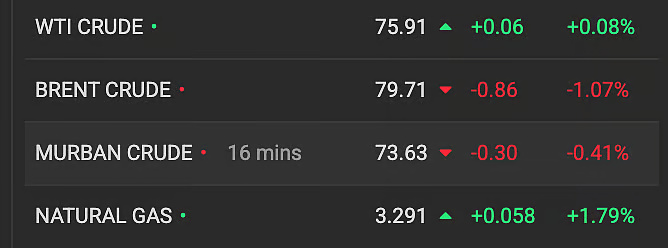
Oil prices traded mixed in Asian markets on Monday as investors weighed new signs of Middle East de-escalation against ongoing concerns over supply and security risks. As of 10:33 a.m. Tokyo time on June 22, 2026, WTI edged higher while Brent and Murban declined.
West Texas Intermediate was quoted at $75.91 a barrel, up 6 cents or 0.08%.
Brent crude oil stood at $79.71, down 86 cents or 1.07%, while Murban crude oil fell to $73.63, down 30 cents or 0.41%.
The market response followed reports that Iran’s military joint command had halted offensive operations against Israel after hours of retaliatory strikes that had heightened fears of a broader regional escalation.
The softer tone helped ease some of the geopolitical risk premium in crude, although prices remained volatile as traders assessed whether the pause in hostilities would hold.
Natural gas also edged higher, rising 5.8 cents, or 1.79%, to 3.291.
Iran halts offensive operations against Israel
The Iranian military’s joint command announced that it is suspending offensive operations against Israel, hours after both sides exchanged retaliatory strikes early Monday amid ongoing Iran–US talks in Switzerland.
The escalation had raised fears of a broader regional conflict, with concerns that the situation could spiral into a full-scale Middle East war. However, Iran’s decision to pause its attacks signals a potential easing of tensions and a possible path toward de-escalation.
Impact on oil prices
The ceasefire development is broadly seen as supportive of oil supply stability, helping to ease immediate concerns over potential disruptions in the region.
Reduced risk of a Strait of Hormuz closure: roughly 20–25% of global oil flows through this strategic chokepoint, and a ceasefire reduces the immediate threat of disruption.
Lower geopolitical risk premium: Investors typically respond positively to de-escalation, easing fear-driven spikes in oil prices.
Supply security intact: There is no immediate threat to production from Iran, Saudi Arabia, or the UAE, supporting stable global supply expectations.
Historically, periods of easing Iran–Israel tensions have often led to a decline in oil prices as markets unwind the war-related risk premium and move closer to pre-conflict pricing levels.
For example, following an earlier Iran–Israel ceasefire, Brent crude fell around 6% to approximately $67 per barrel, while West Texas Intermediate declined about 6% to roughly $64.37 per barrel, returning to levels seen before the escalation.
Analysts at the time suggested that Brent crude oil could stabilise near $70 per barrel if the ceasefire proved durable.
However, current trading shows a more cautious response, with modest gains in WTI and Brent (around +0.9% each), indicating that markets are still assessing the credibility and longevity of the ceasefire rather than fully pricing in de-escalation.
Murban crude oil’s slight decline (–0.41%) may reflect relatively stronger regional sensitivity, as it is more directly influenced by Middle East supply and geopolitical stability conditions.
FACT file
Energy analysts highlighted several key factors shaping short-term crude oil price expectations:
- Iran’s decision to halt offensive operations has reduced immediate war risk, supporting supply stability and easing the geopolitical risk premium.
- If the ceasefire holds, analysts expect prices to gradually normalise toward $70–$75 per barrel for both Brent crude oil and West Texas Intermediate in the coming days.
- Murban crude oil’s slight decline may indicate early signs of regional relief, although markets are expected to remain cautious until the durability of the ceasefire is confirmed.

