

Conflicting US–Iran claims over the Strait of Hormuz raise concerns despite no reported attacks on ships.
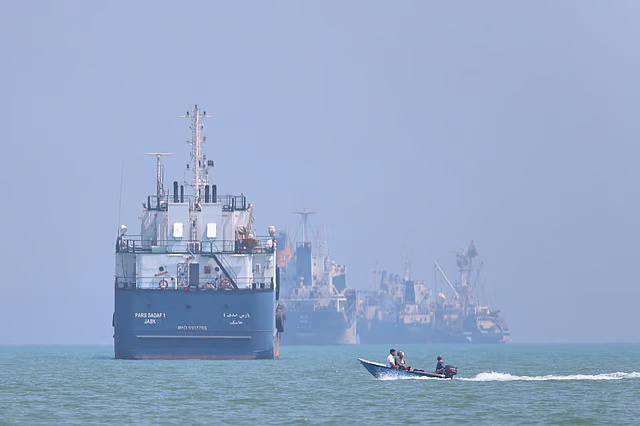
Dubai: Ship traffic through the Strait of Hormuz appeared to ease on Sunday amid ongoing uncertainty over the status of the vital shipping route, as Washington and Tehran offered sharply contrasting accounts of whether the waterway remains fully operational.
The Strait of Hormuz has become a focal point in US–Iran discussions aimed at preventing further escalation in regional tensions following months of conflict, according to a report by the New York Times.
US President Donald Trump said he had spoken with Iranian officials overnight and cautioned them against closing the strait, according to remarks reported by Fox News.
“You close it and you won’t have a country,” Trump was quoted as saying.
The warning followed an announcement by Iran’s military on Saturday that it had reclosed the Strait of Hormuz, citing what it described as a failure by the United States to uphold commitments under a tentative ceasefire framework.
According to Iranian military statements reported by international media, the decision was linked to continued Israeli military operations against Hezbollah in Lebanon, which Tehran said amounted to a breach of the agreement’s terms regarding a halt to hostilities in the region.
Iran’s announcement framed the move as a response to what it called “bad faith” and violations of the ceasefire understandings, particularly the ongoing conflict in Lebanon, which it argued undermined the broader de-escalation deal involving Washington and Tehran.
IRGC warning
Iran’s Islamic Revolutionary Guard Corps (Islamic Revolutionary Guard Corps) issued warnings to vessels approaching the Strait of Hormuz, cautioning that their security could be at risk amid rising regional tensions.
However, the United States Central Command swiftly rejected Tehran’s claims.
“Iran does not control the Strait of Hormuz. Traffic continues to flow, and US forces are monitoring the situation to ensure this remains the case,” said Captain Tim Hawkins, a CENTCOM spokesperson.
Despite competing statements, maritime analysts have noted early signs that shipowners are adopting a more cautious stance.
Ship-tracking data indicates that vessels have largely avoided the northern route through the Strait of Hormuz following recent Iranian warnings. Analysts also cautioned that the available data may be incomplete, as some ships reportedly disable their tracking transponders when operating in sensitive waters.
Why it matters
The Strait of Hormuz is one of the world’s most critical energy chokepoints:
- Around one-fifth of global oil and gas shipments pass through it
- Even perceived disruption can push up oil prices and insurance costs
- Shipping companies may reroute or delay voyages, slowing global trade flows
- Uncertainty alone can drive market volatility even without direct attacks
- The strait has become a key pressure point in US–Iran negotiations
“The situation remains fraught,” said Daniel Mueller. “The Iranians are maintaining the strait is closed again, though there have been no attacks.”
Another maritime intelligence firm, Windward, reported that only 12 vessels transited the waterway on Sunday, marking a decline from the previous day.
The figures highlight continued caution among shipping operators, even in the absence of confirmed attacks on commercial vessels.
On Saturday, United States Central Command said 55 commercial ships had transited the Strait of Hormuz—the highest daily total recorded since the conflict began in late February—though still significantly below the pre-war average of around 130 vessels per day.
US Energy Secretary Chris Wright said on Sunday that 67 vessels had crossed the strait in the previous 24 hours, adding that US forces were assisting in guiding traffic through a southern shipping lane after parts of the main channel were reportedly heavily mined during the conflict.
Maritime analytics firm Windward noted that some vessels crossing on Sunday appeared to have turned off their transponders, likely to reduce visibility while transiting the sensitive waterway.
The Strait of Hormuz remains one of the world’s most critical energy chokepoints, carrying roughly a fifth of global oil supplies prior to the outbreak of hostilities. Any disruption—or even uncertainty over access—has the potential to ripple through energy markets and global trade.
Although neither Washington nor Tehran has reported any fresh attacks on commercial shipping, the conflicting statements from both sides appear to be sufficient to prompt shipowners to reassess their risk exposure before entering the corridor, underscoring the fragile nature of efforts to stabilise the region.

