

Dubai gave him a second life, and now he hopes his Quranic masterpiece will find a public home.
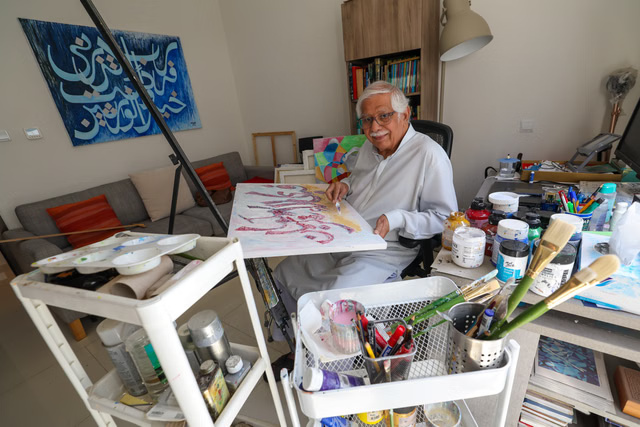
Dubai: In a modest apartment-turned-studio in Dubai, 83-year-old Pakistani artist Nazar Haidri continues to paint despite significant vision loss.
A longtime resident of the UAE, Haidri has exhibited his work in prestigious galleries in Dubai and London. However, his eyesight has gradually deteriorated, making it increasingly difficult for him to see the world he once captured in fine detail.
He described the experience as a “black dim” closing in before his diagnosis, later learning from doctors that his optic nerves are drying out. Although treatment with steroids has provided some relief, his vision remains blurred and softened.
Despite this, Haidri has continued working, maintaining his artistic practice with determination and a renewed sense of purpose.
“I can’t stop painting. It’s my passion,” he said. “Before, I would sketch everything out, work with a brush, and build up detail carefully. That level of precision is harder for me now, so I found an alternative.”
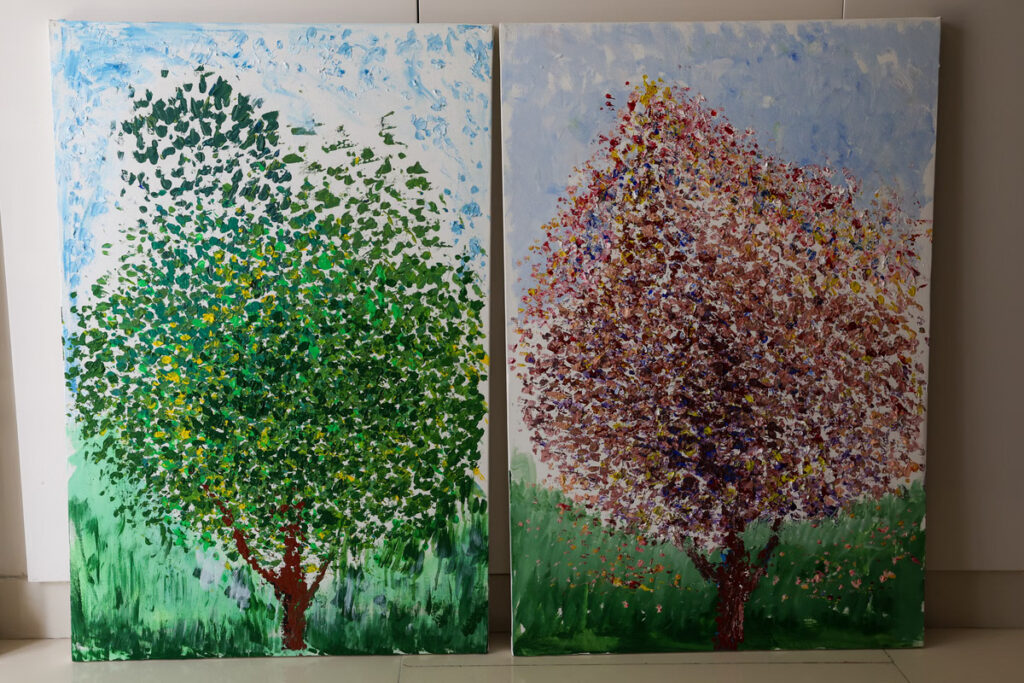
For Nazar Haidri, the 83-year-old Pakistani artist based in Dubai, this shift has become a form of liberation. His move toward thick, expressive impasto strokes allows him to work with presence rather than precision, prioritising feeling over fine visual detail.
His goal, he says, is to continue painting for as long as his health allows. But his deepest aspiration remains a body of earlier work created while his eyesight was still intact—pieces he considers among the finest of his long artistic career.
“I made a Quranic calligraphy work of Surah Al-Fatihah, the first chapter of the Quran, seven verses. It is one of my proudest works. I really hope something so significant, so meaningful, can be placed in a public institution, somewhere it can not only be seen but truly appreciated,” said Nazar Haidri, the 83-year-old Pakistani artist based in Dubai.
His request reflects not just a personal wish, but a lifelong artistic belief: that art achieves its purpose when it reaches and inspires as many people as possible.
Reinventing art in retirement
For more than four decades, Nazar Haidri, the 83-year-old Pakistani artist based in Dubai, worked as a marketing executive in Saudi Arabia’s advertising industry—balancing commercial deadlines with his creative interests.
After retiring and moving to Dubai nearly a decade ago to be closer to his children, he devoted himself fully to art. The city provided him both time and space to pursue his passion, and his work soon gained recognition in the UAE’s cultural landscape. He was nominated by Dubai Culture and awarded the UAE Golden Visa in recognition of his contribution to the arts.
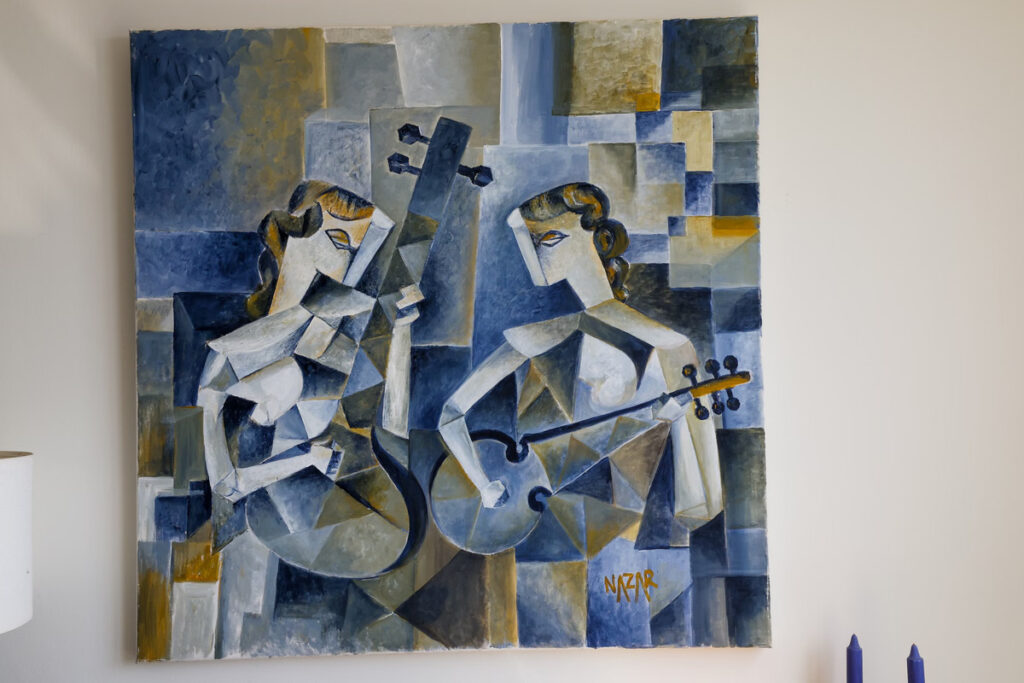
Haidri’s work is marked by a distinctive fusion of Cubist geometry, traditional Quranic calligraphy, and the luminous technique of Pointillism, creating a unique visual language that reflects both heritage and modern artistic expression.
“I wanted to be different and was inspired by Picasso as an art student, and I found that Cubism gave me a unique way to stand out,” said Nazar Haidri, the 83-year-old Pakistani artist based in Dubai. “Quranic calligraphy is traditionally black and white, but I felt it could hold so much more by incorporating colour. And when it comes to inspiration—music, nature, poetry, the vibrant parts of life—Cubism allows you to play with colour in a way that depicts all of that.”
From Lucknow to Karachi
To understand Nazar Haidri, the 83-year-old Pakistani artist based in Dubai, one must go back further—to Lucknow, India, where he was born. The city, steeped in centuries of Urdu poetry, music, and art, shaped his early sensibilities.
While his family appreciated the arts, support for a career in them was another matter. “Back then, saying you wanted to study art was radical,” he recalls. “I came from a modest, traditional family. They wanted stability, a government job. But since I was a child, I could never keep my hand from sketching.”
In 1958, he migrated to Karachi, Pakistan, as a young man starting from scratch, far from his family and building a life in a city that offered him no guarantees. To support himself, he worked at a petrol station. But then came a turning point that changed the course of his life.
He eventually found his way to the Arts Council of Pakistan, where his professors encouraged him to experiment and push artistic boundaries. His early career was also shaped by a pivotal opportunity to work alongside two major figures in South Asian art: Sadequain, known for his monumental calligraphic murals, and Zainul Abedin, celebrated for his powerful depictions of the Bengal famine.
Both artists had been commissioned to create murals for the State Bank of Pakistan, and Haidri was selected as one of the students to assist them.
“Just being near them, watching the grit and the calm they brought to their work, still gives me inspiration today,” he said.
His reputation grew steadily and quietly. He exhibited annually at the National Art Exhibition, and in 1963, his work was purchased by Faiz Ahmed Faiz—a moment of recognition that few emerging artists ever experience.
But as life progressed, family responsibilities took priority. While he completed his studies, building a life around art as a husband and father proved more complex, leading him toward a more practical career in advertising and marketing. For decades, he worked on major campaigns and regional clients, building what he describes as a successful professional life, even as his artistic ambitions remained in the background.
“My passion for art took a back burner,” he said. “But because of my job, I was able to travel to Europe, to America. I could walk into the great galleries.”
It was in one of those galleries that the spark returned. Standing before Pablo Picasso’s Girl with a Mandolin at the Museum of Modern Art in New York, something shifted for him. He didn’t just admire the work—he instinctively began to reinterpret it through his own cultural lens.
“I wanted to emulate it in a way I could relate to,” he said. “Two girls playing the sitar and the santoor.”
Dubai and a second beginning
Retirement brought Nazar Haidri to Dubai to be closer to his children, but the city offered him something unexpected—a renewed beginning in his artistic journey.
“Dubai was the place where, in my retirement, I could pursue my passion and be recognised for it,” he said. “This city has given me a new lease on life. As an old man, its openness to all—that is what made me go on with passion.”
Dubai Culture supported his work, and exhibitions soon followed. His paintings have since been showcased across the UAE and Pakistan, including at World Art Dubai and DIFC Art Nights, as well as in galleries and collections spanning the United States, the United Kingdom, and Hong Kong. Some works have sold for thousands of dollars to collectors who recognised their distinct artistic value.
But for him, commercial success was never the goal. “Art has been reserved for a few for too long,” he said. “People need to have it in their lives—in their homes. Someone will buy a house for a million dollars but won’t invest in a painting that has a soul.” He added with a smile, “It’s a zero-sum game financially. But it’s worth every penny for your soul.”
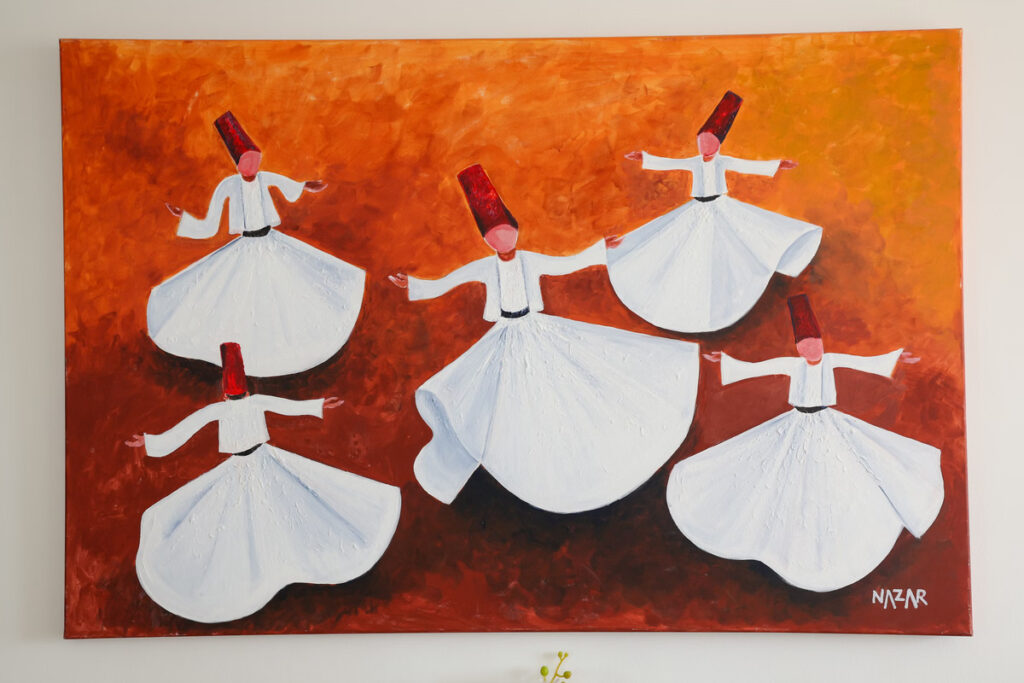
The pandemic brought a quieter phase in Nazar Haidri’s life. Once a regular presence at gallery openings and exhibitions, he stepped back to prioritise his health. However, his work continues to be accessible through his website, serving as a digital archive of a practice that has always been deeply physical and hands-on.
His artistic process has evolved over time—pencils have given way to markers, and brushes to palette knives—as he adapts to changing eyesight while continuing to create.
“I’m still inspired to create, even though my sight is weak,” said the 83-year-old Pakistani artist based in Dubai. “At the end of the day, Allah blessed me with a good life and a family that pushes me to keep going. I can’t complain. Ever.”

