

Saudi gold prices stay unchanged as oil fluctuations and Iran-related geopolitical tensions drive bullion market sentiment.
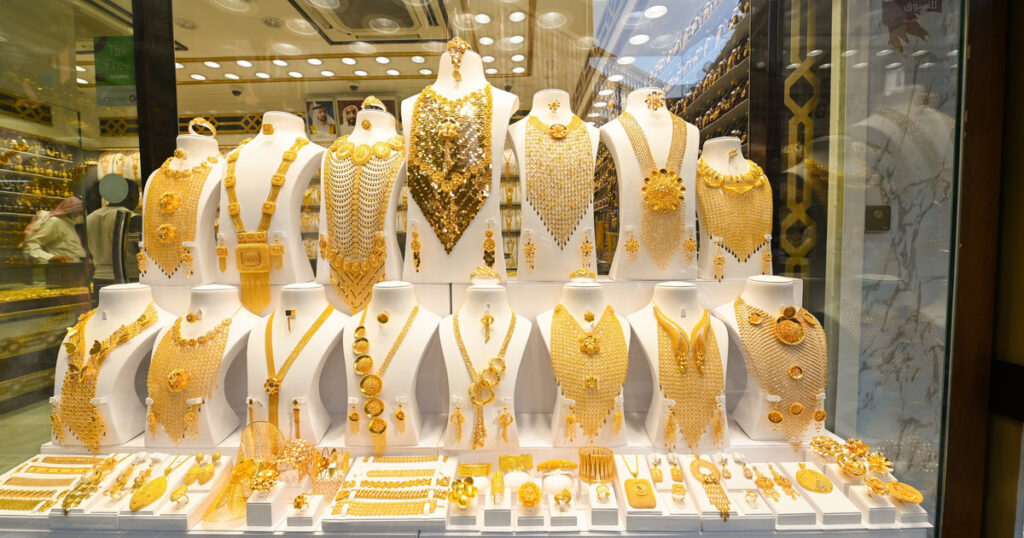
In Dubai, gold prices opened unchanged on Monday morning after a volatile week in global markets, as shoppers and investors monitor whether Middle East tensions and rising oil prices could drive bullion higher again in the coming days.
This comes despite a slight dip in international gold prices in early trading, indicating that buyers in the United Arab Emirates are still facing elevated rates close to historic highs.
In Dubai, gold prices opened unchanged on Monday morning, with 24K gold steady at Dh568.25 per gram, matching Sunday evening’s close.
Similarly, 22K gold remained stable at Dh526.25 per gram. The flat opening suggests the local market is pausing after sharp fluctuations last week, when international bullion prices surged amid concerns over the ongoing US–Iran conflict and disruptions linked to the Strait of Hormuz.
The recent geopolitical tensions have added volatility to global markets, keeping gold near elevated levels even as traders reassess risk and demand for safe-haven assets.
Global market trends
International gold prices edged lower as markets reopened after the weekend. Spot gold was trading near $4,678 per ounce in early Asian trade, while UAE-quoted international rates slipped by 0.54% to $4,661.05.
Analysts say bullion is being influenced by two opposing forces: rising geopolitical tensions, which typically boost safe-haven demand for gold, and concerns that higher oil prices could keep inflation elevated and interest rates higher for longer.
Since gold does not generate yield, higher interest rates generally reduce its attractiveness compared to interest-bearing assets, adding pressure to prices despite ongoing global uncertainty.
Regional trends
Saudi Arabia’s gold market also reflected the stability seen in Dubai on Monday morning, with prices showing little movement. 24K gold held steady at SAR 586 per gram, while 22K gold remained unchanged at SAR 535 per gram.
The subdued activity across Gulf markets reflects cautious investor sentiment as traders monitor developments in the Middle East and await upcoming US inflation data later this week.
According to Reuters, gold prices came under slight pressure after expectations of a quick diplomatic breakthrough between the US and Iran weakened. US President Donald Trump rejected Iran’s latest response to a proposed peace plan over the weekend, increasing concerns that the conflict could continue and sustain market uncertainty.
The conflict has already disrupted shipping routes around the Strait of Hormuz and pushed oil prices higher, heightening global inflation concerns. Analysts say this is increasingly influencing gold markets, as sustained inflation could prompt the U.S. Federal Reserve to keep interest rates elevated for a longer period.
Tim Waterer told Reuters that markets are now scaling back expectations of a near-term peace deal, while rising crude oil prices are adding further pressure on gold.
According to Bloomberg, bullion had climbed about 2% last week before easing in Monday’s trading session. Analysts also pointed out that weekend incidents near the Gulf region underscored how fragile the current ceasefire environment remains.
Investors are closely monitoring upcoming US consumer inflation data and signals from the Federal Reserve for indications on the future path of interest rates. Stronger-than-expected inflation could further support the US dollar, making dollar-denominated gold more expensive for international buyers.
Despite Monday’s decline, analysts expect gold to continue trading within a broad range of $4,400 to $4,800 per ounce in the near term, as ongoing geopolitical uncertainty and disruptions in energy markets continue to shape investor sentiment.

