

Oil benchmarks rally sharply, heightening concerns over renewed risks to global supply.

Oil benchmarks surged sharply, renewing fears over global supply disruptions.
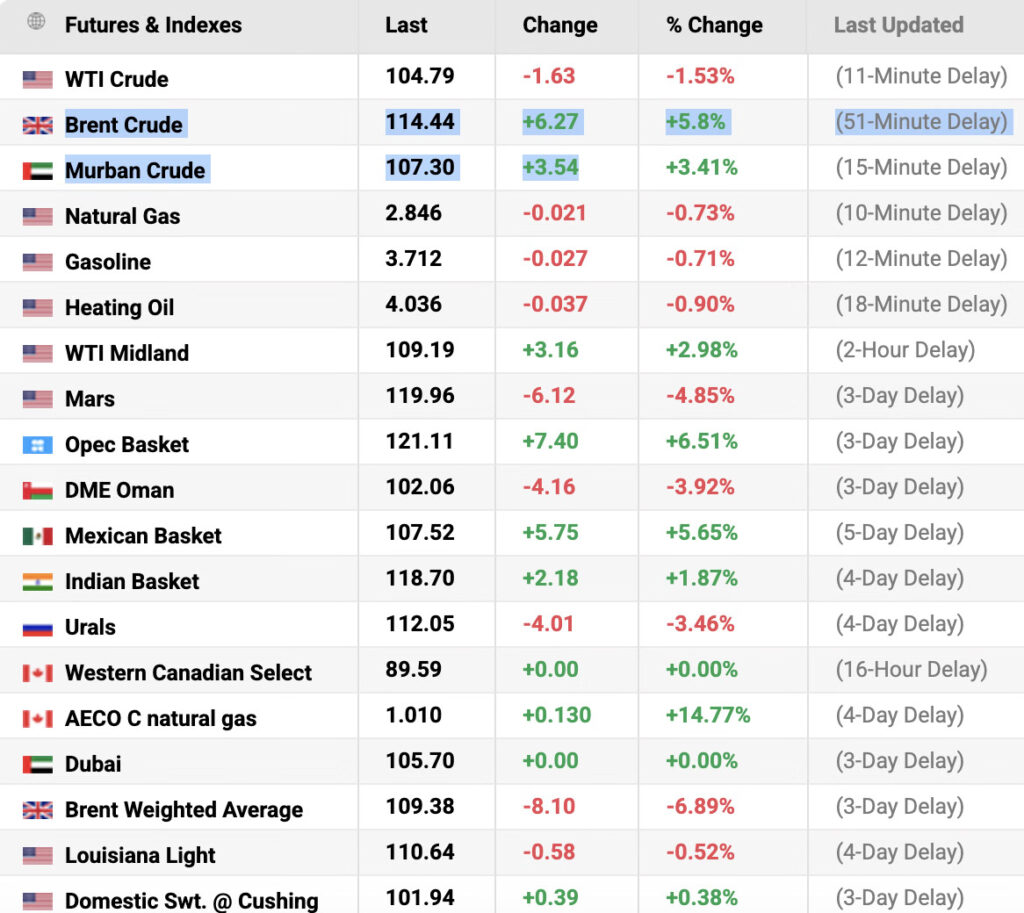
Brent crude futures jumped 5.8% on Tuesday (May 5, 2026), rising $6.27 to $114.44 a barrel, as markets reacted to mounting concerns over supply pressures following fresh uncertainty around the US–Iran ceasefire.
Murban crude, a key Gulf benchmark, also gained 3.4%, reaching $107.30 by around 7:35 am in Tokyo, reflecting heightened market anxiety over the stability of the region’s energy corridor.
The spike followed reports on May 4, 2026, that the Iranian regime carried out missile and drone strikes on the UAE, targeting energy infrastructure and a major oil port in Fujairah.
The attack triggered fires and was viewed as the most significant escalation since the ceasefire earlier in April.
The UAE also reported that Iranian drones targeted an empty ADNOC tanker near the Strait of Hormuz, underscoring growing threats to maritime oil traffic.
The attacks intensified fears of potential disruptions to oil shipments, prompting traders to unwind risk assets and push up crude prices to reflect a higher geopolitical risk premium — the additional cost markets assign when supply security becomes uncertain.
Strategic shipping routes under pressure
The Strait of Hormuz remains a critical artery for global energy flows, and any conflict that slows, blocks, or reroutes shipments typically triggers sharp market reactions.
Recent strikes on vessels and threats to energy infrastructure have further amplified that risk, reinforcing concerns over the vulnerability of global oil supply chains passing through the region.
Even before the May 4 attacks, markets were already under pressure due to intermittent disruptions in the Strait of Hormuz and earlier strikes on vessels and energy infrastructure by Iran — developments that effectively tighten global supply buffers.
US military involvement
In response to the escalation, US forces reportedly destroyed several Iranian small boats in the Strait during fresh engagements while escorting commercial shipping to keep the route open under “Project Freedom”.
This more direct military involvement adds another layer of uncertainty for traders.
Even conflicting reports — including Iranian media claims of attacks on US warships that were denied by US Central Command — have been enough to unsettle markets, as traders factor in worst-case scenarios and push prices higher in anticipation of potential escalation.
The so-called “dual blockade” refers to a 2026 maritime standoff in the Strait of Hormuz, where competing restrictions from Iran and US-led forces have severely disrupted global energy flows.
Following the escalation of conflict in late February, Iran imposed limits on shipping access and introduced controls targeting vessels it deemed hostile, while the United States responded in April with a naval blockade aimed at restricting Iranian oil exports and maintaining passage for allied and commercial traffic.
The resulting overlap of restrictions has effectively choked normal traffic through the waterway, contributing to widespread delays, heightened security risks, and significant uncertainty for global energy markets.

