

The prospect of resumed movement brought relief after weeks of disruption that had left around 1,000 ships stranded.
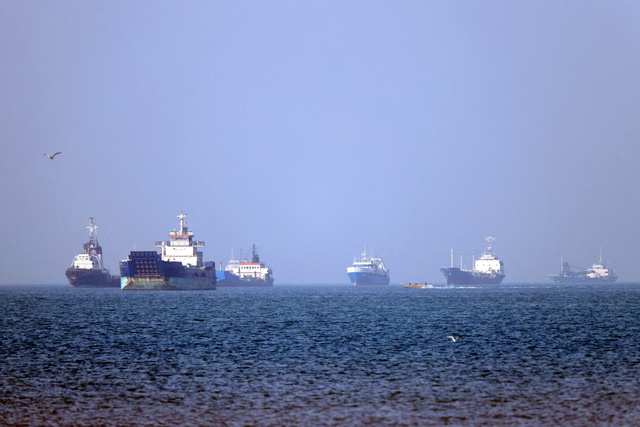
Dubai: Oil prices eased as markets reacted to signs that shipping may resume through the Strait of Hormuz, following a US-led initiative associated with Strait of Hormuz and diplomatic efforts involving Donald Trump to help guide vessels out of the disrupted waterway. After weeks of blockage that left around 1,000 ships stranded, the prospect of renewed movement has provided immediate relief to markets.
That relief, however, reflects expectations rather than conditions on the ground. The Strait of Hormuz typically carries close to a fifth of global energy supplies, meaning even brief disruptions can create lingering pressure across global trade and pricing systems.
Slower, more complex
Even as vessels begin to move again, the operating environment they return to has changed, with additional layers of coordination, security measures, and routing complexities affecting transit times. Nigel Green, chief executive of deVere Group, describes the impact as a “latency shock” accumulating across global supply chains.
“Markets are reacting to the expectation that ships will start moving again, but the system does not reset instantly. There is a real ‘latency shock’ to consider,” he said.
He added that convoys now need tighter coordination, inspections have increased, and shipping routes are being adjusted—all of which extend transit times.
“All of this adds time, and time is now the pressure point in global trade,” Green said. “The real disruption goes beyond the oil price. It lies in how long everything takes to move from one point to another.”
Costs rising everywhere
The effects of slower maritime movement are already feeding into higher costs across industries that rely on predictable supply chains.
“Every additional hour at sea or waiting for clearance feeds into cost structures across industries,” Green says. “These are not isolated effects. They ripple through the global economy and reinforce inflationary pressure at multiple levels.”
Manufacturers are facing delays in receiving inputs, retailers are adjusting delivery timelines, and energy buyers are having to operate in a more uncertain and less predictable supply environment.
More risks to energy flows
At the same time, the wider geopolitical backdrop continues to influence the outlook. Analysis from Fitch Ratings indicates that while oil flows may gradually stabilise in the coming months, the risk of escalation remains significant.
It warned that an adverse scenario could involve a more prolonged conflict, leading to a lasting deterioration in the security environment, tighter restrictions on shipping through the Strait of Hormuz, and a higher risk premium on oil prices.
Despite these risks, the region does have some built-in resilience. Major oil production assets such as the Ghawar Oil Field, along with pipeline networks, provide alternative routes that can partially divert crude flows if maritime transit is disrupted.
Pressure on energy imports
The effects are especially evident in economies that depend heavily on energy imports passing through the Strait of Hormuz. “Asian emerging markets are vulnerable… given their heavy dependence on oil and gas from the Strait of Hormuz,” Fitch notes. This reliance increases sensitivity to both supply disruptions and price volatility, particularly if delays continue.
Downstream industries are also beginning to experience tighter supply conditions. “A shortage of jet fuel is a risk and airlines may reduce their networks in response,” Fitch says, highlighting potential pressure on aviation if disruptions persist. Countries with strong refining capacity may be better able to cushion the impact by processing imported crude domestically.
Overall, the system remains functional but less efficient and more uncertain. “The focus on headline oil prices risks missing the broader story,” Green says. “The cost of moving goods is rising because the system itself has slowed down.”
Reopening the Strait may reduce immediate congestion, but it does not fully restore the speed or predictability that global supply chains previously depended on. As a result, the effects of disruption are likely to linger across trade flows, costs, and broader economic activity even as vessel movement resumes.

