

London summit advances multi-stage peace process integrating moral and political efforts.
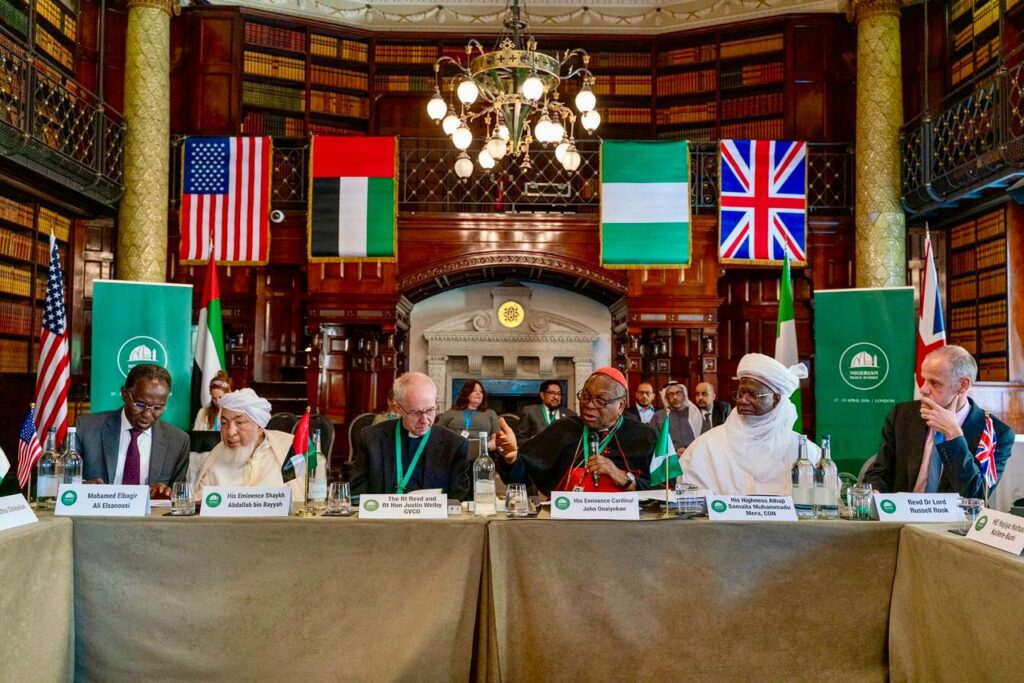
LONDON: The Nigerian Peace Summit concluded on Thursday at the British House of Lords in London.
The high-level international initiative spanned three days, focusing on pathways to strengthen civil peace in Nigeria as part of broader efforts to promote stability across the African continent.
The summit was organised by the Abu Dhabi Forum for Peace in strategic partnership with the US Department of State and the UK Foreign, Commonwealth & Development Office.
The opening session was chaired by Shaykh Abdullah Bin Bayyah, Chairman of the UAE Council for Fatwa and President of the Abu Dhabi Forum for Peace.
Representing the US side was Riley M. Barnes, Assistant Secretary of State for Democracy, Human Rights and Labor, while the UK was represented by Baroness Chapman, Minister of State for International Development and Africa.
The summit brought together prominent figures, including Cardinal John Olorunfemi Onaiyekan, Justin Welby, Samaila Muhammad Mera, Lord Russell Rook, Patricia Scotland, and Shaykh Sharif Ibrahim Saleh Al-Hussaini, who addressed the gathering via video link.
The Nigerian delegation included a select group of Muslim and Christian religious leaders, government officials, academics and civil society representatives.
Supporting peace processes
Shaykh Abdullah Bin Bayyah emphasised that the event reflects the UAE’s growing role in supporting peace processes and its strong ties with Africa, particularly Nigeria.
He described the initiative as an example of the UAE’s active approach to promoting stability—combining value-based diplomacy with international cooperation.
In his opening remarks, Bin Bayyah noted that evolving global conflict dynamics require an integrated model that brings together moral legitimacy and political effectiveness.
He announced the launch of a new trilateral framework bringing together the United States, the United Kingdom and the UAE, aimed at advancing sustainable peace through institutional initiatives grounded in complementary roles, respect for national sovereignty and the integration of diplomatic efforts with moral foundations.
Multi-dimensional
Bin Bayyah offered an analytical view of Nigeria’s complex crisis, highlighting the interplay between resource competition, climate change, organised crime and extremism.
He outlined a five-pillar roadmap focused on rationalising public discourse, building trust, supporting local initiatives, addressing violence through a combined security and justice approach, and aligning national and international efforts.
Riley Barnes also praised the Abu Dhabi Forum for Peace for fostering dialogue, describing the partnership as a model that brings together religious insight and diplomatic effectiveness.
Baroness Chapman expressed the United Kingdom’s pride in joining the initiative, saying the Forum’s approach fills a real gap in peace-building efforts and highlighting that Nigeria’s stability is central to security across West Africa.
Justin Welby, who recently held meetings in Nigeria with political and religious leaders, stressed that peace is a moral responsibility requiring the courage to recognise the other.
The London summit marks the second stage in a multi-step consultative process, following an earlier meeting in Washington last February.
Future sessions are expected to take place in Abu Dhabi, Rabat and Abuja, in coordination with the Nigerian government, to finalise an integrated international approach to supporting peace in Nigeria and across the African continent.

