

Dr Singara Vadivel, currently on a global motorcycle journey, said life in the UAE remained stable during the regional conflict, noting a contrast between outside perceptions and on-the-ground reality.
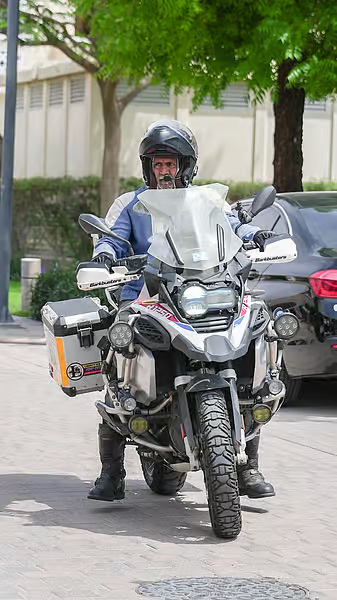
When Dr Singara Vadivel arrived in the UAE on his motorcycle, the country was widely in the news due to the US–Israel–Iran conflict. However, his experience on the ground was very different from the narrative he had seen and heard in the media.
He observed that life in the UAE was calm and normal, with people continuing their daily routines—going to work, meeting friends, and spending time with family as usual. Despite the headlines, Dr Vadivel described the country as stable and well-managed.
“Life continues as normal here. People from different nationalities live and work together without fear and with a shared sense of purpose. What I saw was calm, resilience, and coexistence,” said Dr Vadivel.
An Indian-origin American technologist and former Silicon Valley professional, Dr Vadivel began a solo motorcycle journey around the world at the age of 58. He has now travelled across 59 countries on a BMW R1250 GSA, with a mission to promote artificial intelligence and digital infrastructure, particularly in Africa.
However, his journey did not start with motorcycling. He said the idea developed gradually as he began to feel life had become predictable. “I felt I was not truly living, but simply following a routine,” he said.
He learned to ride a motorcycle at 50, and a short solo trip soon after changed his perspective.
“That experience gave me clarity. It felt like an inner journey through an outer journey. That is when I decided to explore the world.”
Today, his life on the road is simple but uncertain, with long rides across countries and no fixed plans for where he will stay each night.
“This is not like tourism. You don’t always have a plan. You learn to adapt, take one step at a time, and keep moving forward,” he said.
His travels have taken him across continents, through diverse cultures, climates, and experiences, before reaching the UAE as part of his global journey.
He said his experience in the UAE stood out because of the contrast between perception and reality.
“When you hear about tensions, you expect things to feel uncertain,” he said. “But here, the reality on the ground feels stable and well-managed. It reminded me that what people experience in their daily lives can be very different from what we see in the news.”
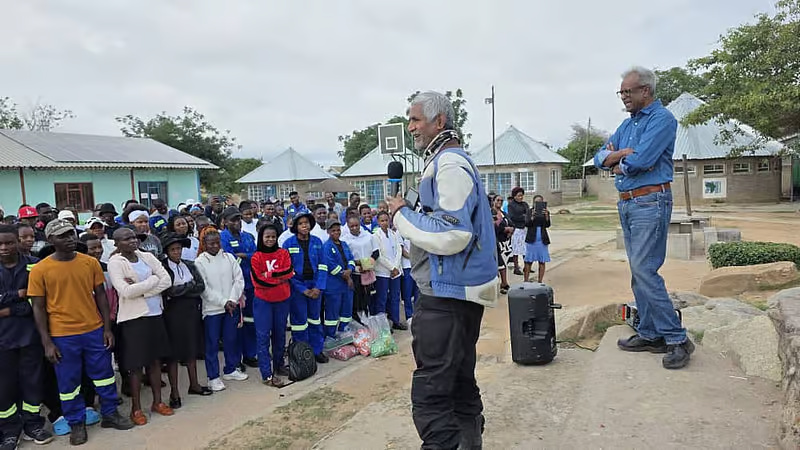
Along the way, Dr Vadivel has also been engaging with communities, students, and professionals, sharing his knowledge of artificial intelligence and digital development.
He believes technology should not be reserved for a select few. “Technology should not be a privilege. It should reach those who need it the most.”
Despite the purpose of his journey, he said the biggest transformation has been personal. “It is not about how many countries you visit. Over time, the journey becomes something deeper. It changes you from within,” he said.
He recalled an incident near Ushuaia, Argentina, where he met with an accident and faced a difficult situation. A local mechanic helped repair his motorcycle without expecting anything in return. “In that moment, I realised how strong human connection can be. Even in uncertainty, there is kindness.”
In another challenging episode in Mozambique, he was involved in an accident that led to police and court proceedings. Instead of leaving, he stayed and took responsibility until the matter was resolved. “That was one of the toughest phases of my journey. It tested me not just as a traveller, but as a human being.”
After travelling across numerous countries, Dr Vadivel said he has found a common thread among people everywhere. “People are looking for the same things—belonging, dignity, and peace,” he said.
Reflecting on his experience, he said the journey has been less about distance and more about inner change. “This journey is not just about crossing countries. It is about understanding life in a deeper way.”

