

Rising import costs and strained supply chains prompt Ulyanov to champion food security.
Dubai: The UAE relies heavily on food imports, a vulnerability that Roman Ulyanov, founder and CEO of premium vertical farm Greeneration, says can no longer be ignored. Ulyanov and a group of investors have invested $5 million to create a homegrown alternative.
Walking through Greeneration’s climate-controlled facility, located between Dubai and Abu Dhabi, Ulyanov does not fit the typical image of a farmer. With the measured cadence of a finance professional—a career he pursued before entering agriculture—he calls Greeneration “my baby.”
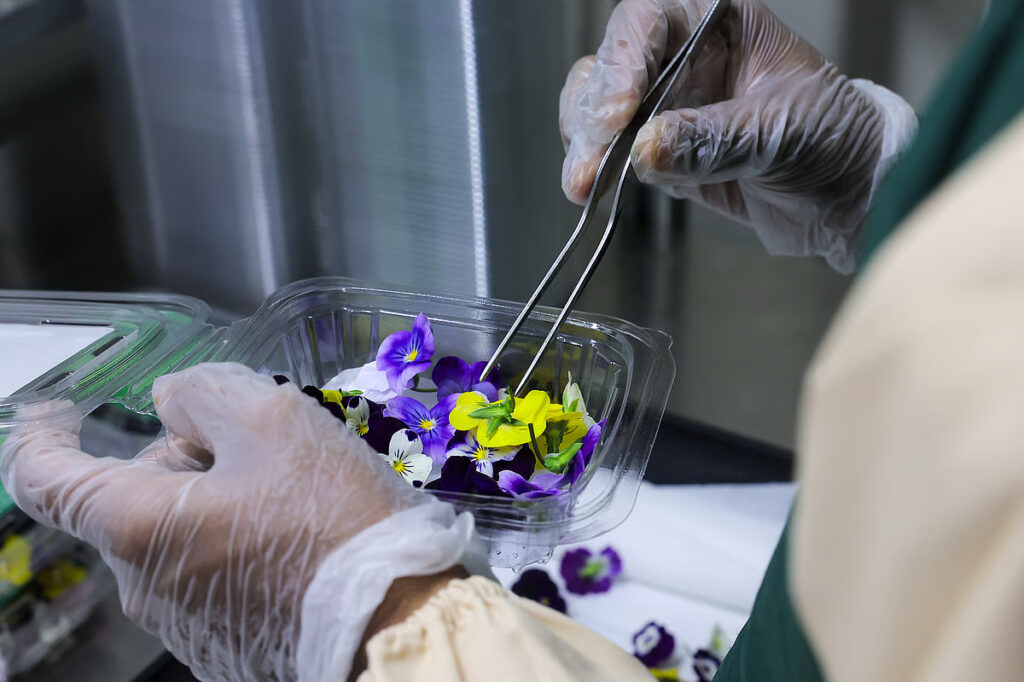
Today, the company supplies edible flowers, specialty leaves, microgreens, and vegetables to over 350 restaurants and hotels across the UAE, including Atlantis and Jumeirah properties.
Ulyanov noted that Greeneration experienced 15–20% month-on-month growth in its early years.
The banker who bet on farming
Ulyanov’s journey into vertical farming began not in a field, but in a boardroom. “I’m an investment banker originally,” he says.
“I was looking for prominent investments for my fund, and that was when I discovered vertical farming as a concept.” While his institution passed on the opportunity, he did not.
Starting in 2019 with a group of enthusiasts and what he calls experiments “in a garage,” Ulyanov spent years travelling to study vertical farming operations across Europe, Japan, and North America.
He tested container farms, large-scale facilities, and software-driven growing systems before reaching a clear conclusion: the real bottleneck in the industry was not technology—it was operations.
“There are a lot of reputable companies that can help you design and build a farm, and then they walk away,” he explains. “That region is especially critical. Greenhouses delivered, great design, lots of money spent—and then we struggle to manage them.” Greeneration’s solution: stay in the room and manage operations continuously.
How the farm works
Greeneration’s process starts with municipal water, which is filtered through a reverse osmosis system and chilled to around 24°C—essential because plants cannot absorb water above 30°C, Ulyanov explains.
The cooled water is then blended with minerals, including calcium and magnesium, creating what he calls a “super potion” of nutrients. The farm operates soil-free.
Seeds are planted in rockwool—a fire-resistant stone wool insulation made from basalt, a fine-grained volcanic rock melted at around 1,400°C into a sponge-like cube, sourced locally. “We try to source as much locally as possible,” Ulyanov notes. “That is one of our core values.”
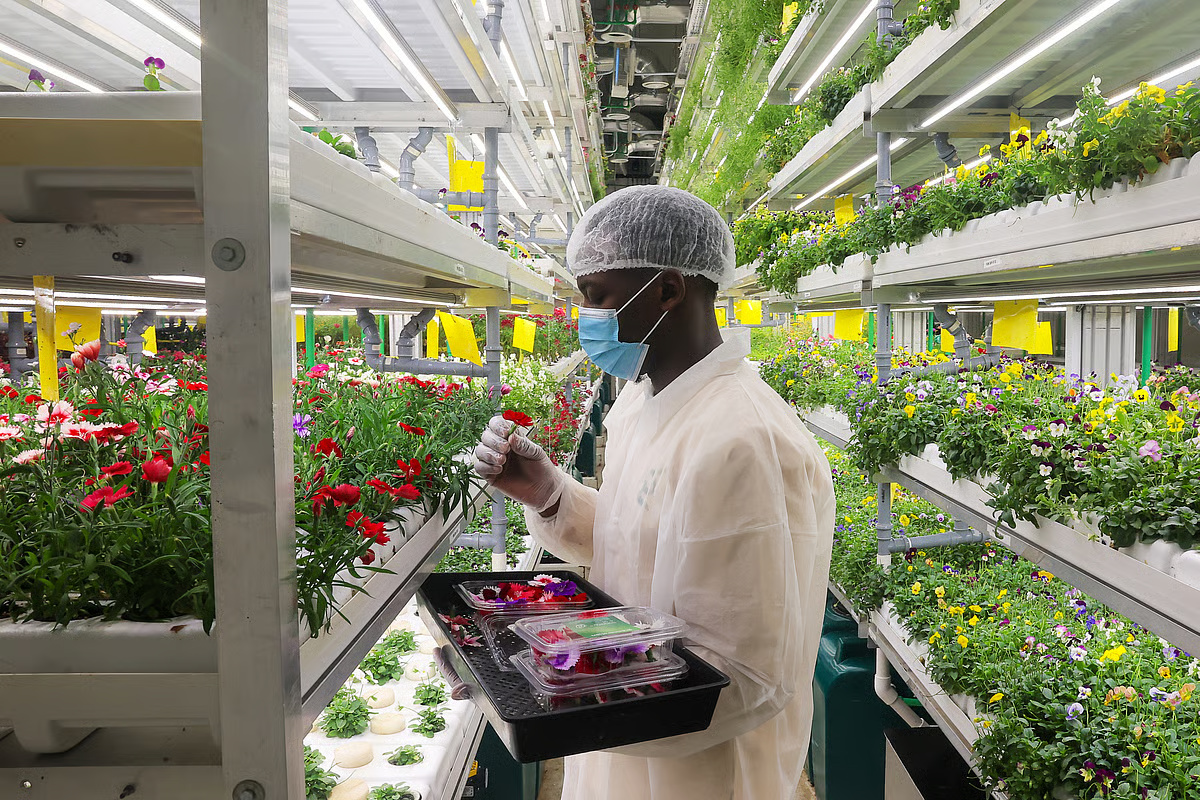
Different plant varieties at various growth stages receive tailored nutrient mixes. Currently, 55 varieties are cultivated across three rooms, with over 70 crops in production across two facilities.
The farm grows specialty leaves like Shiso red leaves, watercress, and ice plants; microgreens including broccoli, arugula, kale, coriander, mustard greens, and chives; and a wide range of edible flowers, such as marigold gem, begonia, buzz buttons, and Egyptian star flowers.
Propagation hub and greenhouse integration
Greeneration also functions as a propagation hub—a nursery where plants are nurtured before being transferred to conventional greenhouses.
“Vertical farming is amazing for growing rare ingredients that require extra attention,” Ulyanov says. “We like to say it is like a Burj Al Arab for plants—perfect climate, perfect light, imitating an Italian spring.”
Delicate crops, such as edible flowers and specialty leaves, remain in the controlled indoor environment. Hardier produce—strawberries, tomatoes, cucumbers, and peppers—starts in the vertical farm before moving to rented greenhouses, allowing Greeneration to scale production more economically.
“The most challenging part is growing small strawberry plants,” Ulyanov explains. “Once we have done it, they become stronger, like teenagers, and then they are ready to move into the more aggressive environment of the greenhouse.”
Who needs the flowers?
Greeneration serves 350 active clients across the UAE’s top hospitality brands, including Ossiano, Five, Jumeirah, Four Seasons, Avatara, and more. The company uses its own cold-storage vans and direct sales team rather than distributors—a choice driven by the delicate nature of its products.
“We try to co-create with chefs,” Ulyanov explains. This often leads to unique requests, such as specific potato varieties from the Netherlands, bespoke high-nutrient kale, or Japanese-style strawberries with a tailored sweetness profile.
The impact of war
Regional conflict has added new pressure on the UAE’s food supply chain. Ulyanov notes that land freight costs from Saudi Arabia have nearly doubled, while air freight prices have surged alongside rising fuel costs, driving up the price of imported produce across the board.
Alexandra Levkova, COO of Greeneration, explained how the company has responded: minimum order quantities have been lowered, payment terms extended, and deliveries increased to twice daily.
“We are on the same boat,” she said, referring to the company’s partnership with suppliers and clients. “We need to support each other.”
Doubling down on local production
Ulyanov speaks plainly about the wider significance: “Imports started to be really expensive, and we are literally an alternative to round supply.”
Greeneration currently operates two farms, with 2,000 square metres of growing space at the main facility, staffed by over 15 full-time employees and supported by around 30 part-time workers—a total investment exceeding $5 million.
All profits are reinvested. “We don’t want to stop at edible flowers and leaves,” he says. Future plans include premium mushrooms, functional foods—such as a kale variety enriched with GABA—and expanding into the retail market in partnership with a major distributor.
On UAE food self-sufficiency, Ulyanov is realistic: “I don’t think it is possible to replicate 100 per cent food production here, and there is no such goal. But in case things go really bad, you need to have some food to survive. That is why it is important to double down on local production.”

