

The sessions saw active participation from senior representatives across both government and private sectors.
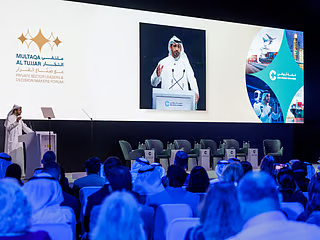
During the Traders–Decision Makers Forum, recently hosted by the Abu Dhabi Chamber of Commerce and Industry, government officials highlighted the emirate’s continued commitment to business continuity, resilient supply chains, and smooth goods flow, emphasizing Abu Dhabi’s proactive approach to navigating global developments with confidence.
Held at the Abu Dhabi Energy Center, the forum brought together senior government officials and key private-sector leaders. The event focused on aligning efforts, discussing national economic priorities, accelerating joint initiatives, and supporting sustainable growth trajectories.
The forum builds on a series of recent high-level engagements, uniting government bodies and business leaders to tackle market stability and supply chain challenges amid global economic shifts.
It underscores Abu Dhabi’s commitment to coordinating institutional efforts and fast-tracking implementation through a structured platform that connects decision-makers with the business community. The discussions focused on practical solutions to ensure business continuity, enhance supply chain resilience, and strengthen the emirate’s ability to respond proactively to global developments.
Advancing Abu Dhabi’s Business Ecosystem
The sessions also highlighted ongoing initiatives to strengthen the business ecosystem through specialized programs and enabling regulatory frameworks, alongside the rapid expansion of non-oil sectors, now a core pillar of the UAE’s economic diversification. This underscores a model built on stability, competitiveness, and long-term strategic planning.
Readiness and Responsiveness
Ahmed Jasim Al Zaabi, Chairman of the Abu Dhabi Chamber of Commerce and Industry, emphasized that Abu Dhabi’s economic model is anchored in readiness and responsiveness, supported by strong institutional alignment, flexible regulations, and effective public-private partnerships.
He noted:
“Roundtable discussions provided direct insights into market realities, enabling better alignment between policies and operational needs. Given current developments, priority is placed on maintaining uninterrupted trade, enhancing supply chain resilience, and empowering companies to plan with confidence. The focus today is on execution—translating outcomes into tangible actions, accelerating delivery, and reinforcing the private sector’s role in supporting stability and growth.”
Broad Public and Private Sector Participation
The forum saw senior representation from both government and private sectors, including the Abu Dhabi Department of Economic Development, AD Ports Group, Abu Dhabi Customs, Abu Dhabi Investment Office, Integrated Transport Centre (Abu Dhabi Mobility), Seven X, Etihad Credit Insurance, Dell, and Presight AI.
Key Forum Outcomes and Initiatives
Among the main highlights was the “Adheed” platform, an advanced digital system providing companies with real-time supply chain data, enabling proactive decision-making and boosting logistics resilience. A live demonstration showcased how technology can support business continuity and enhance Abu Dhabi’s trade infrastructure.
The forum began with two closed-door roundtables, focusing on tourism and the industrial sector, where government officials and business leaders discussed key challenges, opportunities, and strategies to improve supply chain efficiency and business continuity.
Discussions centered on several priority themes for the private sector in Abu Dhabi, including business-supportive policies, trade and logistics growth, industrial expansion, and advancing the emirate’s transition toward a knowledge-based economy.
Business Support Initiatives
The first session, titled “Business Support – Direct Announcement of Policies and Initiatives,” highlighted proactive measures by government entities aimed at ensuring business continuity and strengthening supply chain resilience.
Ensuring Readiness and Market Stability
Participants emphasized Abu Dhabi’s preparedness to tackle challenges through the activation of emergency plans and strong inter-agency coordination. Key efforts to enhance logistics efficiency were highlighted, including expanding port capacity, accelerating cargo handling, broadening operational services, ensuring smooth goods movement, and alleviating infrastructure pressure, all contributing to market stability.
The forum also addressed private sector support initiatives, such as streamlined customs procedures, fast-track clearance channels, and digital solutions to simplify access to government services, alongside strengthening public-private partnerships through direct engagement.
Growth Prospects in Trade, Logistics, and Industry
The second session, “Growth Prospects – Trade, Logistics, and Industrial Opportunities in Abu Dhabi,” featured insights from Mohamed Jaber, CEO of Combi Lift Projects MEA, and Tareq Al Wahedi, CEO of Seven X Group.
Discussions focused on Abu Dhabi’s competitive advantages, reinforcing its status as a regional trade hub and exploring opportunities to expand business activities and enhance integration across economic sectors.
Leveraging Technology for Logistics and Business Resilience
Participants highlighted that the UAE has a highly advanced and diversified logistics network providing seamless access to global markets. They stressed the importance of developing digital platforms to improve logistics efficiency and enhancing shipment tracking and real-time operational monitoring, enabling more precise and flexible decision-making.
During the third session, “Empowering the Future – AI, Technology, and Government Innovation,” Hani Khalaf, CTO at Dell, and Magzhan Kensbai, Chief Growth Officer at Presight, discussed the pivotal role of advanced technologies and artificial intelligence in reshaping and enabling the business environment amid rapid global changes.
Strengthening Supply Chains and Essential Goods
Hamad Sayah Al Mazrouei, Undersecretary of the Department of Economic Development, emphasized during the forum’s opening:
“We have moved from readiness to execution, forming an integrated economic task force within a unified response framework to fully strengthen supply chains, ensure uninterrupted flow of goods, activate alternative logistics corridors, enable air freight, enhance rail freight readiness, and streamline customs processes.”
Ensuring Market Stability and Supply Chain Continuity
Hamad Sayah Al Mazrouei, Undersecretary of the Department of Economic Development, added:
“Green lanes have been introduced for essential goods to ensure their availability, alongside firm measures to safeguard market stability through daily monitoring and continuous inspection campaigns.”
Al Mazrouei highlighted Abu Dhabi’s 18 consecutive quarters of GDP growth, with non-oil sectors now contributing over half of total GDP, reflecting the strength of the emirate’s economic diversification strategy. He noted that non-oil foreign trade continues to grow at strong double-digit rates, and as of March 2026, Abu Dhabi’s high credit ratings have been reaffirmed with a stable outlook.
He confirmed that markets remain stable under continuous monitoring, with retail outlets, shopping centers, and business operations running normally. Key sectors, including construction, are fully supplied, with no impact on licensing, trade flows, or investor services, while efforts continue to improve transparency and resilience in supply chains.
Activation of Emergency and Crisis Management Protocols
Captain Saif Al Mehairi, Chief Sustainability and Risk Officer at AD Ports Group, stated that the group has activated emergency, crisis management, and business continuity protocols in close coordination with national authorities, ensuring safety and uninterrupted services.
Ports and Maritime Operations Ensure Continuity
Captain Saif Al Mehairi, Chief Sustainability and Risk Officer at AD Ports Group, confirmed that all ports and terminals, along with related services, are operating at full capacity.
He explained that the group’s integrated model—covering ports, maritime shipping, logistics, economic cities, and digital services—enables rapid operational adjustments during crises. Most of the fleet operates outside the Strait of Hormuz, minimizing operational risks.
“Vessels within the Strait continue to serve the Gulf region, ensuring uninterrupted services for regional consumers,” he added.
Al Mehairi also emphasized that trade routes along the UAE’s eastern seaboard remain active, reducing reliance on congested corridors and ensuring continuous cargo flow. Additional vessels and routes across India, Pakistan, Africa, and the Middle East further strengthen connectivity, supporting trade and the flow of essential goods to the UAE.
He concluded by highlighting that AD Ports Group operates a fleet of over 800 vehicles and possesses extensive cross-border capabilities, ensuring the continuity of regional and international trade flows.

