

Plans to use naval escorts to help reopen the narrow Strait of Hormuz off Iran’s coast are being discussed by some governments as a way to protect commercial shipping once regional tensions ease, but actual military escort operations have not yet been deployed due to ongoing security risks.
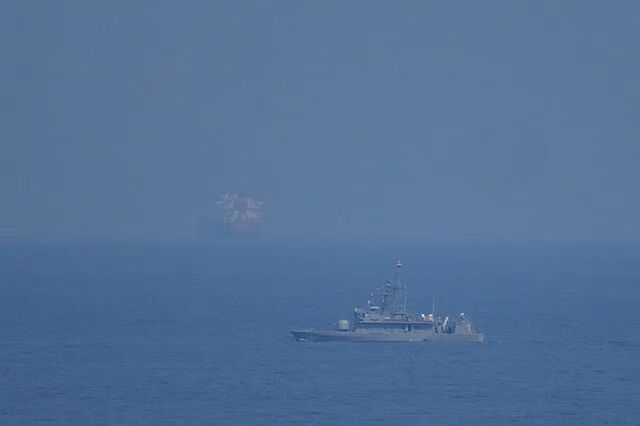
Gasoline prices are climbing largely because the ongoing Iran war has effectively halted traffic through the Strait of Hormuz, a crucial oil and gas passageway, and reopening the narrow waterway off Iran’s coast will be a major challenge once hostilities end.
Context (Brief Explanation)
- The Strait of Hormuz is one of the world’s most important energy chokepoints — about 20% of global oil and LNG exports normally pass through it.
- The current conflict has led to a near‑complete cessation of tanker traffic, tightening the global energy supply and pushing crude oil and fuel costs higher.
- Governments are already discussing plans — including potential naval escorts or coordinated international efforts — to reopen the strait for commercial shipping when the situation stabilises.
In Europe, French President Emmanuel Macron is spearheading an international effort to reopen the energy chokepoint, aiming to restore the flow of oil, gas, and goods “when circumstances permit.
He envisions countries deploying warships to escort tankers and container vessels through the strait once hostilities subside, though the timing remains uncertain.
Former naval officers with experience in the Hormuz passage caution that ships would be extremely vulnerable, with little room to maneuver in the strait’s narrow lanes, if foreign forces attempted to reopen the waterway before fighting ceases.
“In today’s context, sending warships or civilian vessels into the Strait of Hormuz would be suicidal,” said French navy retired Vice Adm. Pascal Ausseur in an interview with The Associated Press.
A ceasefire agreement with Iran, he explained, “would shift the situation from suicidal to dangerous. At that point, military ships could be deployed, and escort operations could begin.”
Battle-Hardened in the Red Sea
French, American, British, and other naval crews already bring extensive experience in defending vessels from missile and drone attacks. They have successfully escorted and protected cargo ships against attacks by Iran-backed Houthi rebels in the Red Sea off Yemen, providing a foundation for potential operations in the Strait of Hormuz.
French frigates employed machine guns, cannons, and advanced air-defense missiles to fend off Houthi attacks.
In 2024, the French frigate Alsace shot down three ballistic missiles in the Red Sea while escorting a container ship.
The ship’s commander at the time, Capt. Jérôme Henry, told The Associated Press that being targeted by such potentially deadly strikes was both unnerving and exhausting.
The engagements also took a heavy toll on U.S. Navy ships and personnel operating in the region.
“There were repeated attacks, either by drones or missiles,” Capt. Jérôme Henry said in an interview. “The crew didn’t get much sleep.”
French retired Vice Adm. Michel Olhagaray, former head of France’s center for higher military studies, noted that “all navies learned a great deal” from their Red Sea missions, including escorting vessels under threat. Lessons were also drawn from Ukraine’s experience defending against Russian missile and drone barrages.
“It allows us to deploy to that region with fairly refined know-how and a high level of cooperation — and that is extremely important,” Olhagaray added. He previously commanded a French frigate patrolling the Strait of Hormuz during the Iran-Iraq war in the 1980s.
Higher Risks
Iran is far more militarily capable than its Houthi proxies in Yemen, who caused significant disruption in the Red Sea between November 2023 and January 2025. Armed by Iran, the rebels targeted more than 100 merchant vessels with missiles and drones, sinking two ships and killing four sailors, while severely reducing trade flows.
Iran can reach the entire Strait of Hormuz and its approaches with anti-ship cruise missiles developed from Chinese designs, according to mapping by the U.S. Defense Intelligence Agency. It can also target vessels using longer-range missiles, drones, fast-attack craft, and naval mines—tactics it employed during the Iran-Iraq war. Recent U.S. strikes on mine-laying Iranian vessels in the current conflict highlight the severity of the threat.
With active fighting ongoing, the Hormuz passage is “very, very dangerous,” and the risks for shipping are far greater than those faced by vessels in the Red Sea against Houthi attacks, according to Vice Adm. Michel Olhagaray.
“The means to counter this threat must be far more substantial and far more effective,” he said. “Before the heat can decrease … most of the offensive installations on land in Iran would have to be eliminated. There would need to be constant monitoring, patrols, extremely close surveillance, and a very high level of intelligence to even consider allowing tankers to transit, even with military escorts. That will not happen at all — not at all — in the near future.”
Reassuring Insurers
Experts say another major challenge will be convincing shipping companies and insurers that navigating the Strait of Hormuz is feasible once the situation stabilizes.
Insurance premiums for vessels operating in the strait have soared to levels that France’s transport minister described as “insane,” creating serious problems for shippers.
“Maritime traffic is a business. That business has to make money. If insurance costs are so high that you can’t make a profit by sailing through a given area, then you don’t sail through that area,” said Pascal Ausseur, now director of the Mediterranean Foundation for Strategic Studies, a think tank.
Insurance rates for oil tankers seeking to transit Hormuz are now many times higher than before the war, approaching the levels charged for ships carrying grain from Ukraine during Russia’s ongoing conflict, according to Marcus Baker, global head of marine, cargo, and logistics at insurance broker Marsh Risk.
Potential naval escorts for commercial ships “would be helpful,” said Marcus Baker.
“That’s been done before in past conflicts, so it’s not unusual, and it would obviously provide insurers with greater confidence that the vessels will have a higher level of safety,” he added.

