

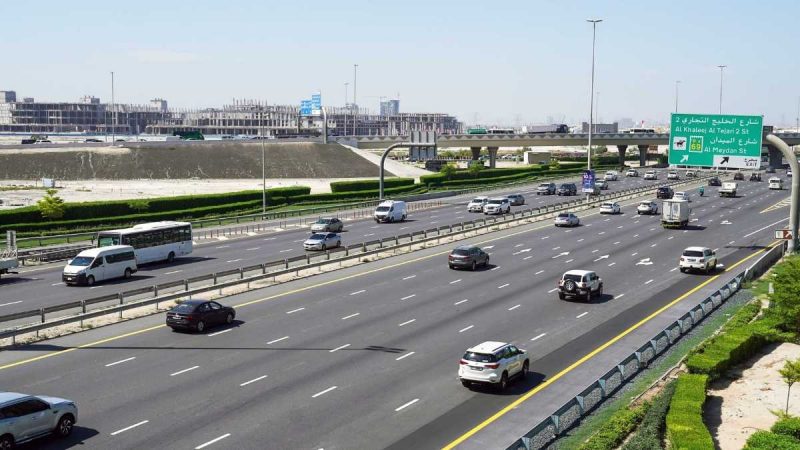
Dubai: With its daytime population rising to nearly six million and vehicle numbers growing by around 10% annually, Dubai is fast-tracking a multi-billion-dirham road expansion to keep pace with traffic and population pressures.
Over the past two decades, the Government of Dubai has invested roughly Dh175 billion in the roads and transport sector, delivering major highway upgrades, new corridors, and smart mobility solutions aimed at ensuring smooth traffic flow in the fast-growing global city.
Mattar Al Tayer, Director General and Chairman of the Board of Executive Directors of the Roads and Transport Authority (RTA), noted that Dubai, like other global cities, is undergoing rapid urban transformation driven by population growth, technological advancement, rising public expectations, and environmental challenges.
Annual growth
During an interaction at the recently concluded World Government Summit 2026, Mattar Al Tayer revealed that Dubai’s population is growing at an annual rate of about 7%, with the daytime population reaching nearly six million—reflecting heavy daily commuting and economic activity. This growth is further fueled by tourism, as the emirate welcomed over 17 million international visitors last year, a 5% increase compared with 2024.
At the same time, vehicle numbers are rising far faster than global averages. Registered vehicles in Dubai are increasing by around 10% annually, compared with 2–3% worldwide, placing sustained pressure on road capacity despite ongoing network expansion.
Managing mobility
Al Tayer emphasized that while road development remains a cornerstone of Dubai’s mobility strategy, expanding infrastructure alone cannot fully resolve congestion challenges. “Managing mobility demand has become just as critical as building new roads,” he said, highlighting the importance of integrated public transport and smart solutions that encourage residents to shift away from private vehicle use.
Dubai’s long-term vision aims to transform the city from a vehicle-centric model to a human-centric mobility ecosystem, placing people at the heart of urban planning. The strategy seeks to reduce travel times and emissions while improving quality of life through efficient, connected, and technology-enabled transport services.
Investment
The scale of Dubai’s transport investment has delivered substantial economic and social returns. Over the past two decades, transport projects are estimated to have generated Dh320 billion in time and fuel savings, contributed more than Dh156 billion to Dubai’s GDP, and attracted over Dh32 billion in logistics and distribution investment.
Road safety has also seen dramatic improvement, with traffic fatalities falling from 22 to 1.8 deaths per 100,000 residents.
Confidence in Dubai’s quality of life and infrastructure is reflected in transport-related indicators. Al Tayer noted that the emirate is home to around 170,000 luxury vehicles, while premium number plates have generated Dh1.7 billion in revenue over the past three years—reinforcing Dubai’s status as a preferred destination for living, investment, and long-term settlement.
He added that global geopolitical developments have further strengthened Dubai’s appeal due to its safety, stability, and high living standards, trends that continue to drive demand for reliable and efficient mobility.
Future needs
Al Tayer emphasized that governments must evolve from being operators to enablers and regulators, empowering the private sector through clear frameworks and strategic partnerships. Dubai has embraced this approach through flexible legislation and the commercial transformation of RTA entities, fostering innovation while maintaining high service standards.
Looking ahead, the RTA is advancing next-generation mobility solutions, including autonomous buses, autonomous taxis, and the planned Dubai Loop—expected to deliver a significant improvement in first- and last-mile connectivity.
With population growth, vehicle ownership, and daytime movement continuing to rise, Al Tayer stressed that Dubai’s strategy focuses on staying ahead of demand through early investment, long-term planning, and rigorous execution, ensuring the city keeps moving efficiently amid unprecedented urban growth.

