

Desert transforms into green giant: India’s 30GW Khavda Park to energize 18 million homes.
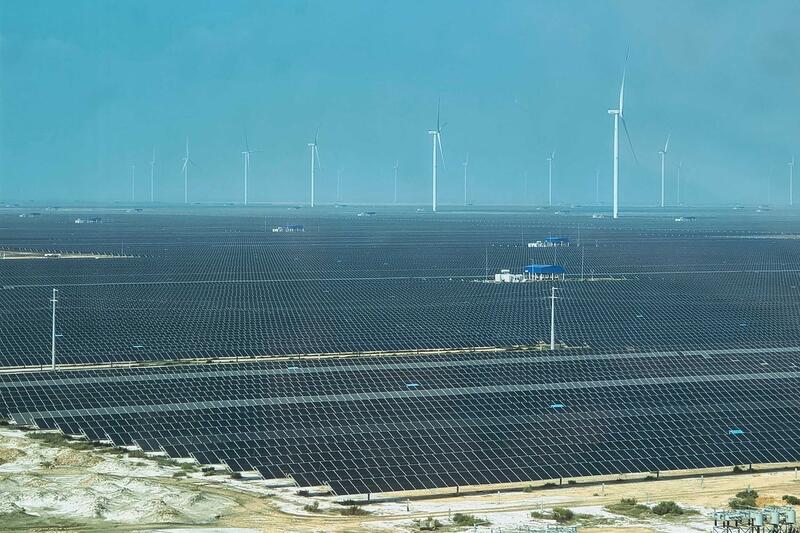
India is transforming the barren Rann of Kutch desert — larger than Singapore and five times the size of Paris — into the world’s largest renewable energy hub.
The project is converting the salt flats into a green giant: the 30-GW Khavda Park, which, once completed, is expected to power 18 million homes, making it the world’s largest single-site renewable energy project.
It is the subcontinent’s most ambitious hybrid solar-wind mega-project, set in the Kutch salt flats, and has sparked excitement online, highlighting a major leap toward clean energy.
Footage shared on X shows seemingly endless solar panels and wind turbines emerging from what resembles a lunar wasteland.
Spread across 72,600 hectares (726 million square metres) of Gujarat’s barren Rann of Kutch, the Gujarat Hybrid Renewable Energy Park — also known as Khavda — is targeting a capacity of 30 GW.
The project comprises roughly 20 GW of solar and 10 GW of wind capacity, enough to power around 18 million homes and meet nearly 10% of India’s projected energy demand.
Launched in 2020 with Prime Minister Narendra Modi laying the foundation, the Adani Green-led project — partnered with companies including TotalEnergies — already has over 1 GW operational as of early 2024, with full buildout expected in the coming years.
The hybrid design pairs daytime solar with round-the-clock wind generation, providing steadier output while utilizing state-owned wasteland.
Flagship Project
Khavda Park is a flagship initiative of India’s 500 GW renewable energy target by 2030, transforming “empty” desert into a massive power station, creating jobs, and reducing reliance on coal.
The project’s location also underscores challenges: searing heat, long 12-hour shifts, and reliance on migrant labor. Critics raise concerns about output intermittency without large-scale storage and the need for environmental safeguards in the fragile desert ecosystem.
Nonetheless, the project offers a visually striking demonstration of engineering at planetary scale — a powerful example of how deserts can help power the future.

