

The achievements reflect years of dedication, adaptability and perseverance in the face of uncertainty, supported by the guidance of teachers, families and wider school communities.
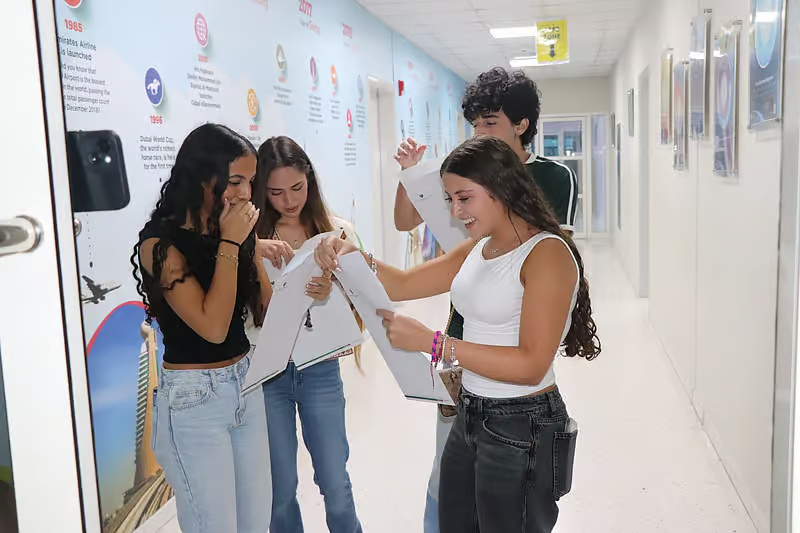
As International Baccalaureate (IB) results continued to be released across UAE schools on Monday, students celebrated not only outstanding scores but also the resilience and determination that helped them navigate an unprecedented academic year.
Many students achieved results well above the global average, with some earning the maximum 45 points and several others securing scores above 40.
This year’s results follow the introduction of the Non-Exam Contingency Measure (NECM), under which IB Diploma and Career-related Programme students across the UAE received grades after final examinations were cancelled due to regional tensions.
For graduates, these achievements represent more than academic success — they reflect years of hard work, adaptability and perseverance through a period of uncertainty, supported by teachers, families and their school communities.
Spoke to several students about their experiences navigating an academic year shaped by both achievement and unexpected challenges.
‘My hard work did pay off’
Among the standout achievers was Nour Bilal Al Husseini, a student at Dubai International Academy (DIA) Al Barsha, who credited years of consistent effort and the support of her teachers and family for her success.
Having joined the school in Grade 7, Husseini described the IB Diploma Programme as highly demanding, particularly during the final year when coursework deadlines became more intense.
“My teachers supported me all the time. No matter how many times I went to get feedback, they were always patient and supportive,” said the Lebanese expatriate.
“At home, I had a great support system from my parents and my family. I always had a good environment while growing up, and that helped me focus on my studies.”
The final stage of the programme often required long hours and personal sacrifices to complete academic requirements.
“Typically, after school, especially during the Internal Assessments (IAs), I worked a lot of extra hours, till 2am sometimes. The coursework required a lot of effort, so I’d have to work hours upon hours,” Husseini said.
Like many IB students across the region, she experienced mixed emotions when final examinations were cancelled.
“It was a bittersweet moment when the exams in the GCC got cancelled. On one hand, we didn’t have to study anymore, but at the same time I was very disappointed because I put in so much effort in the last two years.”
“But it didn’t matter eventually because in the end, my hard work did pay off.”
Beyond academics, Husseini balanced several commitments, including studying Mandarin for the past decade, contributing to her school’s design team and publishing a mindfulness colouring book, From Dragons to Dunes, inspired by Emirati and Chinese cultures.
She plans to pursue Mechanical Engineering at the American University of Beirut before continuing with a master’s degree in Biomedical Engineering.
Reflecting on her journey, she said her biggest challenge was balancing academic demands with her health, family time and personal commitments.
Perfect 45 after overcoming burnout
At DIA Emirates Hills, Australian expatriate Kane Simpson achieved a perfect score of 45 points, describing the result as almost unbelievable.

Simpson said he entered the programme aware of its academic reputation and focused on maintaining balance across all subjects.
“I knew IB was going to be challenging even when I was going in. So, I put my best effort into all my subjects, not trying to focus on anything too much but rather spread my efforts across them and also not overwork myself,” he said.
Despite his balanced approach, Simpson experienced burnout during Year 12.
“After putting in so much work, I burnt out and my grades started dropping. Then I started to review my study methods, and my grades began improving again by the time I reached Year 13,” he said.
Managing multiple overlapping deadlines was among the biggest challenges of the programme.
“We have a lot of IAs (internal assessments), our core extended essay and TOK (Theory of Knowledge). These deadlines piled up towards the end, and submitting everything within one month was a challenge,” Simpson said.
When the results were released, the achievement came as a surprise.
“I was definitely expecting to be in the 40 range, but this is absolutely unbelievable. I was shocked when I first saw the results. I almost yelled and thought, ‘This is crazy,’” he said.
“I know how difficult this is and only a handful of students get it. Wow, this is crazy. I immediately went and thanked all my teachers. I couldn’t have done this without them.”
Having studied at the school since KG1, Simpson said the Diploma Programme changed his approach to learning.
“Academics wasn’t my priority, but stepping into the challenging environment of the IBDP level showed me what I should be focusing on. So, I shifted my perspective more towards academics later,” he said.
The aspiring student plans to study Philosophy, Politics and Economics at University College London.
Reflecting on the cancellation of final examinations, he recalled the uncertainty students faced.
“To be honest, it was quite stressful because nobody knew what their IB predicted grades could be,” he said.
“It was a mixed feeling — ‘Fine, I don’t have to study… yay! But how will all this affect academic performance?’”
Transitioning from CBSE to IB
At Ambassador International Academy, Anusha Talwalkar achieved a score of 42 after successfully adapting from the CBSE curriculum to the IB framework.
Having joined the IB pathway in Grade 8, she said adjusting to the Diploma Programme’s expectations was initially challenging.
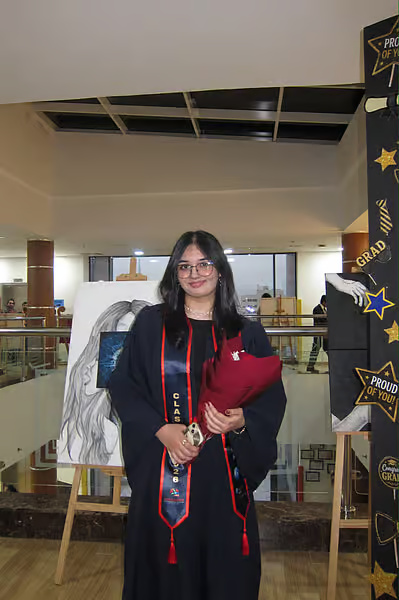
“I think the biggest challenge was my initial unfamiliarity with the curriculum because I came from CBSE,” Talwalkar said.
The breadth of the programme and its multiple assessment components required careful planning, organisation and discipline.
“DP was a huge leap from MYP (Middle Years Programme),” she said.
“Even though two years seems like a lot, we’re working continuously, so it’s hard to find time and manage everything within the deadlines set by the school and the IB.”
Over time, Talwalkar developed stronger organisational skills and established a routine that often involved several hours of study after classes.
“In a day, I would study for five hours after returning from school. I also pulled quite a few all-nighters during the year,” she added.
The cancellation of final examinations was especially disappointing after years of preparation.
“100 per cent… I was extremely disappointed because I’d been working continuously, and I really wanted all my hard work to amount to something,” Talwalkar said.
“But despite the exams being cancelled, I feel that my result is still a consequence of all the hard work I put in over these two years.”
Outside the classroom, Talwalkar also designed two book covers for internationally published books.
Looking ahead, she plans to study Project Design at the University of Leeds after receiving offers from five universities in the UK.
“I want to study project design. So, I applied to five universities in the UK, and I got into all of them, but I’ve decided to go with the University of Leeds,” she said.

