

Gulf conflict escalates: UAE residents advised to prepare for potential disruptions.
The US-Israel-Iran conflict continues to affect the Gulf, raising concerns over potential disruptions to air travel, shipping and energy supplies across the region.
UAE residents are advised to follow official announcements, stay informed about regional developments, review travel arrangements and check airline schedules as the situation evolves.
Latest developments
Iran’s military said three oil tankers had struck naval mines and caught fire east of the Strait of Hormuz.
The claim could not be independently verified. Meanwhile, the Joint Maritime Information Center warned that further attacks on commercial vessels were “highly likely”.
Houthi attacks on Saudi Arabia
A Houthi attack on Riyadh damaged the PIF Tower, Saudi Arabia’s tallest building and the headquarters of its sovereign wealth fund.
Nearby buildings in the King Abdullah Financial District were also damaged.
Saudi Civil Defence reported no injuries. Earlier, the Saudi-led coalition said it had intercepted missiles launched towards Riyadh and the southern region after a loud explosion was heard in the capital.
Early on Friday, it also destroyed a ballistic missile and two drones heading south. Civil Defence issued early warnings in Abha and Khamis Mushait before withdrawing them shortly afterwards.
Saudi Arabia warned that it would not tolerate attacks on its territory or national assets, reserving the right to take all necessary measures. It also urged permanent members of the UN Security Council to condemn the attacks.
The UAE condemned the strikes, describing them as a violation of Saudi sovereignty.
Iran’s position
IRGC spokesman Hossein Mohebbi said Iran would not accept a prolonged war of attrition or a situation of “neither war nor peace”.
He said the conflict would either be resolved on the battlefield or the US would have to accept Iran’s conditions.
Mohebbi added that the Strait of Hormuz would remain closed until Washington met those conditions in a verifiable manner. He also said Iran would not discuss the nuclear issue until the situation surrounding the waterway was resolved.
Washington
Speaking to Fox News during his visit to China, US President Donald Trump said Washington would “see what happens” after January 1, without explaining the significance of the date.
He also played down an imminent threat following reports that Iran had explored chemical and biological weapons. Tehran has described the allegations as “baseless” and denies seeking nuclear weapons.
Israeli officials reportedly shared intelligence with Washington, while Mossad chief Roman Gofman visited the US amid reports that he had advocated renewed joint strikes.
Cost and politics
Pentagon deputy comptroller Arthur Miller said the war had cost more than $48.3 billion as of November 13. This is around 26 per cent higher than the Congressional Budget Office’s estimate of $38 billion as of August 1.
The figure does not include damage to US military bases or the wider economic impact of the conflict.
Senator Tammy Duckworth vowed to oppose any funding bill that did not reduce financing for the war, amid concerns about a potential government shutdown in December.
Diplomacy
Qatar’s Foreign Ministry spokesman Majed Al Ansari described the closure of the Strait of Hormuz as an international crisis and called for collective action and diplomatic engagement.
Oman, meanwhile, is seeking greater inclusion in regional diplomacy rather than relying permanently on outside powers.
The recent meeting between Iranian Foreign Minister Abbas Araghchi and Omani Foreign Minister Badr Albusaidi is understood to be part of diplomatic efforts towards a broader regional security arrangement.
The latest Araghchi-Albusaidi discussions reportedly covered regional developments, diplomatic de-escalation, maritime security and the uninterrupted movement of international shipping and trade.
Muscat is not calling for the US to abandon its Gulf partnerships. Instead, it wants regional governments to take the lead in shaping their own security arrangements, while Iran is expected to demonstrate that its inclusion can contribute to restraint.
For Gulf countries, involving Iran in regional diplomacy does not mean legitimising its military influence. Any arrangement would need measurable commitments to respect national sovereignty, freedom of navigation and regional security.
The Iran-Oman diplomatic engagement has not resulted in a publicly announced final agreement on navigation.
Lebanon
Israel struck a former Hezbollah missile site in the Beqaa Valley, marking its second attack in the area this week.
Military developments
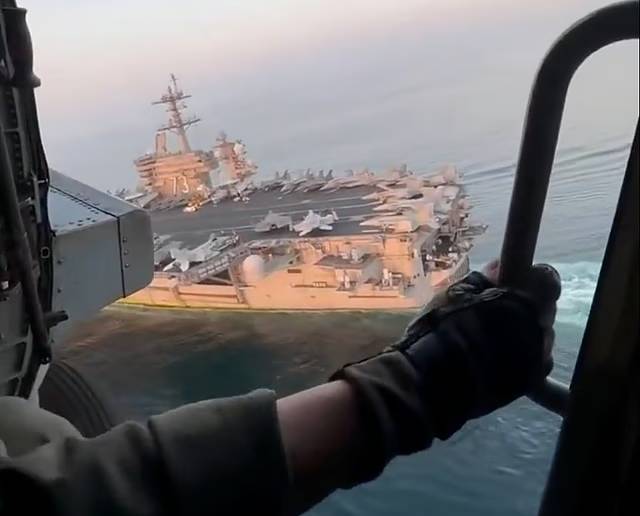
The USS Theodore Roosevelt has arrived in the Middle East, bringing the number of US carrier strike groups in the region to three as tensions with Iran continue.
The USS George Washington has departed after spending approximately three months in the region and is reportedly heading east. The move maintains US naval capabilities while giving President Trump greater flexibility should he decide to resume military action against Iran.
US Pacific Fleet confirmed the USS George Washington‘s departure, although its final destination has not been officially announced.
Reports suggest the carrier is likely heading to Yokosuka, Japan, its home port. US Central Command described the USS Theodore Roosevelt‘s movement as a scheduled deployment rather than an announced escalation. However, its arrival comes at a sensitive time, adding pressure on Iran as diplomatic efforts have yet to produce a breakthrough.
Critical waterway
The Strait of Hormuz remains a vital passage for global oil and gas shipments. Iran began blockading the waterway and targeting tankers after US and Israeli strikes triggered the crisis in February.
Gulf countries are facing mounting pressure on oil exports as shipping and insurance costs rise. The UAE is particularly exposed because of its reliance on ports, aviation and energy trade.
For UAE residents, the conflict could have implications for flights, fuel prices and regional security. The UK’s Foreign Office has described the situation in the Middle East as “deeply unpredictable”, warning of potential flight cancellations and airspace closures.
The US State Department has also warned of risks to civil aviation operating within or near the Persian Gulf and Gulf of Oman, including the UAE.
What should residents do?
Travellers should check airline and airport announcements before setting out for their journeys.
Etihad has extended the cancellation of flights between Abu Dhabi and Riyadh, as well as Abu Dhabi and Dammam, until November 30.
flydubai has extended cancellations on its Riyadh and Abha routes until November 27, while services to Dammam have resumed on a reduced schedule.
For residents, preparedness remains important. Keep travel documents, emergency contact details and essential supplies accessible, and follow official channels for updates on flights, fuel availability and security.
Businesses should also review their supply chains, insurance arrangements and contingency plans to prepare for potential disruption.
For the UAE, the evolving conflict remains a test of resilience amid heightened regional uncertainty.

