

Minister of Family shares country’s approach amid a sharp fall in fertility rates across the globe
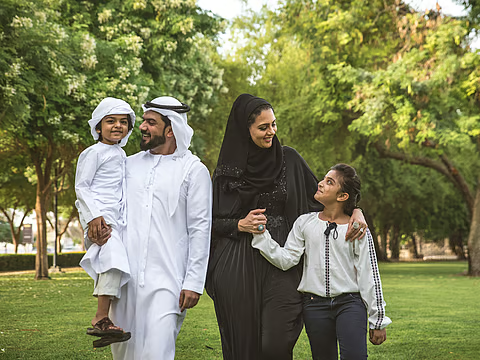
The UAE has implemented over 60 family-related policies in a bid to encourage family growth in the country. A cross-sector task force involving more than 20 federal and local government entities was established for this purpose. They reviewed existing frameworks to identify gaps in areas like housing, healthcare, education, employment and social support.
This comes amid a sharp fall in fertility rates across the globe.
Sana bint Mohammed Suhail, UAE Minister of Family, said the country’s leadership has placed family formation, growth and sustainability at the heart of national planning, particularly in recent years. “Family has always been apriority in the UAE, but today it is being addressed as a national, multi-dimensional challenge,” she said. “We are approaching this topic with an optimistic lens.”
She was speaking during a panel discussion at the World Government Summit 2026, where experts pointed out how governments can respond to changing family dynamics, declining fertility rates and shifting priorities.
As part of translating policy into everyday life, the Ministry of Family launched the ‘Family First’ programme at the summit as part of the National Family Growth Agenda 2031 to make public and urban spaces more supportive of families. The programme will focus on simple, practical changes like priority parking for expectant mothers, family seating on public transport, and dedicated family and child care rooms.
It will begin in Dubai and expand nationwide. This comes as 2026 was designated as the Year of the Family.
Integrated approach
However, Sana stressed that policies alone are not enough to reverse fertility decline. “Policies can translate intentions into actions, but they are not the only tool to spark the desire to form a family and make it grow,” she said.
Instead, the UAE is adopting an integrated approach that combines policy reform with behavioural insights, mindset shifts, and healthcare support. This comes after extensive local research, including interviews and national youth surveys conducted over several years.
She said that the findings were encouraging. “A strong percentage of young people in the UAE still believe deeply in the family institution,” she said. “The challenge is not rejection of family, but prioritisation.”
Research indicates a growing gap between aspirations and lived realities, with young people often delaying family formation in favour of education, career progression, or financial stability. “At certain stages of life, the definition of success becomes more about professional growth than family life,” she said.
Her views were supported by Serbian Minister Tatjana Macura, who said that the country was working to educate youngsters why it was “important for them not to postpone the decision if they want to have a family” even though Serbia has a liberal, fully paid IVF programme for women who had trouble conceiving.
“It is not still giving the results that we are hoping for,” she admitted. “That’s why we need to talk to the young people who want to have family. Not putting pressure on them to have it if they don’t want to, but if they do, we need to inform them why it’s important to do that early.”
Targets
Rather than achieving “number-driven” fertility targets, the UAE wants to focus on creating an enabling ecosystem that allows young people to align their aspirations with family life when they are ready. “We are very optimistic about our youth. We believe we have the right foundation,” she added.
A key factor shaping the UAE’s strategy is its demographic advantage. While many countries face ageing populations, the UAE expects its population aged 15 to 35 to grow by around 30 per cent over the next decade. The government views this as a critical opportunity window requiring targeted and well-timed interventions.

