

Bashayer Al Salami’s platform, Deepy, uses deep learning to identify AI-generated manipulation in images, videos, and audio, helping journalists, institutions, and everyday users verify authenticity before sharing content.
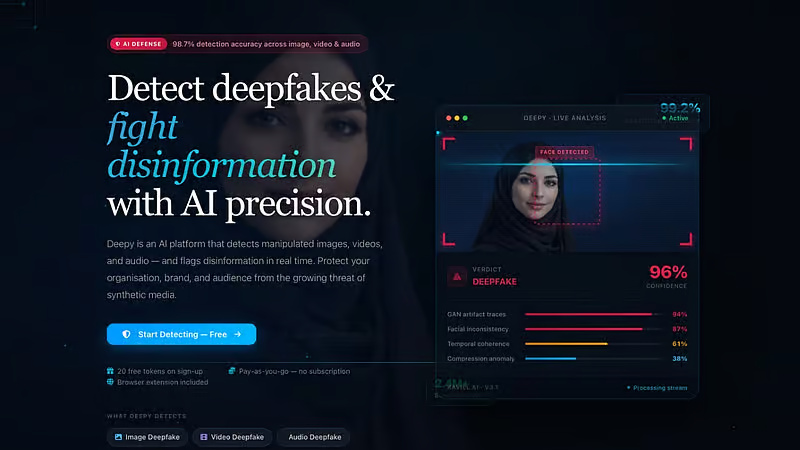
An Emirati cybersecurity researcher has developed an AI-powered platform that detects deepfakes in images, videos, and audio, aiming to curb the rapid spread of manipulated content across social media.
Bashayer Al Salami created the platform, called Deepy, following her master’s research at Zayed University, which focused on emerging digital threats and how AI-generated manipulation is increasingly outpacing what ordinary users can detect on their own.
“As AI advanced, deepfakes emerged as one of the most serious digital challenges, making it possible to alter images, videos, and audio in ways that the average viewer cannot easily detect,” she said.
Deepy analyses uploaded files and generates a credibility assessment, flagging the likelihood of AI manipulation. “It relies on advanced AI algorithms to analyse images, videos, and audio clips, examining technical indicators within the digital file such as pixel patterns, inconsistencies in lighting, and distortions in movement or sound,” Al Salami explained.
Detection is based on subtle indicators that are difficult for humans to notice, including asymmetry in lip movements or facial expressions, inconsistencies in lighting and shadow patterns, and minute distortions at the pixel or frame level. The system also identifies digital fingerprints left by image and audio generation tools, with deep learning models trained on thousands of examples of both authentic and manipulated content, enabling Deepy to flag potential fakes at an early stage.
The platform is designed for use by government bodies, security agencies, media organisations, journalists, and companies that rely on content verification. It can also support digital security and social media monitoring entities. Versions for general users are currently under development, allowing individuals to verify images or videos before sharing them.
Periods of crisis or political tension often lead to a surge in fabricated content circulating online, Al Salami said, with deepfake technology increasingly used to spread misinformation, create panic, or influence public opinion. Deepy is designed to offer rapid verification tools so journalists, official bodies, and everyday users can assess content before sharing it.
“The role of technology does not stop at detecting manipulation,” she said. “It extends to promoting digital awareness and building a more reliable and secure media environment in the digital age.”

