

SME growth in the UAE is being reshaped by government-backed equity and contract support.

Abu Dhabi: The UAE government is strengthening its commitment to small businesses.
That was the message from Dr. Ahmad bin Abdullah Belhoul Al Falasi, UAE Minister of Sports and Chairman of the Emirates Growth Fund, who spoke at a fireside chat on building enduring enterprises during the Make it in the Emirates forum in Abu Dhabi.
With corporate taxes now in effect and regional uncertainty weighing on investor confidence, Al Falasi acknowledged the challenges facing SMEs but firmly rejected the notion that the government is pulling back its support.
“Nothing beats access to market,” he said. “You can always offer a temporary solution, but that would not sustain a company if it wants to grow.”
Filling the gap left by the market
The Emirates Growth Fund was created to tackle what Al Falasi described as the “missing middle” in SME financing—companies that have moved beyond early-stage funding but still require patient, long-term capital to reach their full potential.
The fund’s approach is deliberate, taking minority stakes of 20 to 49 per cent while introducing governance structures and global expertise, without displacing founders from control. Al Falasi said the goal is to help companies transition from founder-led models to more institutional frameworks, while also leveraging the fund’s networks to expand market access.
The Emirates Growth Fund has attracted nearly ten times the expected interest following its latest announcements, with its Dh1 billion in equity being actively deployed across priority sectors such as manufacturing, healthcare, food security, and advanced technology.
“We intentionally take a non-controlling stake,” he said. “We also bring global expertise to provide operational depth and open up markets.”
Local capital, a different kind of risk
On regional uncertainty, including the impact of the Iran conflict on investor sentiment, Al Falasi was direct. He argued that perceived risk is significantly higher than the actual risk on the ground, and that for businesses backed by local capital, this gap represents an opportunity rather than a constraint.
He noted that international investors often assess risk at a broad regional level, while institutions such as the Emirates Growth Fund are able to apply a more granular understanding of the market and price risk more accurately.
“The perceived risk is much higher than actual,” he said. “That combination will work for us. It’s an opportunity for us to deploy more capital since we know the market.”
For SMEs facing rising costs, including war risk insurance increasingly embedded in contracts, Al Falasi said access to government-backed equity helps absorb these pressures at a more competitive cost than international capital typically requires.
Fee waivers, corporate tax and the new reality
Al Falasi acknowledged that the introduction of corporate tax has reshaped the SME landscape, adding a cost burden that many businesses did not previously face. He said fee waivers continue to play an important role as a support measure, but stressed that access to equity has now become equally critical.
“By definition, if you’re not profitable, you would have to build in additional costs,” he said. “Fee waivers are important. But access to equity is also on the table.”
He pointed to the fund’s surge in demand as evidence that its proposition is resonating, adding that equity investment is emerging as one of the most effective tools for SMEs navigating the current environment.
Government as buyer, not just backer
Beyond investment, Al Falasi highlighted the government’s increasing role as a direct purchaser of locally produced goods and services, describing it as one of the most powerful tools for supporting SME growth.
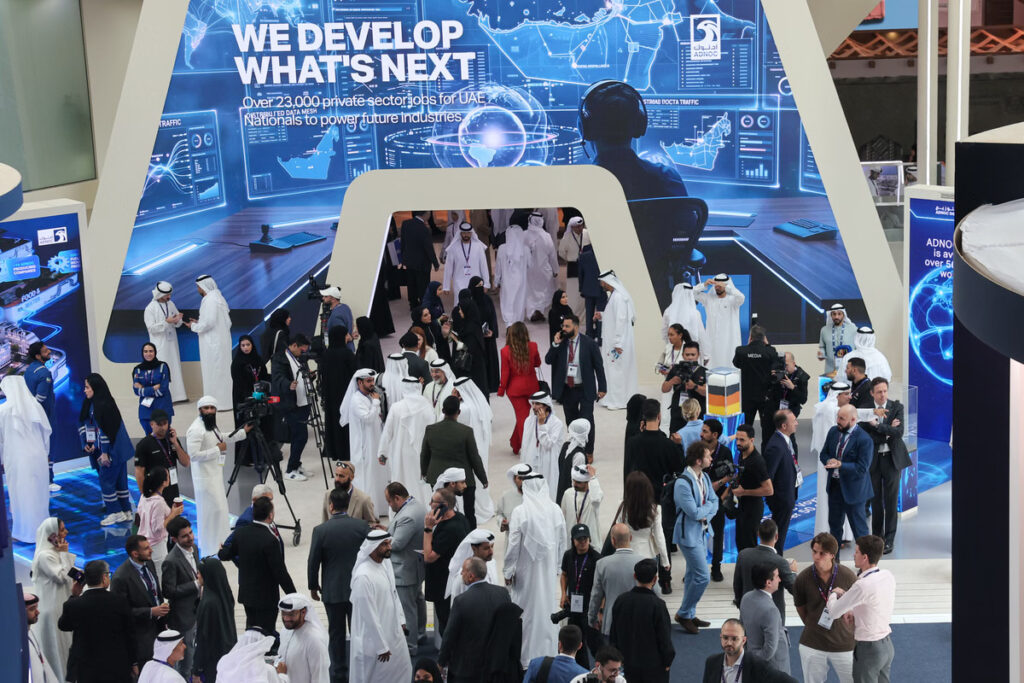
At the Make it with ADNOC forum, held in parallel with Make it in the Emirates, ADNOC unveiled projects valued at over Dh200 billion for the next two years and introduced its Local+ initiative, which links engineering, procurement and construction contractors with 70 qualified UAE manufacturers.
Al Falasi framed this as a strategic shift rather than a simple procurement exercise. In the wake of the pandemic, which exposed vulnerabilities in global supply chains, he said the government accelerated efforts to localise critical sectors ranging from defence to healthcare.
“That not only helps these companies, but also helps us as government,” he said. “We quickly realised that it is to our advantage to offer contracts locally and localise everything, from defence to healthcare to all services.”
A different model from Saudi
Asked how the UAE’s investment landscape compares with Saudi Arabia and the Public Investment Fund model, Al Falasi said the UAE’s strength lies in the diversity and complementarity of its investment vehicles.
He pointed to a range of entities—from more passive sovereign wealth funds to active players such as the Emirates Growth Fund, alongside Mubadala and ADQ—as evidence of a structured ecosystem rather than reliance on a single dominant institution.
“Each one has a mandate,” he said. “We have passive ones, we have more active ones, and we have federal ones. They all complement each other.”
Within that framework, he said the Emirates Growth Fund occupies a distinct niche, filling a gap where equity financing is available for tech startups but has historically been limited for growth-stage manufacturers and industrial companies. Al Falasi added that this gap is now gradually closing.
“I think what we have is a very healthy landscape of equity being deployed,” he said. “And I truly believe the future will remain strong. We will be able to weather any challenge that comes our way.”

