

Diplomatic efforts and new visa agreements are expanding travel opportunities for Filipino passport holders.
Manila: The Philippine passport has posted modest but steady gains in global mobility rankings over the past eight years, according to a visa-tracking website.
From rankings in the low 70s and 80s in the early 2020s, the Philippine passport has risen to around 61st to 73rd globally, depending on the index used, as the country continues to secure incremental reciprocal visa-free and visa-on-arrival agreements — aided in part by diplomatic efforts.
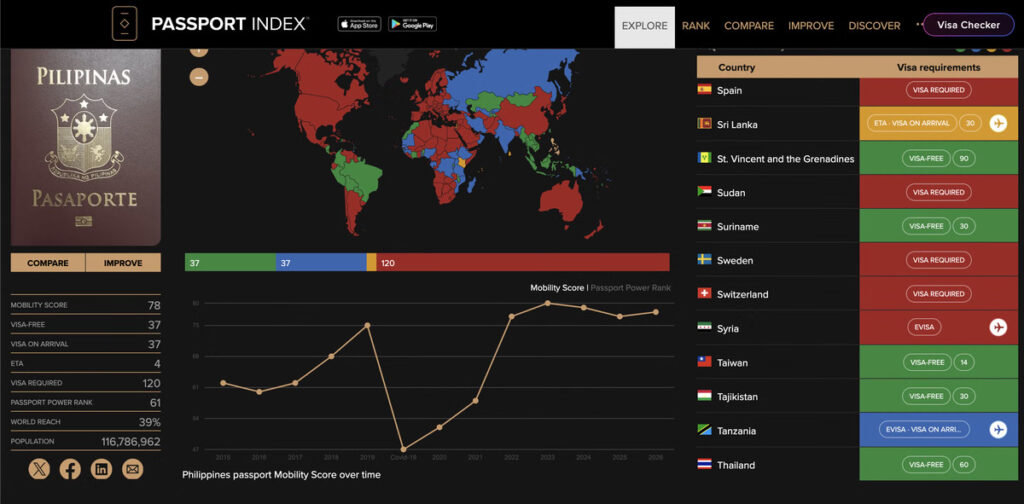
According to Passport Index, the Philippine passport currently has a mobility score of 78, providing access to 78 destinations through visa-free entry (37 countries), visa on arrival (37), and electronic travel authorisation or eTA (4).
It ranks 61st in passport strength globally, with a world reach of 39%.
Over the past eight years, the Philippine passport’s global standing has fluctuated but generally trended upward from lows near 80th place.
It ranked around 77th in 2022, improved to the mid-70s during 2023 and 2024, and has recorded further gains recently following new bilateral visa agreements.
Earlier in the decade, the Philippine passport hovered between the high 60s and low 70s in global rankings.
Diplomacy and economic ties fuel gains
Recent improvements have been driven by sustained diplomatic efforts, including new or expanded visa waivers and simplified entry policies with countries across Asia, Africa, and Latin America.
Examples include expanded access arrangements with destinations such as Uzbekistan, Kazakhstan, and Taiwan, alongside broader regional agreements.
Recent visa waiver agreements, including a pact with Paraguay reached during high-level diplomatic visits, highlight how stronger foreign relations, tourism promotion, and economic cooperation are helping improve mobility for Filipino travelers, overseas workers, and businesses.
Analysts say these incremental gains reflect successful “reciprocity” negotiations, improving bilateral relations, and the Philippines’ growing economic profile, all of which have strengthened its leverage in diplomatic talks.
However, the Philippine passport still trails many of its ASEAN neighbours, particularly Singapore, underscoring the need for continued reforms in security, digital governance, documentation standards, and diplomatic outreach.
As of early 2026, the Singapore passport remains consistently ranked among the world’s most powerful, offering visa-free or visa-on-arrival access to 192 to 195 destinations.
It regularly tops the Henley Passport Index, reflecting Singapore’s strong global diplomatic and economic ties.
With a population of more than 116 million, stronger passport mobility benefits millions of Overseas Filipino Workers (OFWs) and the tourism sector by easing travel restrictions and reducing barriers to international movement.
Philippine officials continue to pursue additional visa agreements and reciprocal arrangements aimed at further improving the country’s global mobility standing.
The rankings highlight both the progress made and the continuing challenges in an era where global mobility is still shaped by geopolitics, security considerations, and economic interdependence.

