

Inside a US automaker’s push to compete with China’s low-cost electric vehicles.
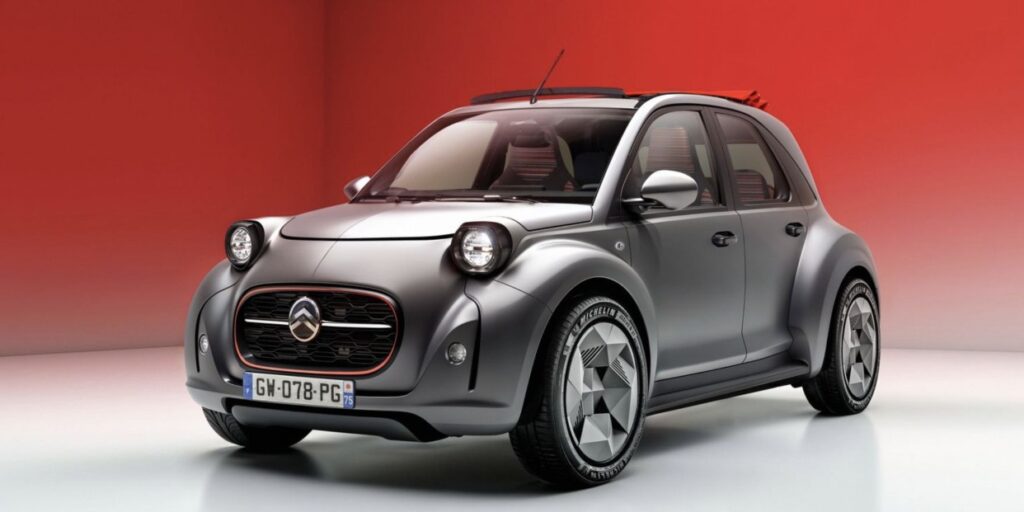
European car buyers could soon witness the revival of one of the continent’s most iconic “people’s cars,” this time reimagined as an electric vehicle.
Stellantis, the global auto group behind brands including Citroën, Fiat, Jeep, Peugeot, and Ram, is reportedly advancing plans for a low-cost EV in Europe priced under €15,000 (about $17,000) by 2028.
At the heart of the speculation is a potential modern reboot of the legendary Citroën 2CV — the simple, affordable French car that once symbolized mass mobility in postwar Europe. Industry reports suggest Stellantis executives are exploring an electric reinterpretation of the 2CV as part of a wider effort to revive Europe’s shrinking budget-car segment.
The move comes as European automakers step up efforts to counter the growing dominance of low-cost Chinese EV makers, while also navigating tighter emissions rules and weakening demand for higher-priced electric vehicles.
European battleground
Analysts say the fight to dominate Europe’s next wave of affordable electric vehicles could reshape the continent’s auto industry over the next decade.
For Stellantis, the challenge goes beyond simply producing a low-cost EV — it must also be profitable.
Battery costs remain the biggest barrier to affordable electric cars. Automakers are also grappling with higher labour expenses, strict safety regulations, supply-chain instability, and investor pressure to maintain healthy margins. Over the past decade, many European manufacturers have moved away from ultra-small entry-level models, as SUVs and crossovers proved far more lucrative.
That shift has driven up average car prices across Europe, effectively pricing many younger and lower-income buyers out of the new-car market.
Industry observers say Stellantis’ planned “e-car” initiative is aimed at reversing that trend.
French media reports citing company insiders suggest the vehicle would focus on simplicity, lightweight design, and strict cost control rather than premium features. One consultant involved in the discussions reportedly described the approach as “industrial minimalism,” where every component, material, and supplier choice is scrutinized to reduce costs.
The potential revival of the 2CV also carries strong symbolic weight in France.
First launched by Citroën in 1948, the 2CV became renowned for its bare-bones practicality, low running costs, and durability on rural roads. Much like the Volkswagen Beetle in Germany, it helped democratize car ownership in postwar Europe, making mobility accessible to millions of ordinary families.
Democratising electric mobility
Reports connecting the 2CV to Stellantis’ future EV strategy gained traction after Citroën CEO Xavier Chardon publicly signalled interest in reviving the model in electric form.
Although Stellantis has not officially confirmed the project, Chardon’s remarks have fuelled speculation that the company sees the 2CV name as a powerful blend of nostalgia and affordability — potentially helping to market a low-cost EV to mainstream buyers.
However, the risks are significant.
If the new model ends up being too expensive, overly complex, or strays too far from the original 2CV’s defining simplicity, it could face strong criticism from both enthusiasts and prospective customers.
Affordable EV platform
Industry reports suggest there is also internal competition within Stellantis over which brand will spearhead the affordable EV project.
Both Citroën and Fiat are reportedly vying for control of the low-cost EV platform, a decision that could shape everything from design language and pricing to factory allocation and overall market positioning.
The Pomigliano d’Arco plant near Naples, Italy — historically linked with production of the Fiat Panda, another iconic European small car known for its practicality and low running costs — is frequently cited in reports as a potential manufacturing base.
Producing the vehicle in Europe would also carry significant political weight.
European tariffs
European governments have become increasingly concerned about growing reliance on Chinese-made electric vehicles and battery supply chains.
EU policymakers have already introduced tariffs on certain Chinese EV imports, amid fears that heavily state-supported Chinese automakers could undercut European rivals through aggressive pricing strategies.
At the same time, Stellantis maintains significant ties to China.
The company holds a 21% stake in Chinese EV maker Leapmotor, which has led to speculation that Chinese technology, particularly in batteries or components, could eventually influence or support the development of Stellantis’ planned low-cost EV.
Stellantis is not alone in the push to build affordable electric vehicles.
French automaker Renault has already attracted strong interest with the return of the electric Renault 5, alongside plans for a low-cost city EV inspired by the classic Twingo.
Meanwhile, Chinese manufacturers such as BYD and MG have rapidly expanded their presence in Europe, offering competitively priced electric models that are intensifying pressure on local brands.
Analysts say the coming years could prove decisive in determining whether Europe can still produce truly affordable cars domestically — or whether leadership in the low-cost EV segment will shift firmly toward Chinese automakers.
If Stellantis manages to deliver a road-ready EV priced close to $17,000 without heavy reliance on subsidies, it could compel rivals to significantly rethink their pricing models and approach to small-car development.
If it falls short, however, the initiative risks joining a long list of ambitious industry pledges where truly affordable electric mobility has remained elusive.

