

New technologies aim to tackle real-world challenges, from forecasting oil spills 72 hours ahead to accelerating customs checks and emergency rescues.
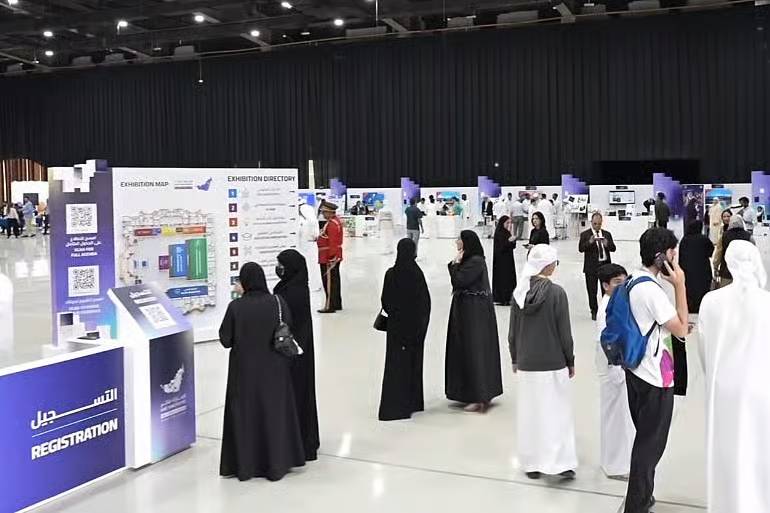
From predicting oil spill movements up to 72 hours in advance to speeding up customs inspections and improving emergency rescues, four new technologies showcased in Ras Al Khaimah aim to address real-world challenges.
The innovations were presented at the Ras Al Khaimah Innovation Exhibition, organised by the Standing Events Committee of Ras Al Khaimah as part of UAE Innovates 2026. The event brought together government entities, educational institutions and private companies to showcase smart technologies and AI-powered solutions.
Here are four innovations featured at the exhibition.
1. AI-powered system predicts oil spill movement 72 hours in advance
An artificial intelligence-powered system developed by Etihad Water and Electricity (EtihadWE) aims to help protect desalination plants by forecasting the movement of oil spills up to three days in advance. Its development followed a recent tanker accident that affected coastal areas across the Northern Emirates.
The oil tanker Gem No. 2 was involved in an accident in UAE territorial waters in October, resulting in an oil spill concentrated off the coast of Umm Al Quwain and extending partly towards Ras Al Khaimah, Ajman and Sharjah.
The Ministry of Climate Change and Environment previously reported a “noticeable decline” in pollution intensity as cleanup operations continued. Authorities also said the leak had been stopped at its source, with subsequent field assessments detecting no further oil spill from the tanker.
Tauseef, a member of EtihadWE’s IT artificial intelligence team, said the incident prompted the development of a forecasting application that gives emergency teams advance warning of potential threats to desalination facilities.
“When we got to know about the issue, we started getting satellite images and monitoring them to understand the area of the spill,” he said.
The system combines satellite imagery, machine learning, wind direction, ocean currents and other environmental factors to forecast the likely movement of oil slicks over the following 72 hours.
It monitors four desalination plant locations in the Northern Emirates: Al Zawraa, Naqaa, Utico and Ghalilah.
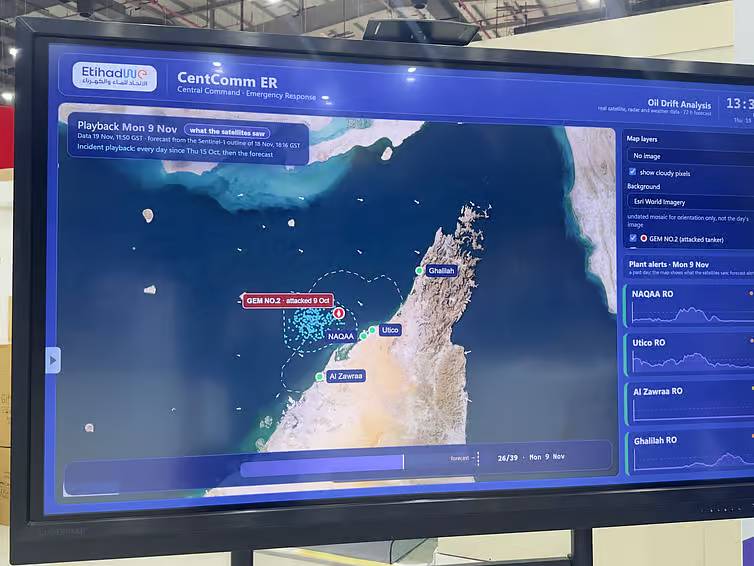
“The forecast gives supervisors a 72-hour heads-up. If there is an oil drift somewhere close to the region, they can take pre-emptive action, plan their activities accordingly and make sure emergency response teams are on standby,” Tauseef said.
He added that alerts are initially sent to plant supervisors, who verify the information and assess conditions on the ground before deciding whether further action is required.
“Instead of having to do something reactive, we try to do something more proactive,” he said.
2. Digital medicine screening system speeds up airport customs inspections
A digital medicine screening system developed by a customs officer at Ras Al Khaimah Airport aims to reduce inspection times by helping officers quickly identify permitted, restricted and prohibited medicines carried by passengers.
Naema Al Teneiji, Senior Customs Officer at Ras Al Khaimah Airport Customs, said she developed the system to replace paper-based medication lists that inspectors previously used to check medicines against regulations issued by the Ministry of Health and Prevention.
The digital platform allows officers to enter the first two letters of a medicine’s name and retrieve relevant information immediately, reducing waiting times for passengers.

“Previously, we relied on paper lists to check medications, which took time for both passengers and inspectors. I wanted to develop a digital version that would make the process faster and easier,” she said.
The system uses a colour-coded classification: green indicates permitted medicines, red identifies prohibited substances, and orange flags restricted medicines that require additional documentation, such as an approved medical prescription.
Al Teneiji said passengers carrying certain controlled medicines, including Tramadol and Lyrica, may need to provide medical documentation recognised in the UAE. Medicines without the required documents may be temporarily held while passengers obtain the necessary approvals.
She also highlighted a separate device, known as Rigaku, which customs officers use to identify unknown substances, including unlabelled medicines, chemicals and potentially hazardous materials.
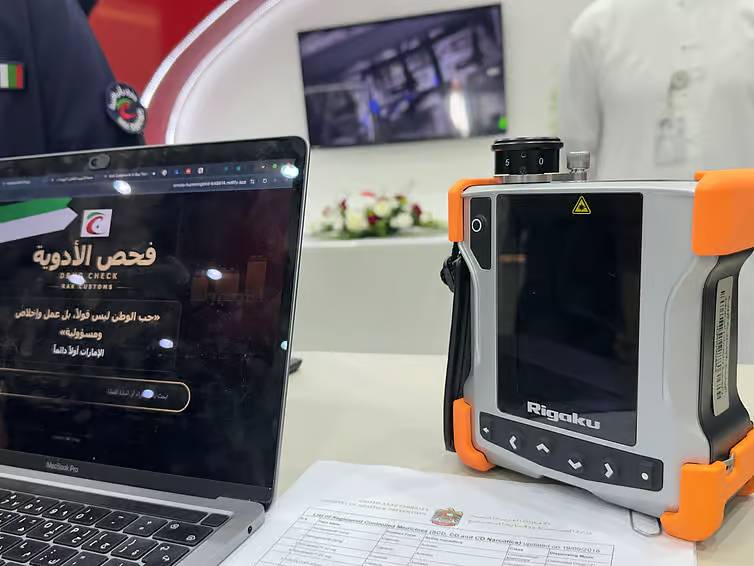
The device uses laser-based technology to analyse substances without requiring officers to handle potentially dangerous materials directly.
According to Al Teneiji, it is particularly useful when inspecting unidentified capsules, traditional medicines or substances concealed inside everyday products such as shampoo, toothpaste and soap.
3. Firefighting vehicle equipped with drone to reach difficult terrain
A rapid-response firefighting vehicle equipped with a drone capable of reaching heights of up to 100 metres was another innovation showcased at the exhibition. It is designed to help emergency teams locate and tackle fires in mountainous, desert and other hard-to-reach areas.
Presented by NAFFCO in collaboration with Ras Al Khaimah Civil Defence, the vehicle combines a Compressed Air Foam System (CAFS) with a firefighting drone fitted with surveillance and thermal cameras.
Mohammad Al Khatibeh, Group Marketing Director at NAFFCO, said the technology helps emergency responders identify incidents and reach locations that conventional fire engines may struggle to access.
He said the system uses significantly less water than conventional firefighting pumps, which typically discharge between 1,500 and 2,000 litres per minute.
The vehicle can operate with wet or dry foam, while an internal compressor allows the system to run for longer periods than earlier versions.
Weighing approximately 3.5 tonnes, compared with 18 to 20 tonnes for a conventional fire engine, the vehicle can reach speeds of 160 to 170 kilometres per hour. Al Khatibeh said, however, that its main advantage is its ability to respond quickly to emergencies.
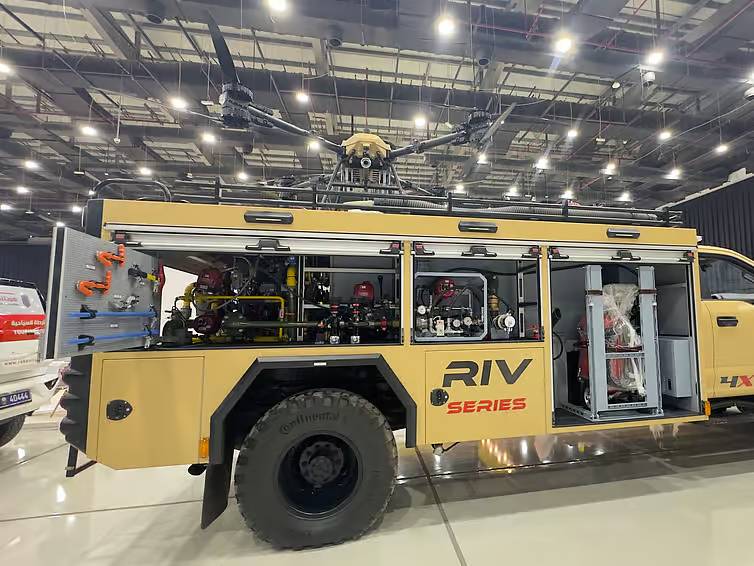
The technology could be particularly useful in Ras Al Khaimah, where mountainous terrain can make it difficult for rescue teams to locate accidents or reach stranded people.
Al Khatibeh said the drone could be deployed to identify fires, accidents or people needing assistance during floods and heavy rainfall. It can also support firefighting operations in areas inaccessible to vehicles.
He added that rapid-response firefighting vehicles are already used across several emirates, but integrating a firefighting drone directly with the CAFS is a newer development.
4. Improved diving mask and life jacket speed up maritime rescues
Ras Al Khaimah Police showcased an improved diving mask designed to provide rescuers with almost 360-degree underwater visibility, alongside a rapid-response life jacket that can be put on in less than 30 seconds.
Mehdi Hamdan Jaber, Assistant at the Search and Rescue Department of Ras Al Khaimah Police, said the diving mask was developed to address visibility and communication challenges faced by rescuers during underwater operations.
The improved design reduces blind spots and prevents fogging, which can affect divers’ ability to see clearly underwater.
Unlike conventional equipment that requires divers to breathe through their mouths, the mask allows them to breathe through both their nose and mouth.
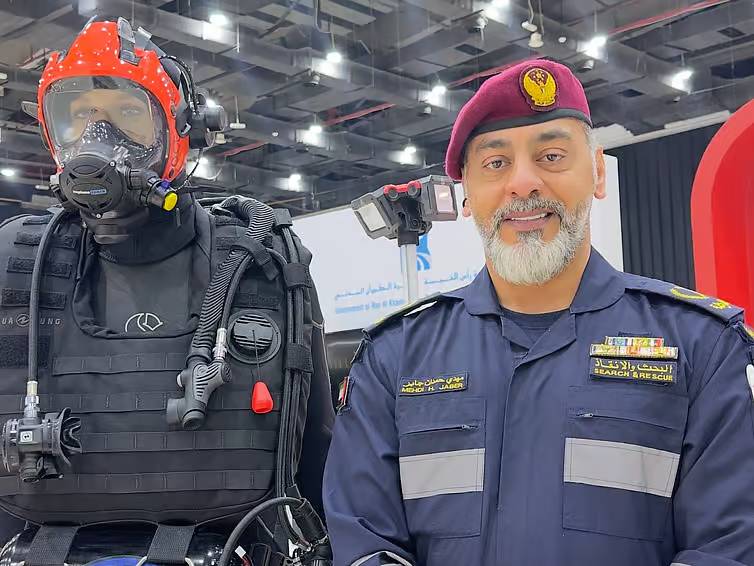
It is also equipped with a wireless communication system that enables rescuers to receive instructions from teams above the surface while operating at depths of up to 40 metres.
Jaber also highlighted a rapid-response life jacket designed to reduce the time rescuers need to prepare for emergencies, particularly drowning incidents.
He said conventional rescue equipment could take around a minute to put on, while the new life jacket can be worn in less than 30 seconds. This allows rescuers to enter the water and reach people in distress more quickly.
He stressed that every second counts during maritime emergencies, particularly in summer and during busy beach periods, when a faster response can make a difference to rescue operations.