

How Small Braking Mistakes Can Trigger Massive Traffic Jams on UAE Highways.
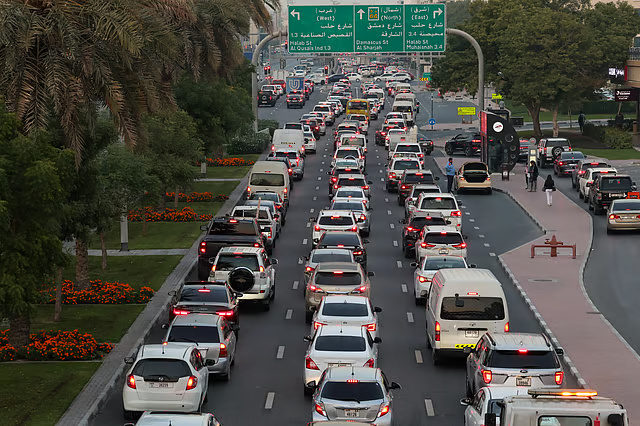
Dubai: You’re driving along one of the UAE’s busiest highways when, suddenly, traffic slows to a crawl. There’s no accident ahead, no broken-down vehicle blocking a lane, and no roadworks creating a bottleneck. So, what’s causing the sudden slowdown?
The answer may be a phantom traffic jam — a traffic disruption that appears to come from nowhere, even when there is no visible obstruction on the road.
“This is known as phantom traffic, which refers to a sudden slowdown or complete stop on a road without any obvious cause, such as an accident or roadworks,” Thomas Edelmann, founder of RoadSafetyUAE.com, told Gulf News.
On some of the UAE’s busiest highways, where thousands of vehicles travel in close proximity, even a minor change in one driver’s behaviour can quickly ripple through the traffic, triggering widespread slowdowns.
How does a phantom traffic jam start?
Phantom traffic jams are more likely to occur when vehicles are travelling close together in heavy traffic.
“A driver may lightly tap the brakes, perhaps because they have moved too close to the vehicle ahead. The driver behind sees the brake lights and takes a moment to react, braking slightly harder. The next driver does the same, and the effect continues down the line,” Edelman said.
Eventually, drivers further back may be forced to slow sharply or even come to a complete stop.
“The important point is that nothing major has to happen to create the jam. A small disturbance in otherwise free-flowing traffic can be enough to trigger a chain reaction,” Edelman said.
The slowdown does not necessarily remain confined to a single lane.
“Motorists in the adjacent lane may also brake if they see another driver slowing down. They may assume something is wrong or simply wonder what is happening. In some cases, the effect can spread across multiple lanes,” Edelman said.
Phantom traffic jams are more likely to develop when roads are carrying large volumes of vehicles. In heavy traffic, even a minor change in speed — such as a sudden brake or following too closely — can trigger a chain reaction. Each vehicle behind may slow down slightly more than the one before it, eventually bringing traffic to a standstill.
— Thomas Edelman, founder of RoadSafetyUAE.com
Why heavy traffic can turn into a phantom jam
The first factor to understand is traffic density. As the number of vehicles on a road increases, the gaps between cars become smaller, leaving less room for minor changes in speed to be absorbed.
This is particularly relevant on busy UAE roads, where congestion is a common part of daily driving. A 2025 study found that 91 per cent of Dubai residents and 90 per cent of Sharjah residents typically experience traffic jams.
Dubai also recorded 3.5 million vehicles in 2024, a 10 per cent increase, according to data from the Roads and Transport Authority (RTA).
Can phantom jams happen when there are fewer cars?
Yes. A 2008 experiment in Japan demonstrated that phantom traffic jams can form even without an obvious cause.
Researchers asked drivers to travel around a circular track at a steady 30km/h while maintaining a safe distance from one another. There were no accidents, lane changes, roadworks or obstacles. Yet within about a minute, a traffic jam began to form.
The chain reaction started when one driver travelled slightly slower or made a small braking adjustment. The driver behind reacted by slowing down, prompting the next driver to slow down even more. The effect continued along the line until vehicles at the back were forced to slow sharply or come to a complete stop.
The experiment demonstrated how a seemingly insignificant change in an otherwise smooth flow of traffic can grow into a major slowdown, particularly when vehicles are travelling close together.
UAE roads: Is following distance the problem?
According to Mustafa Aldah, founder of RoadHeroAcademy and a road safety expert, the same phenomenon can occur frequently on UAE roads.
One of the key contributing factors, he said, is drivers failing to maintain enough distance from the vehicle ahead.
When the gap is too small, drivers have less time to react to sudden changes in speed, making it easier for a minor braking adjustment to trigger a chain reaction through surrounding traffic.
“If everybody left a safe distance, that gap would be enough to absorb a slowdown without anyone needing to brake. The wave would never form, and the phantom jam could disappear before it even starts,” Aldah explained.
When drivers follow too closely, there is little room to absorb even a minor change in speed. “The only response available is the brake pedal, and that’s what passes the problem back to everyone behind,” he said.
Dubai Police recommends maintaining a safe following distance of at least three seconds from the vehicle ahead. But when drivers do not leave enough space, even a small slowdown can trigger a chain reaction.
“As long as that gap is missing, I think this phenomenon will keep appearing occasionally,” said Mustafa Aldah, founder of RoadHeroAcademy.
Can drivers prevent phantom traffic jams?
There may be no way to eliminate phantom traffic jams completely, especially when roads become heavily congested. However, drivers can take simple steps to reduce the chances of creating or worsening them.
Aldah said one of the most important measures is to leave enough space from the vehicle ahead to maintain a clear view of the road beyond it. This allows drivers to anticipate changes in traffic rather than reacting suddenly to the car directly in front.
He illustrated the point using a simple A4 sheet of paper. Hold the paper vertically close to your nose and it blocks much of your view. Move it farther away, and more of the surrounding space becomes visible.
“Driving is exactly the same. If you are too close to the car ahead, you cannot see what is in front of them. If there is something in the road that they cannot avoid, you will get entangled as well,” he said.
His advice is to maintain at least a two-second gap from the vehicle ahead and to “read” the traffic further down the road.
“You can almost always tell when something is wrong before it becomes unavoidable,” he said.
Traffic congestion itself is unlikely to disappear. But for UAE motorists, the message is simple: maintain a safe following distance, brake and accelerate smoothly, and avoid unnecessary lane changes.
These small changes in driving behaviour can help prevent minor disruptions from turning into major traffic slowdowns.

