

Crude benchmarks fall as traders bet on a US–Iran truce and the return of Gulf oil supplies to global markets.

Global crude oil markets extended their selloff on Wednesday (June 17, 2026) as Iranian oil tankers began sailing again after a two-month standoff, signalling the first test of the US–Iran Gulf truce amid signs of softer global demand.
With benchmark prices hovering near three-month lows, traders continued unwinding the geopolitical risk premium built up during months of Middle East tensions.
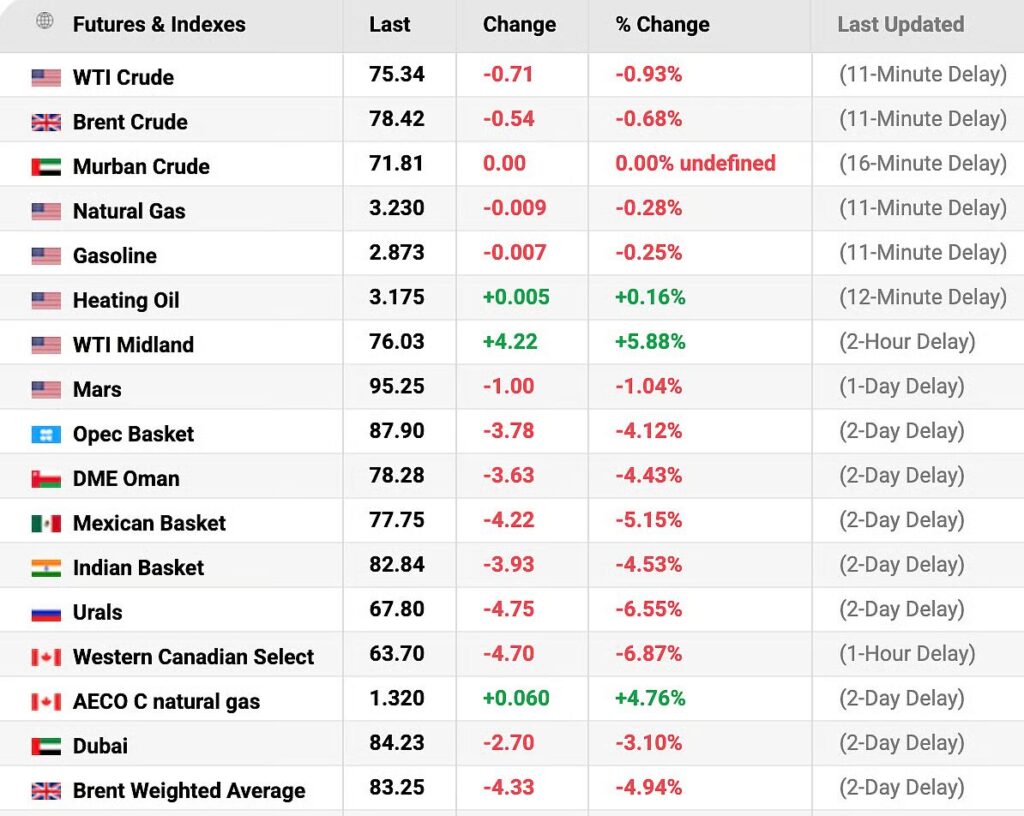
As of 7:10 am GMT on Wednesday (3:10 pm in Tokyo), US benchmark West Texas Intermediate (WTI) crude was trading at $75.34 per barrel, down 0.93%, while Brent crude fell 0.68% to $78.42. Gulf benchmark Murban was flat at $71.81.
The decline was also reflected across major physical crude benchmarks.
The OPEC Basket declined 4.12% to $87.90, while Dubai crude fell 3.10% to $84.23. DME Oman dropped 4.43% to $78.28, the Indian Basket slipped 4.53%, the Mexican Basket eased 5.15%, and Russia’s Urals crude recorded the steepest fall, down 6.55%.
Canada’s Western Canadian Select also fell 6.87%, highlighting the broad-based nature of the global oil market retreat.
The selloff comes after reports that Washington and Tehran are advancing toward an interim agreement that could reopen the Strait of Hormuz, ease sanctions on Iranian crude exports, and initiate renewed negotiations over Iran’s nuclear programme.
In response, traders have rapidly unwound the geopolitical risk premium that had previously driven crude prices higher during the period of heightened regional tensions.
Energy markets are also factoring in the possibility that millions of barrels of Iranian crude currently in storage or awaiting export could gradually re-enter global supply if sanctions relief is implemented.
Physical crude markets across the Middle East have already softened, with Dubai and Oman benchmarks slipping into discounts as buyers price in expectations of increased regional supply.
Softer demand
The price decline has been further driven by signs of weaker demand, particularly in Asia, where refinery utilisation has eased in recent weeks. Analysts say the combination of improving supply expectations and softer consumption has triggered one of the sharpest reversals in oil markets since the conflict began.
However, despite the improved outlook, analysts warn that markets may be pricing in recovery faster than physical supply conditions can actually adjust.
Commercial shipping through the Strait of Hormuz has yet to fully return to normal levels, while insurers continue to impose elevated war-risk premiums. Many shipowners are still awaiting clearer assurances that key sea lanes are free of mines and other security threats before resuming standard operations.
For now, traders appear to be positioning for a scenario in which diplomacy ultimately restores oil flows and prevents a prolonged supply disruption.
Whether those expectations are realised will depend on the formal signing of a U.S.–Iran agreement, the implementation of any sanctions relief, and how quickly shipping activity through the Strait of Hormuz returns to pre-conflict levels.
Iranian tankers move
At least three Iranian supertankers carrying crude have reportedly left waters previously impacted by heightened U.S. naval activity in the Gulf, marking what shipping monitors describe as Iran’s first crude exports in nearly two months and an early test of a fragile U.S.–Iran de-escalation.
Maritime intelligence firm TankerTrackers.com said on Wednesday that two National Iranian Tanker Company (NITC) very large crude carriers (VLCCs) — DIONA and HERO2 — had departed carrying a combined 3.8 million barrels of Iranian crude, based on Automatic Identification System (AIS) data supported by satellite imagery.
The firm later reported that a third NITC tanker also sailed, carrying around 1 million barrels of crude.
If confirmed through official shipping data, the movements would mark the first significant Iranian crude exports since heightened maritime tensions in the Gulf disrupted commercial shipping and left multiple tankers waiting for security clearance.
The reported departures coincide with preparations by Washington and Tehran to formalise an interim memorandum of understanding (MoU) aimed at halting hostilities, reopening the Strait of Hormuz, and initiating a 60-day negotiating process covering Iran’s nuclear programme and wider regional security issues.
Why the tanker departures matter
The movement of these vessels may indicate that both shipowners and Iranian authorities assess the immediate risk of maritime confrontation as reduced enough to cautiously resume limited crude exports.
Iran depends heavily on oil revenue, making the restoration of exports a key economic priority in ongoing negotiations. Reports from Bloomberg News suggest draft elements of the interim agreement may include sanctions waivers allowing Iran to restart oil shipments, with broader financial relief to follow in later phases.
For global energy markets, even a partial return of Iranian crude could add incremental supply, helping to ease concerns about disruptions that previously pushed oil prices higher during the conflict.
Not yet a return to normal
However, shipping analysts warn that a few tanker sailings do not necessarily signal full normalization of Gulf maritime traffic.
Commercial operators are continuing to closely monitor maritime security conditions, while insurers remain cautious about reducing war-risk premiums until shipping lanes are widely regarded as safe.
Many shipping firms are also waiting for formal guidance from naval authorities before resuming normal schedules through the Strait of Hormuz.
What happens next
Attention is now turning to the implementation of the reported U.S.–Iran agreement.
If the deal is formally signed, analysts will focus on several key indicators:
Key indicators analysts will monitor include whether additional Iranian crude tankers begin departing on a regular basis, whether international shipping companies resume normal transits through the Strait of Hormuz, and whether marine insurers start lowering war-risk premiums.
They will also watch whether any sanctions waivers translate into a sustained increase in Iranian oil exports.
Taken together, these signals will help determine whether the Gulf is transitioning from recent weeks of confrontation toward a more stable—though still fragile—maritime environment.

