

Buyers seek discounted barrels amid Middle East tensions causing oil price divergence.
Global Oil Markets Show Volatility Amid Mideast Tensions
As of 7:20 a.m. Japan time on March 25, 2026, the global oil market is showing signs of extreme volatility, with major crudes moving in sharply divergent directions.
US and some producer benchmarks are rising on supply concerns, while premium Middle East grades are sliding, reflecting heightened geopolitical stress.
Key Benchmark Snapshot:
- WTI Crude: $88.50, down $3.85 (-4.17%). Despite global supply worries, US buying remains weak.
- Brent Crude: $104.49, up $4.55 (+4.55%). The North Sea marker shows notable upside.
- Murban Crude (UAE): $119.88, down $15.29 (-11.31%). The session’s largest mover, reflecting a sharp decline in premium Middle East oil.
- Urals (Russia): $89.12, up $7.48 (+9.16%). Buyers are targeting discounted barrels.
- OPEC Basket: $145.24, up $2.38 (+1.67%).
- Indian Basket: $157.04, up $7.11 (+4.74%).
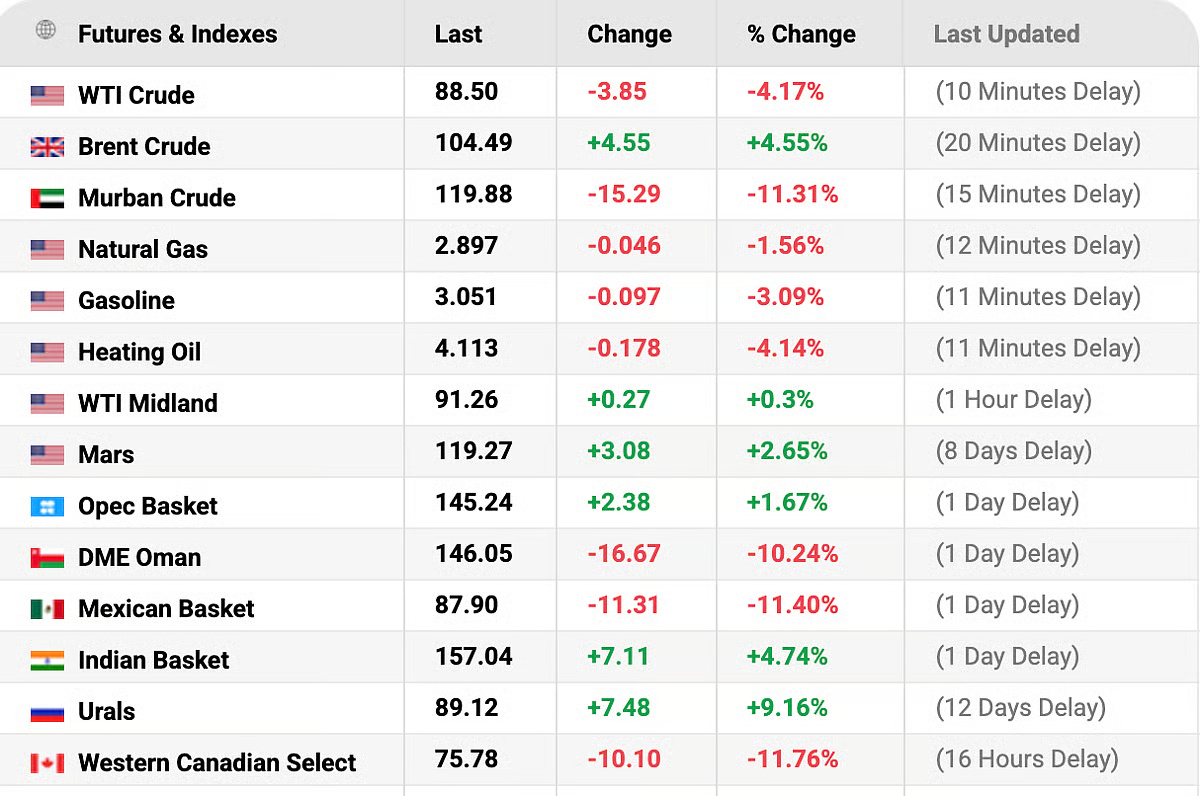
The contrasting movements highlight a market under strain, with buyers seeking discounts amid geopolitical uncertainty, while other benchmarks climb on supply fears.
Fragmented Supply Chains
The market movements are highly uneven — a clear sign of fragmented supply chains and regional risk premiums.
Middle East supply disruptions, driven by the reported tanker squeeze in the Strait of Hormuz, are intensifying market divergence.
Ongoing geopolitical tensions in the region — including transit risks and Iran-related disruptions — have driven wild divergences in oil prices.
Some Asian import baskets and select crude grades have surged sharply, while others, such as Murban, have experienced steep pullbacks, creating one of the most mismatched global crude markets in years.
Despite India’s import basket climbing above $155, domestic fuel prices have been held flat. The government has maintained retail petrol and diesel prices unchanged, even as the Indian basket hits multi-year highs.
While this shields consumers, it is putting significant pressure on refiners and oil marketing companies as global costs continue to rise.
At present, oil is far from a single, unified market — it is a collection of regional stories colliding under mounting geopolitical pressure.
With Brent and the Indian/OPEC baskets climbing, while WTI and Murban experience sharp declines, traders are bracing for continued volatility until tensions in the Middle East ease.

