

The decline reflects relief after Iran, the United States and Israel said they had agreed to a temporary “pause,” easing fears of a prolonged regional conflict.
Oil futures tumbled sharply on Wednesday after U.S. President Donald Trump announced a two‑week suspension of attacks on Iran and progress toward a long‑term peace framework, easing fears of prolonged disruption to Middle East energy supplies. U.S. West Texas Intermediate (WTI) crude for near‑term delivery fell by more than 15 % in early trade, with prices dropping significantly below recent highs as traders reacted to the ceasefire announcement.
Brent Crude, the international benchmark, fell 13.14%—or $14.36—to $94.91 by 12:18 pm Tokyo time on Wednesday, down from $109.27 at 8:42 am the same day.
Murban crude dropped 18.85% to $96.78, losing $22.48 on Wednesday so far, while some longer-dated or alternative grades, such as Urals, remained flat due to differences in delivery schedules and quality.
Sharp decline
The steep fall in WTI and Brent reflected market relief after President Trump announced the two-week pause following discussions with Pakistani leaders.
The move hinges on Iran’s “complete, immediate and safe” reopening of the Strait of Hormuz — a critical chokepoint for roughly one‑fifth of global seaborne oil flows — which traders see as key to easing the energy supply shock.
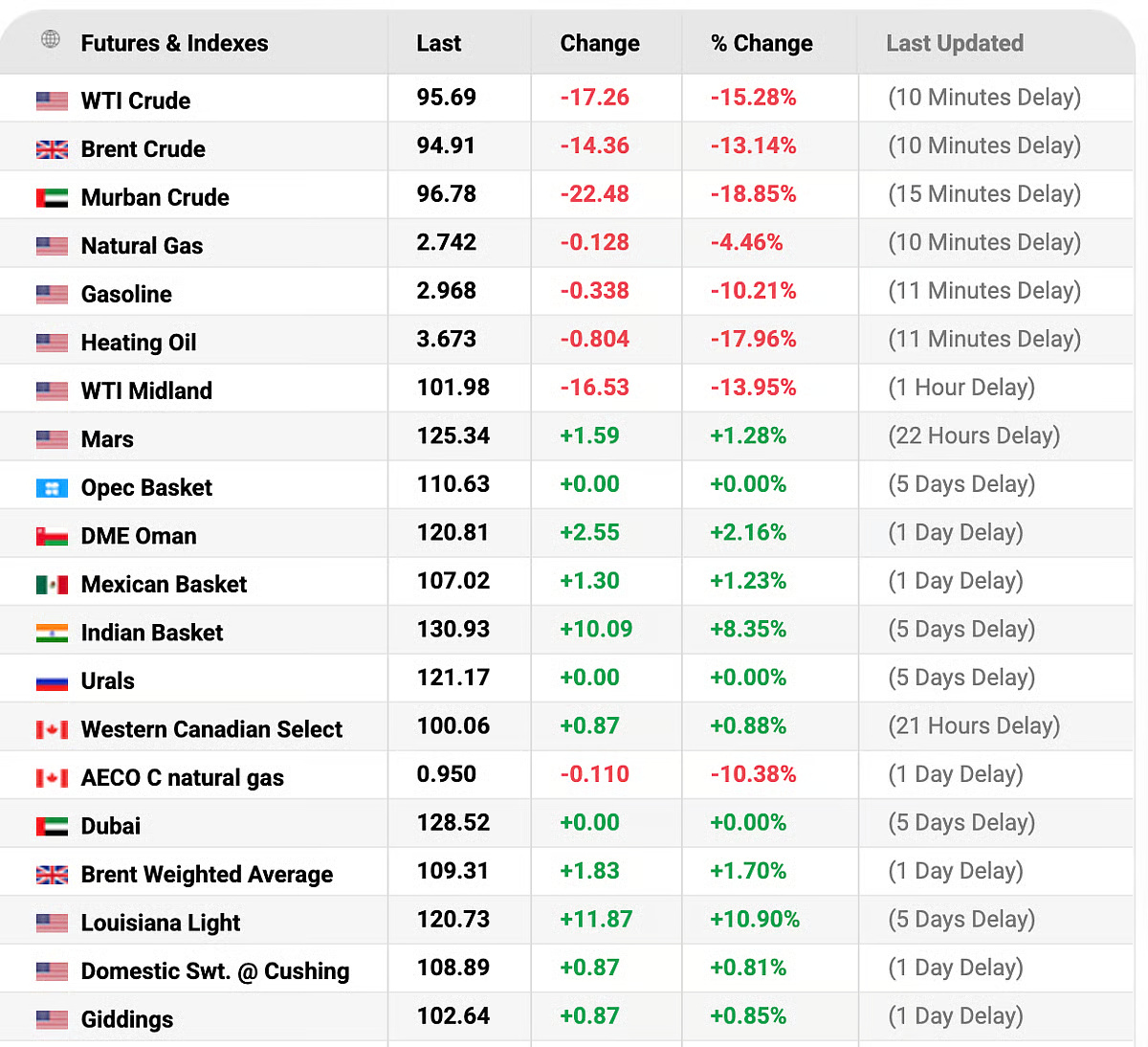
Heating oil plunged 17.96% and gasoline futures fell 10.21%, reflecting expectations that restored supply flows would weaken fuel prices. Natural gas also eased about 4.46%. Other regional crude grades showed mixed moves amid ongoing market volatility.
The OPEC Basket remained steady at $110.63.
The sell-off followed hours after President Trump’s Truth Social post, in which he cited a 10-point Iranian proposal as a “workable basis” for negotiations and stated that U.S. military objectives had already been met and exceeded.
Analysts noted that the immediate market reaction highlighted how closely oil prices had been tied to risks in the Strait of Hormuz in recent weeks.
A sustained reopening of the strait could push prices lower, although verifying compliance and ensuring broader regional stability remain uncertain.
Trading volumes and final settlement levels could fluctuate as U.S. and European markets respond.

