

Brent and WTI slide sharply after reduced threat to shipping through the Strait of Hormuz.

Global oil prices tumble as Hormuz disruption fears ease amid US–Iran de-escalation
Global oil benchmarks fell sharply late Monday and into Tuesday morning (June 16), as markets welcomed the reopening of the Strait of Hormuz and growing signs of easing tensions between the US and Iran.
Crude prices retreated from recent highs on expectations that Gulf energy exports will continue to flow without major disruption. West Texas Intermediate (WTI) fell 4.9 per cent to $80.75 a barrel, while Brent crude dropped 4.5 per cent to $83.38.
Abu Dhabi’s Murban crude recorded the steepest decline among major benchmarks, falling 7 per cent, or $6.21, to $76.81 a barrel as of 6:59am Tokyo time on Tuesday.
The broad-based sell-off follows reports of a preliminary US–Iran peace framework and efforts to de-escalate military tensions in the region. Investors are increasingly pricing in a lower risk of conflict-related supply disruptions and smoother maritime traffic through key Gulf shipping routes, including the Strait of Hormuz.
The Strait of Hormuz, a critical global oil transit route, is no longer effectively closed, with a growing number of vessels beginning to pass through the waterway. The development has prompted traders to quickly unwind the geopolitical risk premium that had accumulated in oil markets during weeks of heightened tensions and conflict in the Middle East.
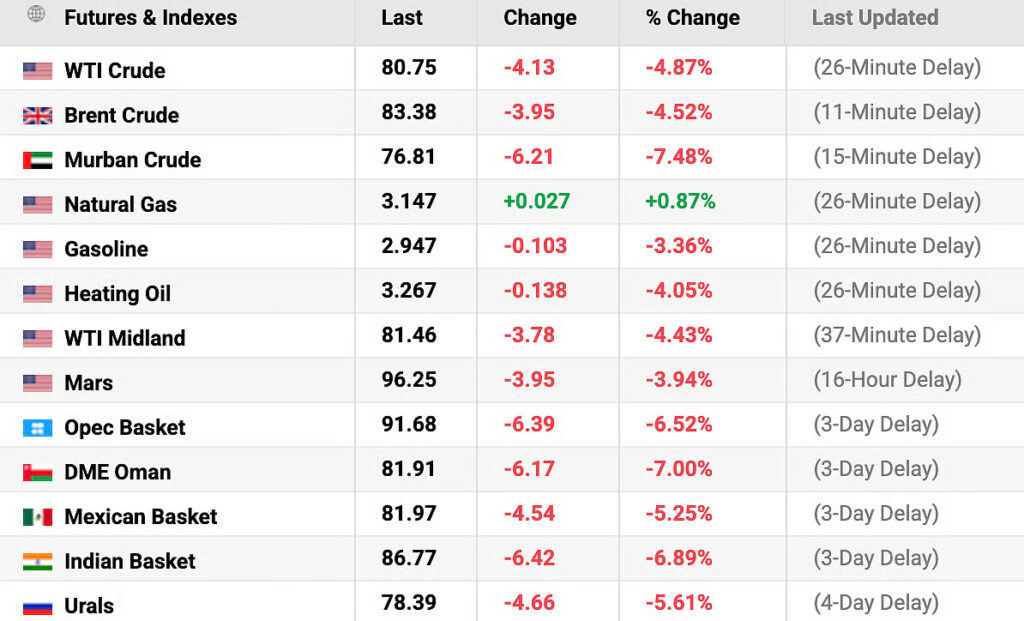
The reopening of the Strait of Hormuz has triggered an immediate reassessment of global supply risks, prompting a broad sell-off across energy markets as traders unwind the geopolitical premium built into oil prices.
Major crude benchmarks recorded steep declines:
- WTI and Brent fell around 4–5 per cent as fears of supply disruptions eased.
- Murban and other Middle Eastern crude grades dropped 6–7 per cent, reflecting their greater exposure to Hormuz-related risks.
- The OPEC Basket declined about 6.5 per cent as producers across the bloc were repriced lower.
- DME Oman, the Indian Basket and the Mexican Basket also fell between 5 and 7 per cent, highlighting the global impact of the shift in sentiment.
- Natural gas prices, however, edged up about 0.9 per cent, diverging from the broader trend due to different market fundamentals.
According to industry analysts, the price action follows a clear pattern: the more closely a crude benchmark is linked to Middle Eastern export flows and the Strait of Hormuz, the steeper the decline as concerns over supply disruptions recede.

