

Middle East tensions cushion oil prices against steeper declines amid supply glut.
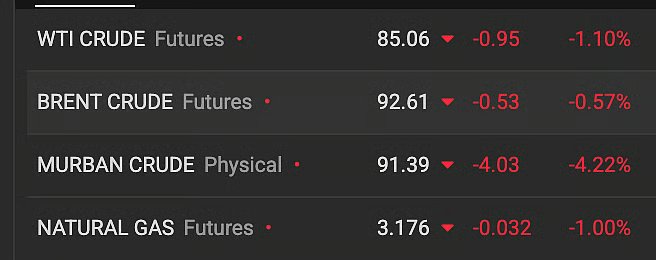
Global oil prices edged lower on Wednesday (November 18, 2026), led by Murban crude, which dropped more than 4%. West Texas Intermediate (WTI) and Brent crude also recorded losses.
Natural gas prices declined by 1%.
- WTI crude futures fell 95 cents, or 1.10%, to $85.06 a barrel.
- Brent crude futures dropped 53 cents, or 0.57%, to $92.61 a barrel.
- Murban crude (physical) declined by $4.03, or 4.22%, to $91.39 a barrel.
Brent traded at a premium of about $7.55 over WTI, while Murban was approximately $1.22 below Brent. Natural gas futures slipped 3.2 cents, or 1%, to $3.176.
Figures are as of 10.35am Singapore time on Wednesday (November 18, 2026). Prices fluctuate throughout the trading day.
Oil prices retreat
The figures indicate a broad decline across the energy commodities tracked. However, the OilPrice.com snapshot alone does not establish whether the pullback is being driven by weaker demand expectations, rising supply, geopolitical developments or profit-taking.
Why are oil prices falling?
Oil prices are facing downward pressure from improving supply expectations, rising US inventories and softer demand forecasts.
However, escalating military tensions in the Middle East are helping limit further declines.
Several factors are influencing the market, according to the latest energy industry reports.
US oil inventories rise
The latest data from the American Petroleum Institute (API) showed that:
- US crude inventories increased by 5.28 million barrels in the week ending November 13.
- Gasoline stocks rose by 5.12 million barrels.
- Distillate inventories, which include diesel, increased by 351,000 barrels.
Rising inventories generally suggest that supply is outpacing immediate consumption or that demand is weaker than anticipated. This has added downward pressure on crude prices, Reuters reported.
Middle East oil supply recovers
The International Energy Agency (IEA), in its November 13 Oil Market Report, reported a significant rebound in global oil production.
- Global oil supply rose by 2.3 million barrels per day in October, reaching 105.4 million barrels per day.
- Production has increased by 5.3 million barrels per day since August.
- Gulf crude exports have recovered faster than initially expected.
- Global oil inventories climbed by 52 million barrels in October.
The IEA expects the global oil market to return to a supply surplus in the fourth quarter of 2026.
The increase in available oil relative to demand is a bearish signal for the market, potentially keeping prices under pressure.
US-Iran conflict and Strait of Hormuz risks
Despite the downward trend in oil prices, geopolitical risks remain elevated. Reuters reported on November 18 that:
- Iran launched drone attacks targeting a US military radar installation in Bahrain.
- The US retaliated with strikes on an Iranian missile launch site on Qeshm Island.
- An LPG tanker was hit by a projectile near Oman, forcing its crew to evacuate.
- Shipping through the Strait of Hormuz remains disrupted.
- Yemen’s Houthi movement also claimed attacks targeting Saudi Arabia’s East-West oil pipeline infrastructure.
These developments threaten shipments through the Strait of Hormuz, one of the world’s most strategically important energy corridors.
The escalating conflict is adding a geopolitical risk premium to oil prices, limiting further declines despite rising inventories and expectations of a supply surplus.
What is happening to global oil supply and demand?
The IEA expects global oil demand to increase by approximately 2 million barrels per day in 2027. However, projected growth in supply is considerably stronger.
This points to the possibility of a substantial market surplus next year, provided production continues to recover and geopolitical disruptions do not intensify.
What do the individual oil prices indicate?
WTI crude – $85.06
WTI is the primary US oil benchmark. Its 1.10% decline reflects concerns over rising American inventories and expectations of increased global supply.
Brent crude – $92.61
Brent is the leading international oil benchmark, particularly important for crude traded in Europe, Africa and Asia. Its comparatively smaller 0.57% decline suggests that international supply risks are continuing to support prices.
Murban crude – $91.39
Murban is a UAE crude grade and an important benchmark for Middle Eastern oil supplied to Asian refiners.
Its 4.22% decline stands out among the three benchmarks. However, Murban’s physical price should not be directly compared with WTI and Brent futures without accounting for differences in pricing arrangements, delivery periods and market structures.
Natural gas – $3.176
Natural gas futures also fell by 1%, indicating weakness in the gas contract tracked. However, natural gas has its own supply and demand dynamics and should not automatically be viewed as moving in line with crude oil prices.

