

The expanded benefits are designed to support Emirati employment, strengthen family stability, and promote long-term growth.
The Emirati Talent Competitiveness Council (ETCC) has announced major enhancements to the Nafis Programme following its extension through 2040. The reforms introduce expanded financial support, wider eligibility criteria, and new measures aimed at strengthening family stability, increasing Emirati participation in the private sector, and boosting national talent competitiveness.
The updates align with the goals of the Year of Family 2026, reinforcing a policy focus on placing family wellbeing at the centre of economic development.
Expanded child allowance with no cap
One of the key changes is the removal of the cap on the number of children eligible under the Child Allowance Scheme for Emiratis working in the private sector. The revised policy allows families to receive financial support regardless of family size, aimed at improving quality of life and supporting long-term social stability.
In addition, the scheme now extends benefits to children of Emirati mothers working in the private sector, providing up to Dh3,000 per month in financial support and broadening the programme’s inclusivity and reach.
New salary support for families
The updated framework also introduces a Salary Support Scheme for wives of Emirati men employed in the private sector, offering monthly assistance of up to Dh3,000. Eligibility requirements include a salary range of Dh6,000 to Dh15,000, a minimum bachelor’s degree, and specific family conditions such as at least two children or five years of marriage. Exceptions are made for key professions, including healthcare workers, educators, and PhD holders from top-ranked global universities.
A parallel scheme has also been introduced for children of Emirati mothers, with eligibility set for those earning between Dh6,000 and Dh20,000 and holding an accredited bachelor’s degree.
Standardised salary threshold and updated support packages
To improve financial and career stability, the minimum salary eligibility threshold across all Nafis support schemes has been standardised at Dh6,000 per month.
Under the revised Salary Support Scheme:
- Bachelor’s degree holders may receive up to Dh6,000 per month
- Diploma holders up to Dh5,000 per month
- High school graduates up to Dh4,000 per month
- Individuals below high school level may receive up to Dh4,000 (if married or with dependents) or Dh3,000 (if single)
These changes reflect a more structured and equitable framework for supporting Emirati employees across different qualification levels.
Phased implementation starting September 2026
The new policies will take effect in September 2026 for new beneficiaries, while existing recipients will be transitioned gradually over a period of up to three years. Under the revised mechanism, current support levels will be reduced in stages by Dh500 every six months until they match the updated framework.
Special provisions will also apply to employees in free zones and sectors not regulated by the Ministry of Human Resources and Emiratisation and the Central Bank of the UAE, ensuring a smooth transition process aligned with compliance to the Dh6,000 minimum salary requirement.
Pension contributions and employer role
The Nafis Programme will continue to cover pension contributions for Emiratis working in the private sector under the “Subscription” scheme. However, from September 2026, employers will take on responsibility for their portion of pension contributions, strengthening private sector accountability and long-term sustainability.
Leadership perspective
His Excellency Ghannam Al Mazrouei said extending Nafis to 2040 reflects the UAE leadership’s long-term vision, highlighting investment in people as a key pillar of national development.
He noted that the programme has played a vital role in strengthening Emiratisation, improving the competitiveness of national talent, and enhancing labour market readiness for future needs. The latest updates, he added, introduce a more inclusive and flexible framework that aligns social and economic priorities.
Strong track record and national impact
Since its launch in September 2021 with a budget of Dh24 billion, Nafis has delivered strong results:
- Over 176,000 Emiratis have benefited from the programme
- More than 152,000 are currently employed across 32,000 private sector establishments
- Women account for 74% of beneficiaries
- Over 38,000 children have received support under the Child Allowance Scheme
In addition, thousands of Emiratis have taken part in specialised training and employment initiatives, including healthcare and skills development programmes, further strengthening workforce readiness.
A strategic shift towards inclusive growth
The latest reforms mark a strategic evolution of the Nafis Programme into a more mature, adaptable, and inclusive national framework. By linking financial support with social factors such as family structure and professional qualifications, the programme is positioned to play a central role in promoting sustainable economic growth and social cohesion in the UAE.
Nafis extended to 2040
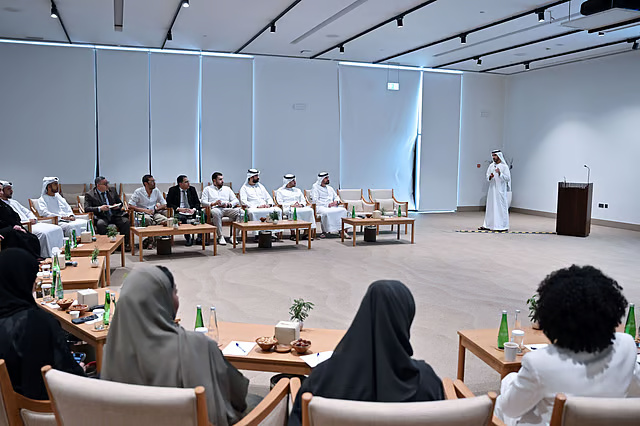
A press conference was held to announce details of the Nafis Programme’s extension through 2040, reinforcing its status as a cornerstone initiative for empowering Emirati talent and strengthening participation in the private sector.
Empowering national talent
Building a highly skilled, competitive workforce capable of innovation, while strengthening readiness to lead key future-focused sectors.
Establishing a sustainable, high-quality Emiratisation ecosystem
Transitioning from a numbers-based approach to Emiratisation towards a competence- and productivity-driven model, thereby increasing value addition in the labour market.
Enhancing job and economic stability
Reinforcing long-term employment security and supporting broader economic stability through a more structured and sustainable workforce framework.
Providing integrated support packages that ensure Emiratis remain in the private sector while improving quality of life and financial stability.
Supporting family stability and social cohesion
Implementing policies and programmes that take family needs into account, linking workforce empowerment with the overall wellbeing of Emirati families.
Aligning national talent with future economic demands
Ensuring Emirati talent is equipped and positioned to meet the evolving needs of future-focused sectors and the broader economy.
Developing future-ready skills and strengthening workforce preparedness in line with ongoing economic and technological change.
Exceptional achievements
The number of Emiratis employed in the private sector has surpassed 176,000, including 16,271 holding work permits from other entities.
More than 32,000 private sector companies have employed Emirati nationals.
Since Nafis launched in 2021, over 159,000 Emiratis have joined and remained employed in the private and banking sectors.
Since the start of 2026 alone, more than 11,000 Emiratis have entered the private sector.
Over 160,000 citizens have benefited from financial support programmes between 2021 and 2026.
A journey of success since launch
High-impact programmes and initiatives
- 46 graduates completed the Nafis Leaders Programme, designed to develop leadership skills in the private sector
- 30 participants joined the Nafis International Programme, which provides global training opportunities for Emirati talent
Training and qualification programmes
More than 3,500 students and graduates participated in the medical and healthcare sector development programme.
Over 7,700 beneficiaries enrolled in initiatives such as Kafa’at, Khibra, and other employment-focused training programmes.
More than 65,000 individual career guidance sessions were delivered to support jobseekers and private sector employees.
Key enablers
Around 90,000 job opportunities were posted on the Nafis platform to support private sector employment.
A total of 235 winners were recognised across individual and corporate categories in the Nafis Awards, highlighting excellence in the private sector.
The Nafis Youth Council comprises 15 members, acting as a key bridge of communication with young professionals in the private sector.

