

Over 25,000 sambosas are sold daily at two popular outlets as residents and visitors flock to enjoy traditional Ramadan flavors.
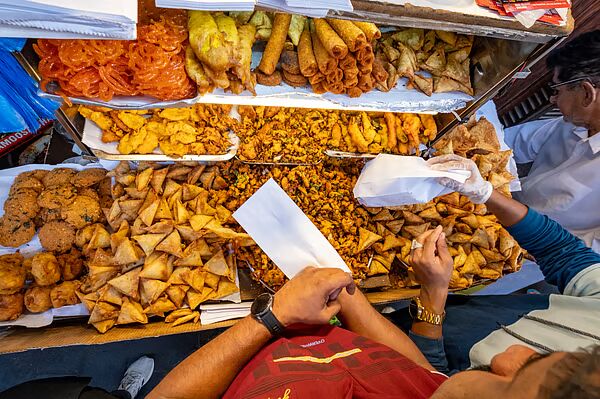
In the streets of Sidrouh, the sound of car horns mixes with the chatter of customers forming long queues outside one of the emirate’s most beloved snack shops.
As sunset approaches, residents hurry to get their share of freshly fried sambosas, prepared using traditional recipes that have stood the test of time.
During Ramadan, demand spikes significantly. At the well-known Sidrouh Restaurant, over 20,000 sambosas are sold daily throughout the holy month — double the usual fewer than 10,000 on regular days. Combined with sales from Mubarak Sweets, which prepares an additional 5,000–6,000 sambosas daily, total daily Ramadan sales exceed 25,000 sambosas across the two popular outlets.
For many families, these crisp, golden parcels have become a staple on iftar tables across the emirate.
Ashraf Ali, manager of Sidrouh Restaurant, says Ramadan is by far the busiest period of the year.
“After just the first two days of Ramadan, sales nearly doubled compared to regular days,” he noted.
While the original vegetable sambosa remains a favourite, the shop now offers three main varieties: vegetable, cheese, and cheese with chips — a flavour that has become especially popular among younger customers.
The shop’s story dates back to 1974, when it was founded by Saidali Kutty Haji as a small business primarily specialising in vegetable sambosas. Over the decades, it has grown steadily and is now run by his sons, who continue the family legacy while expanding the menu to meet rising demand.
Beyond sambosas, the shop offers more than 10 different snacks. During Ramadan evenings, favourites such as Pakkavada, Jalebi, and egg bhaji see a notable spike in sales as Maghrib approaches.
On regular weekdays during Ramadan, most customers are Ras Al Khaimah residents, while weekends attract visitors from other emirates, drawn by the shop’s long-standing reputation and distinctive flavours.
Among those waiting patiently in line was Ahmed Al Mehairi, a resident of Ras Al Khaimah, who described visiting the shop as part of his Ramadan ritual.
“The queue usually starts building from around 3 pm, and by 4:30 pm it’s already crowded,” he said. For Al Mehairi, the appeal lies not only in taste but in tradition.
“These are the flavours people grew up with,” he added. “The vegetable and cheese sambosas are always popular.”
He noted that the queues extend beyond local residents.
“On weekends, people come from Sharjah and Ajman just to experience Ramadan in Ras Al Khaimah,” he said. “They want to enjoy the atmosphere and the authentic taste of these sambosas. The shop still uses traditional methods, which is what makes it unique. It’s rare to find this kind of taste nowadays.”
Despite the expanded menu, sambosas remain the undisputed bestseller, particularly the cheese, cheese with chips, and vegetable varieties, maintaining a tradition that has defined the shop for more than five decades.
Across town in Dahan, Ras Al Khaimah, preparations at Mubarak Sweets begin long before customers start lining up.
Abu Al-Qasim, manager of Mubarak Sweets, said sambosas make up the largest share of sales during Ramadan.
“We prepare between 5,000 and 6,000 sambosas daily,” he said. “Cheese and vegetable are the favourites — these are the first to sell out.”
In addition to sambosas, the shop offers Pakora and sweet treats such as Jalebi, which also see consistent demand throughout Ramadan.
The workflow is carefully organised to handle the afternoon rush. According to Abu Al-Qasim, preparation begins the night before, with sambosas assembled and stored in refrigeration and freezers to preserve freshness, while Baqoura is prepared in the morning.
“We begin organising everything the night before,” he explained. “About two hours before customers arrive, we start the final frying process.”
The busiest period begins around 4 pm, with crowds steadily increasing until Maghrib. By iftar, most of the day’s stock is completely sold out.
As Ramadan evenings unfold in Ras Al Khaimah, the queues outside these shops reflect more than just demand. They tell a story of tradition, community, and flavours that have become inseparable from the spirit of the holy month — one sambosa at a time.

