

After returning from work, he feeds the cats and appeals to volunteers for support.
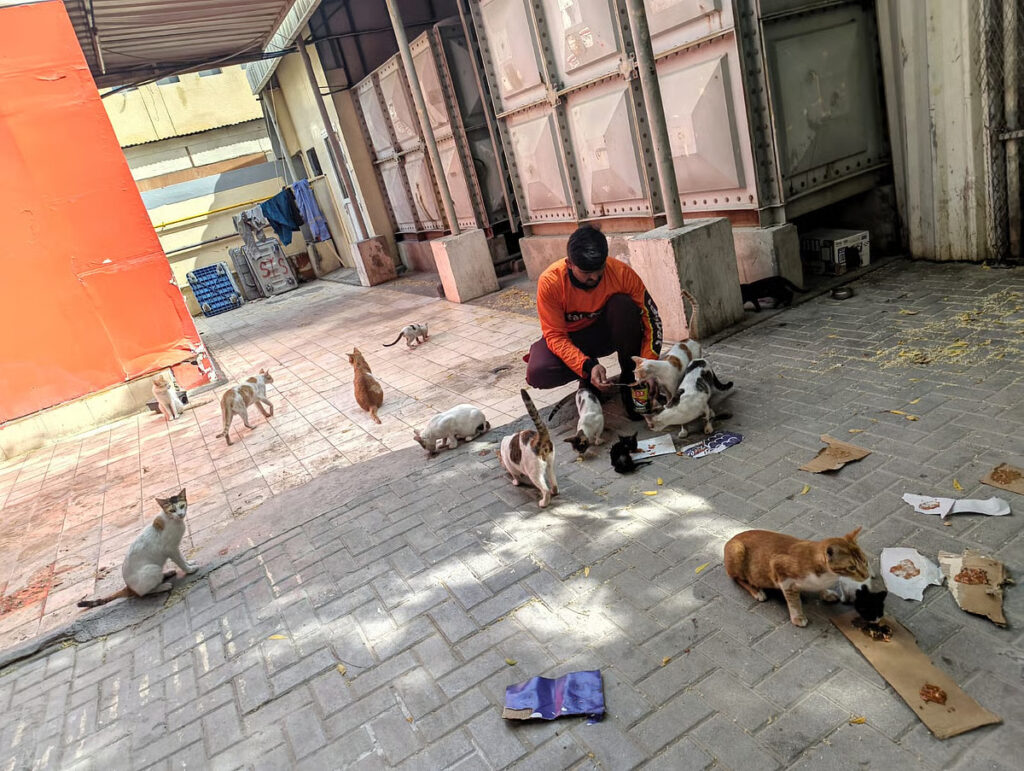
Kaleem Gul’s workday looks a little different from most. By day, he works across Dubai as a Talabat delivery rider; by evening, he returns to a different responsibility — caring for more than 70 stray cats near his home in Al Quoz Industrial Area.
It is a routine that never stops. The cats rely on him for food, attention and, when things go wrong, urgent help. Whether it is injuries, illness or disappearances, he responds as best he can, often turning to volunteer WhatsApp groups for support when cases become too difficult to handle alone.
A little shy at first, Kaleem Gul shares his story in brief moments: “I’ve been in Dubai since 2018.” Over time, he noticed a growing number of abandoned cats in the area — some wandering between warehouses and construction sites, others struggling to find food.
“There were so many stray cats just roaming around, trying to survive,” he says.
Kaleem Gul connected with animal rescue volunteers across the UAE through WhatsApp networks and began reaching out for help whenever needed. He also set up a Facebook group to request food donations for the cats, building a small but steady support system around them.
“I also created a Facebook group so people could donate food,” he says.
That network has been strengthened by Amal CSR, a DED-registered initiative that connects corporate social responsibility efforts with causes such as animal welfare and environmental sustainability. With its support, food donations are organised and, when possible, medical treatment is arranged, with volunteers covering the costs.
An entire ecosystem of stray cats
Sylvia Chandel, an animal rescuer with nearly two decades of experience and a member of several rescue networks, recalls first seeing Kaleem Gul’s messages in these groups, alongside support from fellow volunteers Crystal Borhade, Rupsa Mukerjee, Rakhi Choudhary and Emma Smith.
“He sends photos of the cats and updates on their condition,” she says. “We try to respond with food, and when needed, we coordinate vet visits or sterilisation.”
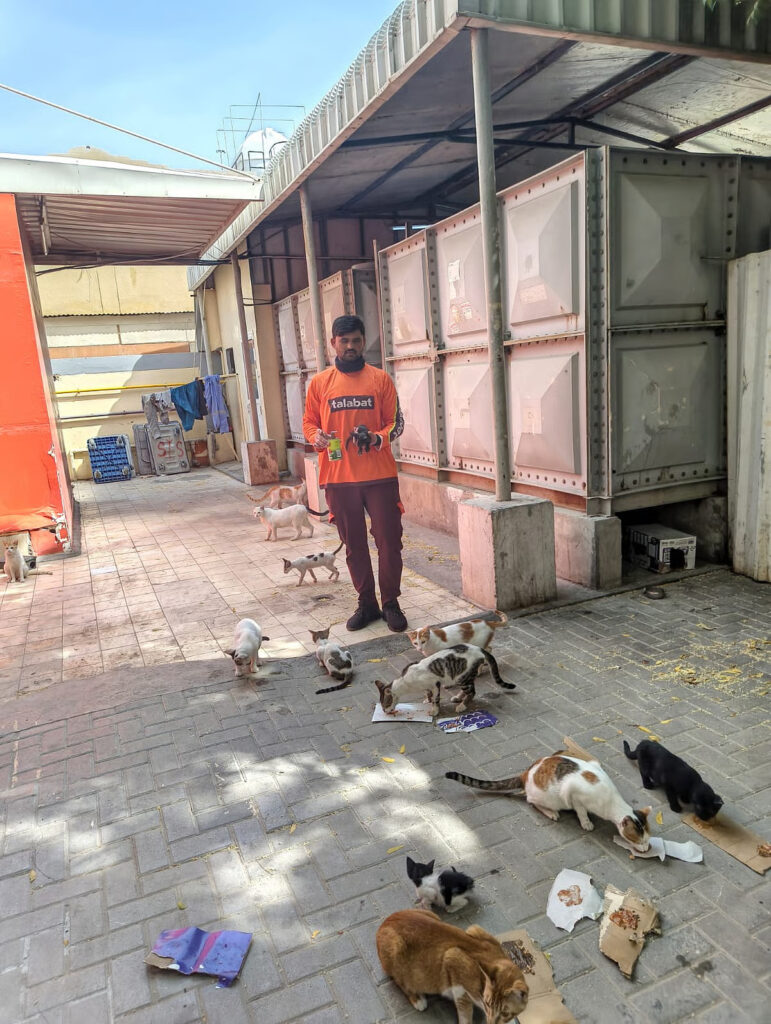
She describes Al Quoz as home to a complex, often unseen stray cat ecosystem. “There’s an entire population of cats in these industrial pockets,” she explains. Volunteers try to intervene where they can, especially through TNR.
Trap-neuter-return (TNR), she adds, remains the most widely accepted humane method for managing stray cat populations in Dubai, helping prevent uncontrolled breeding while allowing the animals to remain in their environment.
The night shift of care
Kaleem Gul is one of several people working quietly to care for stray cats in the area. In another part of Al Quoz, Fatima Younesi begins her second shift after finishing her household duties in the evening.
By 6pm, she is already on the streets, moving between buildings and community spaces, feeding and checking on stray cats. She says there are more than 100 cats in the area that she regularly sees.
“I’ve been doing this for so long. There are so many, between the buildings and near the community centre,” she says. Her work often continues deep into the night. “I do this till 3am, sometimes till 6am.”
She describes frequent cases of abandonment, with cats left behind without warning. Like Gul, she relies on volunteer networks to seek medical help and coordinate trap-neuter-return (TNR) efforts whenever possible.
To support these initiatives and help these cats find homes, residents are encouraged to contact Amal CSR.

