

Dubai: Gold prices in Dubai declined on Tuesday morning, offering jewellery buyers a more attractive entry point after a volatile month in which local rates have fluctuated by more than Dh40 per gram.
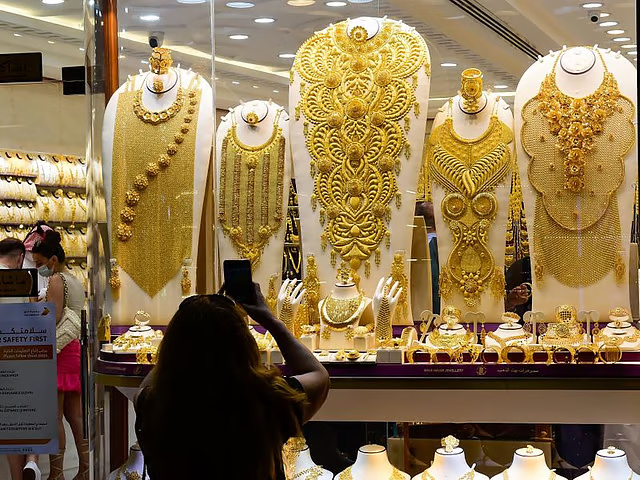
The price of 24-karat gold fell to Dh496.25 per gram at 10:35am on Tuesday, down from Dh506 on Monday. Meanwhile, the more widely purchased 22-karat gold dropped to Dh459.50 per gram, compared with Dh468.50 a day earlier.
The latest decline has pushed 24-karat gold below the Dh500-per-gram mark for the first time since June 10, when it was priced at Dh492.50.
Gold began the month at Dh539.75 per gram on June 1 and rose to Dh542.50 on June 2 before easing to Dh538.50 on June 4 and Dh522.50 on June 5. Prices remained above Dh520 for much of the first week of June before dropping to Dh514.25 on June 9 and then sliding sharply to Dh492.50 on June 10, one of the steepest declines recorded this month.
The precious metal later rebounded, reaching Dh508.50 between June 12 and 14, before climbing further to Dh521.25 on June 15 and Dh522.25 on June 16. However, the upward momentum proved short-lived, with prices easing to Dh508.25 on June 17 and Dh509.25 on June 18.
Gold then slipped to Dh500 on June 19, hovered around Dh500.75 over the weekend, edged up to Dh506 on Monday, and retreated once again on Tuesday, extending its recent volatility.
At Tuesday’s rates, 24-karat gold is Dh46.25 per gram lower than its June 2 peak of Dh542.50, while 22-karat gold has fallen by Dh42.75 per gram from Dh502.25 on the same date, highlighting the sharp correction in local gold prices over the past three weeks.
Fed concerns weigh on gold
Gold came under pressure as persistent inflation worries overshadowed early optimism surrounding negotiations aimed at ending the Iran conflict. The precious metal fell by as much as 1.8 per cent to around $4,115 an ounce, reversing a modest gain recorded in the previous session.
Rising consumer prices, partly linked to nearly four months of tensions in the Middle East, have fuelled expectations that central banks could keep interest rates higher for longer or even consider additional policy tightening. Such a scenario is typically negative for gold, as the non-yielding asset becomes less attractive when returns on cash and fixed-income investments remain elevated.
The hawkish stance adopted by new Federal Reserve Chair Kevin Warsh has also weighed on investor sentiment, offsetting some of the optimism generated by the interim US-Iran peace agreement signed last week. Meanwhile, the US dollar has strengthened by more than 1 per cent since the Fed’s most recent meeting, adding further pressure on gold, which is priced in the greenback.
Gold has fallen by more than 20 per cent since the conflict began at the end of February, while silver has declined by roughly one-third over the same period. Investors are now focused on the release of the US Personal Consumption Expenditures (PCE) Price Index on Thursday, with markets expecting inflation to show signs of acceleration.
According to Linh Tran, gold remains vulnerable to further weakness in the near term as the market has yet to find sufficient momentum for a sustained recovery.
“The main pressure still comes from expectations around Fed policy, with interest rates likely to stay elevated for longer than previously anticipated,” Tran said. “This keeps the opportunity cost of holding gold high, limiting the appeal of the precious metal.”
Tran noted that the US dollar has remained relatively firm, with the US Dollar Index (DXY) hovering between 100.6 and 100.8, while the yield on the benchmark 10-year US Treasury note has stayed elevated near 4.5 per cent.
“The combination of a resilient dollar and high real yields continues to create a significant headwind for gold, especially as short-term capital flows tend to favour yield-bearing assets over non-yielding ones,” Tran said.
At the same time, easing geopolitical tensions have reduced demand for traditional safe-haven assets. While gold previously benefited from defensive positioning amid heightened uncertainty, the recent cooling in tensions has weakened safe-haven buying, limiting the metal’s ability to sustain upward momentum.
Tran also pointed to continued outflows from gold-backed exchange-traded funds (ETFs) in May, suggesting that institutional and financial investment demand has yet to stage a meaningful and sustained recovery.

