

A new federal policy now requires thousands of immigrants to leave the US and return to their home countries before applying for green cards. Here’s a breakdown of what the memo actually states—and what it does not.

The US Citizenship and Immigration Services (USCIS) has introduced a new policy directing certain foreign nationals seeking to adjust their immigration status and obtain a green card to leave the US and apply through an American mission in their home country, unless “extraordinary relief” is granted.
An immigration attorney based in Dubai told Khaleej Times that the announcement has triggered anxiety within immigrant communities, describing the “quiet but consequential” USCIS update as one that “landed like a stone in still water.”
“Imagine spending years building a life in the US—your apartment, your job, your children enrolled in school, and routines that slowly become home,” said Shai Zamanian, legal director at The American Legal Center and an EB-5 investor visa specialist. “Then imagine being told you may have to return to your home country, attend an embassy interview, and essentially seek permission to re-enter the life you’ve already built.”
The anxiety is palpable, and the green card waiting game has become even more uncertain. So, should immigrants be preparing to leave the US and return home?
“Don’t panic, but do pay attention,” advised Shai Zamanian, legal director at The American Legal Center and an EB-5 investor visa specialist, who explained the reasoning behind the new guidance.
Why the sudden procedural change?
According to the US Citizenship and Immigration Services (USCIS), the policy reflects the application of long-standing laws and prior court rulings. It requires certain non-immigrant visa holders who wish to become permanent residents to return to their home countries and apply through US consular offices, unless extraordinary circumstances apply.
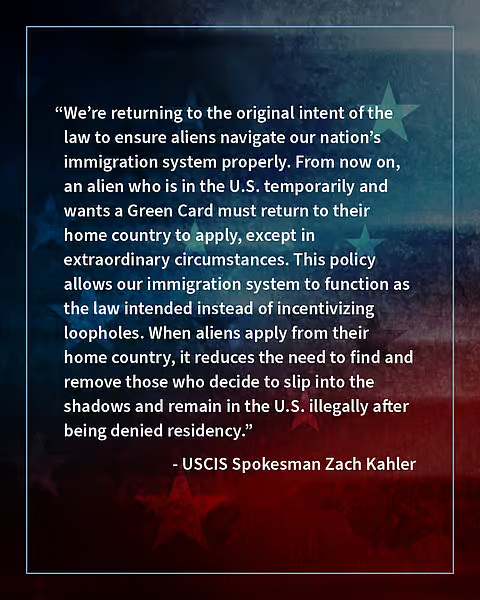
USCIS spokesperson Zach Kahler said non-immigrant visa holders—such as students, temporary workers, or tourists—are expected to leave the US once their authorised stay ends, and their visit should not serve as an initial step toward permanent residency.
He added that the system is being realigned with its original intent to ensure proper use of immigration channels and to discourage overstays or unlawful stays. Processing applications abroad, he said, also helps reduce the burden on USCIS and allows it to focus on other priorities, including visas for victims of crime, humanitarian cases, and naturalisation.
Under the policy, adjustment of status within the US would be granted only in “extraordinary circumstances”.
What does “extraordinary relief” mean?
Zamanian explained that adjustment of status has long allowed eligible individuals already in the US to apply for permanent residency without leaving the country.
In contrast, consular processing requires applicants to return to their home countries for embassy interviews, a process that can be slower, less predictable, and logistically difficult for individuals with established careers, families, and financial commitments in the US.
He noted that the current shift reflects a stricter interpretation of immigration rules, with officials in Washington arguing that embassy-based processing allows for more thorough scrutiny of applicants.
What the memo actually says—and doesn’t
Zamanian cautioned that the memo does not eliminate adjustment of status or change eligibility criteria. Instead, it reinforces that approvals are discretionary and that meeting basic requirements is no longer a guarantee of approval.
Officers are now instructed to consider the “totality of circumstances,” including immigration history, visa compliance, moral character, and family ties.
However, he noted that the memo does not penalise applicants simply for holding dual intent visas, which legally allow individuals to pursue permanent residency while in the US on temporary status.
What applicants should do
“Don’t panic, but do pay attention,” Zamanian reiterated, advising GCC-based students, professionals, and investors to remain calm but alert.
He said many families in the UAE and wider GCC region have long viewed US education and investment pathways as structured routes to residency, but the evolving policy environment may require closer attention to compliance and planning.
He also cautioned against drawing premature conclusions, noting that such policy announcements are often revised, clarified, or challenged in court before full implementation.
“If implemented strictly, the policy could affect tens of thousands of individuals already in the US, which would likely trigger federal legal challenges,” he said, adding that immigration litigation has become common in recent years.
‘Plan carefully and stay compliant’
Zamanian added that further category-specific guidance is expected, which may differentiate rules for students, investors, and family-based applicants.
“For now, the best approach is to plan carefully, stay compliant, and consult reliable legal counsel,” he said. “The green card remains attainable, but it may require more careful navigation than before.”

