

The route will provide mobility for both citizens and residents, while also allowing authorities to open alternative pathways during emergencies.
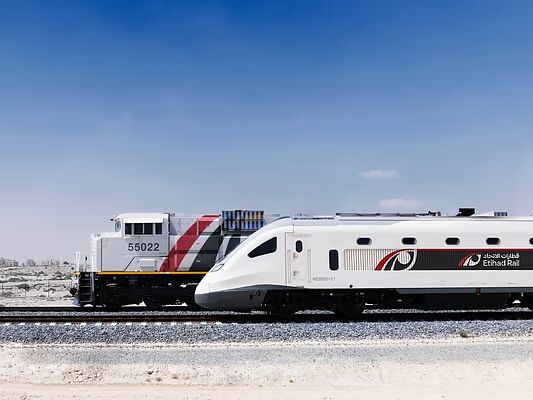
Etihad Rail has operated a passenger train as part of its trial runs on the route connecting Al Ghuwaifat station at the Saudi border and Al Faya station in Abu Dhabi, in coordination with the Emergencies, Crises and Disasters Management Centre – Abu Dhabi (ADCMC). The initiative is designed to support continuity of vital services and provide safe, reliable transport alternatives amid recent regional developments.
The link between Al Ghuwaifat and Al Faya is strategically significant, enhancing the geographical connection between the UAE and Saudi Arabia, facilitating mobility for both nationals and residents, and enabling authorities to activate alternative routes during emergencies under approved response plans.
This passenger trial forms part of a broader set of operational and proactive measures aimed at strengthening logistical security and ensuring integrated response capabilities, guided by continuous risk assessments and coordinated across relevant authorities.
The initiative supports the continuity of vital services while offering safe and reliable transport alternatives, guided by ongoing risk assessments and evolving circumstances.
The connection between Al Ghuwaifat and Al Faya stations is strategically important, enhancing the geographical link between the UAE and Saudi Arabia and ensuring smooth movement to and from key ports. The route facilitates mobility for both nationals and residents and allows authorities to activate alternative pathways in line with approved emergency response plans.
Etihad Rail Trial Highlights Strategic Readiness and Transport Flexibility in Abu Dhabi
The operation of the passenger route between Al Ghuwaifat and Al Faya forms part of a broader set of operational and proactive measures implemented in coordination between the Emergencies, Crises and Disasters Management Centre – Abu Dhabi (ADCMC) and relevant authorities. These initiatives are designed to integrate roles, strengthen logistical security, and support business continuity under multi-scenario risk management frameworks.
Matar Saeed Al Nuaimi, Director General of ADCMC, emphasised that the development and readiness of transport options are a key component of Abu Dhabi’s comprehensive response ecosystem. He noted that all developments are managed within clear governance frameworks and integrated coordination mechanisms across vital sectors, ensuring rapid adaptation and efficient resource use.
He added that the flexibility of the transport sector is critical to societal stability, as it is directly linked to the continuity of essential services. ADCMC will continue to monitor developments and analyse relevant indicators around the clock to enhance Abu Dhabi’s preparedness and reinforce public confidence in the effectiveness of the response ecosystem.
Eng. Mohammed Al Shehhi, Chief Projects Officer at Etihad Rail, said:
“The operation of passenger services between Al Ghuwaifat and Al Faya as part of the trial demonstrates the readiness and flexibility of the UAE’s national railway network, designed to ensure the continuity of vital services in all circumstances.”
He noted that the initiative aligns with the directives of the country’s leadership to strengthen the national transport ecosystem and enhance its strategic role in supporting society, under the guidance of Sheikh Theyab bin Mohamed bin Zayed Al Nahyan, Chairman of Etihad Rail.
“We are proud to support the joint response efforts led by relevant authorities, providing safe, reliable, and well-organised transport solutions at a time when the continuity of the national transport network is crucial. Our teams continue to collaborate closely with government partners to maintain sustainable operations, enhance traffic flow, and support the readiness of the national transport ecosystem,” Al Shehhi added.
The operation of this route reflects a proactive institutional approach, based on advance planning and the timely activation of alternative options when required. It strengthens infrastructure resilience and enhances the emirate’s ability to respond effectively to evolving circumstances.
The trial demonstrates that Abu Dhabi’s response framework goes beyond preventive measures and field coordination. It includes timely operational decisions that enhance service efficiency, ensure smooth movement, and translate risk assessments into practical solutions, supporting vital sectors while reinforcing service continuity and infrastructure readiness.

