

How 1.8-Metre ‘FloodWall’ Barriers Are Protecting Dubai Metro from Heavy Rain.
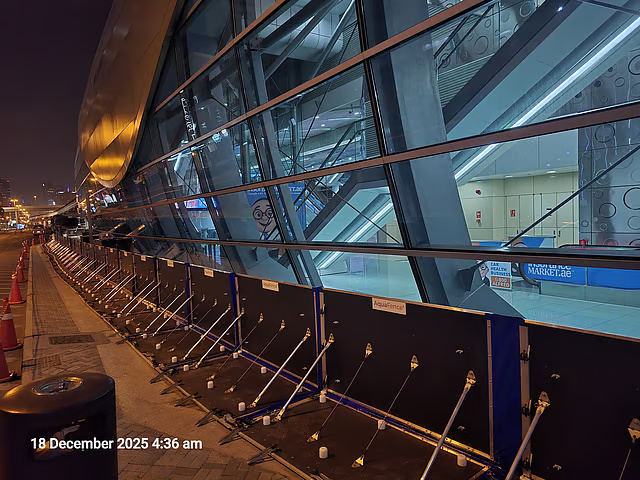
Dubai: If you’ve recently visited Dubai Metro stations such as OnPassive, you may have noticed sturdy barriers installed at the entrances ahead of heavy rain and strong winds. These are not temporary measures—they form part of a carefully planned system developed from lessons learned during one of the UAE’s most significant weather events.
Why barriers have been installed outside some Dubai Metro stations
On April 16, 2024, the UAE experienced its heaviest rainfall in 75 years. The deluge overwhelmed infrastructure at several Dubai Metro stations—including OnPassive, Equiti, Mashreq, and Energy—forcing operations to halt as floodwaters inundated the surrounding areas.
In response, Dubai’s Roads and Transport Authority (RTA) quickly assessed the network to identify the most vulnerable points. Several above-ground stations were located in low-lying areas prone to rapid water accumulation, highlighting the urgent need for a practical, deployable solution.
The solution came in the form of FloodWall, a flood barrier system developed by Norwegian company AquaFence, which has extensive experience safeguarding critical infrastructure against extreme weather.
Dubai-based Avalon Access Technical Services, in a joint venture with AquaFence, won the contract to supply and install the system for the RTA. The barriers—called FloodWall—are installed at heights of 1.2 and 1.8 metres, forming protective perimeters around four of the Metro’s most flood-prone stations.
“The solution was installed at four low-lying Metro stations, including OnPassive and Equiti,” said Mujeeb Karim, Head of Operations at Avalon Access Technical Services, in an interview with Gulf News. “These above-ground stations are located in areas that collect water very quickly.”
He explained, “If water does accumulate inside or outside the barrier, pumps are used to remove it. The system helps manage flooding at stations like OnPassive, where even modest rainfall can otherwise find a way in.”
Water ingress at Metro stations carries risks beyond mere inconvenience: it can cause power disconnections and damage electrical and operational systems, potentially taking a station out of service for days.
Since the barriers were installed after the 2024 floods, Karim noted that damage at the affected stations has been significantly reduced. “We, along with the RTA, implemented this after the 2024 floods, and since then we have prevented and reduced damage to these stations,” he said.
“Rather than merely holding water back, the FloodWall system directs water away from vulnerable assets toward designated drainage areas,” explained Mujeeb Karim, Head of Operations at Avalon Access Technical Services.
He added, “Once deployed, aluminium rubber seals along the base of the barriers prevent water from seeping into the protected structure.”
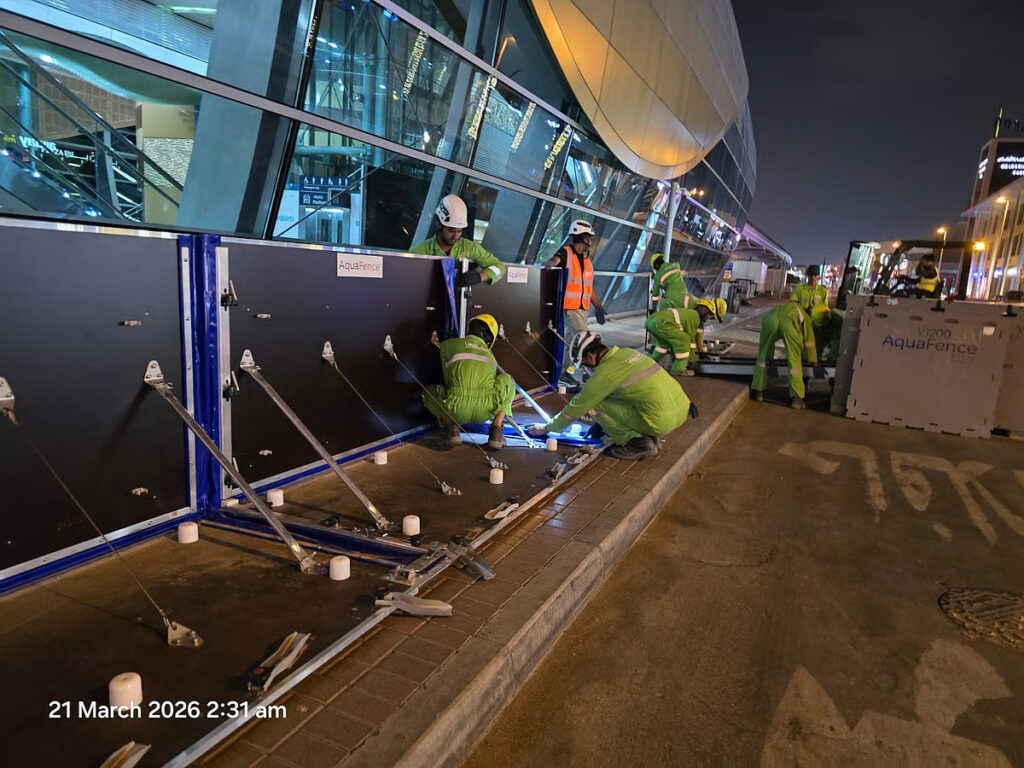
What is FloodWall and how does it work?
Mujeeb Karim, Head of Operations at Avalon Access Technical Services, explained that FloodWall operates on a principle of redirection rather than simple containment. “Rather than merely holding water back, the system guides flow away from vulnerable assets toward designated drainage areas. Once deployed, aluminium rubber seals along the base prevent water from flooding into the protected structure.”
Karim highlighted the system’s environmental benefits. Unlike traditional sandbags—which are single-use and generate tonnes of contaminated waste after each flood—FloodWall is fully reusable, certified for over 60 deployments, and leaves no permanent trace on the infrastructure it protects.
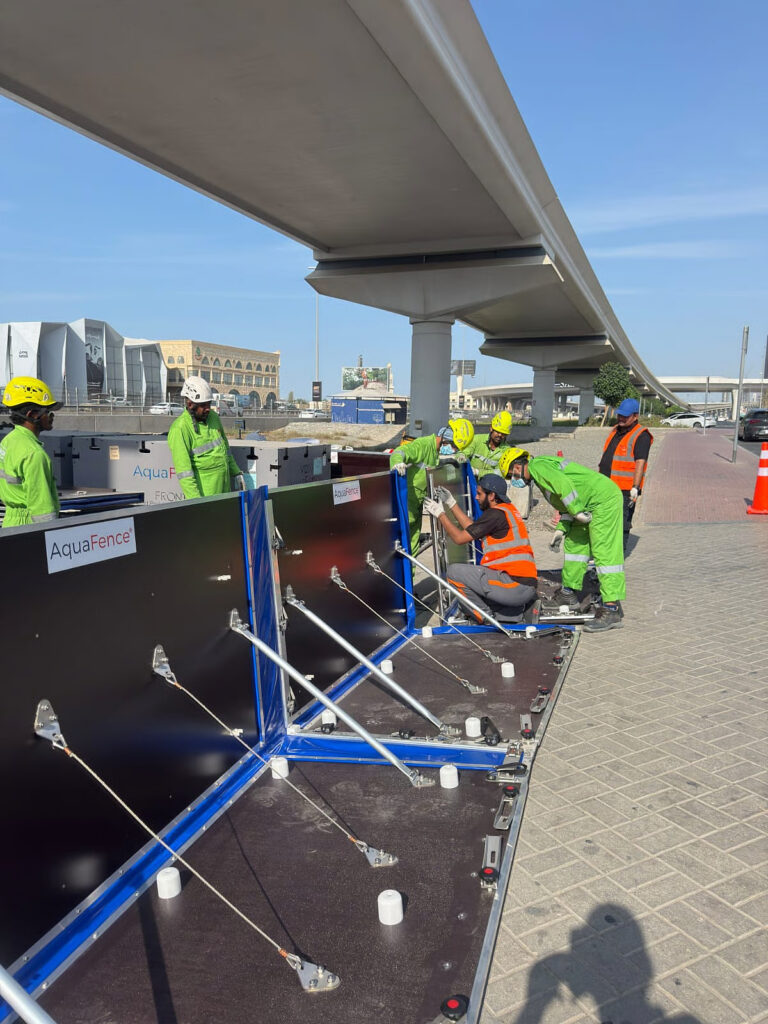
After each weather event, the barriers are dismantled, jet-washed, and returned to storage, ready for the next deployment. “The system produces zero waste and requires no structural modifications to existing buildings or stations. It’s a clean, responsible solution that aligns with the UAE’s Net Zero 2050 vision and Dubai’s commitment to smart, sustainable city infrastructure,” he added.
The FloodWall system is also FEMA-compliant, meeting the standards of the US Federal Emergency Management Agency. In 2024, Tampa Bay, Florida, used AquaFence barriers to protect the city’s only trauma center from severe storms—a setup installed by 60 people in three days, capable of withstanding 15-foot storm surges and winds up to 130 mph.
Environmentally friendly and reusable: FloodWall’s edge
“What makes the FloodWall solution particularly well-suited to Dubai’s sustainability ambitions is its environmental design,” said Mujeeb Karim, Head of Operations at Avalon Access Technical Services. “Unlike traditional sandbags, which are single-use and generate tonnes of contaminated waste after each flood event, the FloodWall system is fully reusable, certified for over 60 deployments, and leaves no permanent trace on the infrastructure it protects.”
How Dubai is strengthening flood prevention
FloodWall is part of a broader effort by the RTA to prepare for extreme weather. In December 2024, the authority confirmed that permanent flood prevention measures had been implemented across the network, addressing vulnerabilities at low-lying stations.
That same year, the RTA also launched a Joint Flood Management Room, one of the largest control centres of its kind, to monitor water accumulation in real time and coordinate responses across traffic and transport during heavy rainfall.
Since the April 2024 storms, Dubai has launched a long-term flood defence investment programme targeting 30 key areas across the emirate, covering 430 million square metres—an area expected to house three million residents by 2040.
Valued at Dh2.5 billion, the programme includes:
- Construction of four-metre tunnels linking high-risk neighbourhoods to the main drainage network
- Extension of drainage infrastructure by over 27 kilometres
- Addition of strategic pumping stations at critical locations
Major roads—including Sheikh Zayed Road, Sheikh Mohammed bin Zayed Road, Al Yalayis Road, and the Dubai–Al Ain Road—will benefit from enhanced flood protection.
A standout feature of the programme is the creation of a strategic lake designed to collect stormwater from Dubai’s fastest-growing residential areas, providing a dedicated buffer against future heavy rainfall events.

