

China’s underwater data hub uses 95% renewable energy to address data centre cooling challenges.
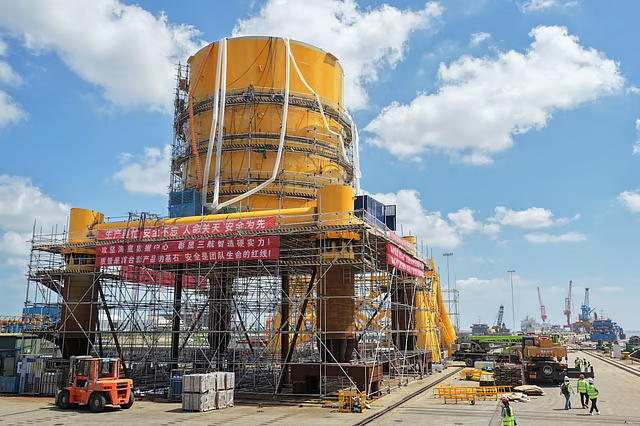
DUBAI: China has become the first country in the world to operate an underwater data centre powered by offshore wind energy, marking a milestone that could transform how the global tech industry addresses the growing challenge of cooling data infrastructure efficiently.
The Shanghai Lingang Undersea Data Centre is located about 30 feet below sea level, roughly 10 km off the southern coast of Shanghai in the Lingang Special Economic Zone. Built at an estimated cost of around $226 million, the project is a joint venture between HiCloud Technology, a private subsea infrastructure firm, and China Communications Construction Company, a state-owned enterprise.
The facility taps offshore wind power and is designed to run on about 95% renewable energy, offering a potential solution to the high energy and water demands of conventional data centres.
Running a data centre is costly not only because of the power needed to operate servers, but also because of the energy required to keep them cool and prevent overheating.
In traditional land-based facilities, cooling alone can account for around 40–50% of total electricity consumption, according to Wired. Many systems rely on continuous circulation of chilled water and air-conditioning to regulate temperatures around the clock, especially in high-density server environments.
The Shanghai Lingang Undersea Data Centre reduces the need for conventional cooling systems by being submerged underwater, where the surrounding ocean naturally helps dissipate heat and significantly lowers reliance on energy-intensive air conditioning.
Instead of drawing power from conventional grids, the facility is connected to a nearby offshore wind farm, with over 95% of its electricity coming from renewable sources.
According to the Chinese government, compared to traditional onshore data centres, the project achieves:
- More than 95% green electricity usage
- Around 22.8% reduction in energy consumption
- 100% elimination of freshwater use for cooling
- Over 90% reduction in land usage
This matters because data centres are essentially the physical backbone of modern computing and Artificial Intelligence (AI), and their resource demands are increasing rapidly.
As AI systems become more widely used, they require large clusters of servers that run continuously, consuming significant amounts of electricity and generating intense heat. This puts pressure on energy grids, increases carbon emissions when fossil fuels are involved, and drives up operational costs.
Innovations like underwater or renewable-powered data centres aim to reduce this impact by cutting energy use, improving cooling efficiency, and lowering reliance on fresh water and land. In that sense, they represent a shift toward more sustainable infrastructure for the next generation of digital and AI-driven services.
Traditional land-based data centres typically use significant energy for cooling, with around 25–40% of total electricity demand going toward circulating chilled water and preventing server overheating, according to The Guardian. They also consume large volumes of fresh water for cooling systems.
The United Nations University Institute for Water, Environment and Health warned on June 3 that global data centre water use could reach 9.3 trillion litres annually by 2030, driven largely by rising AI demand. Subsea data centres address this challenge by eliminating the need for freshwater cooling altogether.
This idea has been explored before. Microsoft tested a similar concept through its Project Natick, placing a data centre pod underwater off the coast of Scotland. While the results were technically successful, the project was discontinued in 2024 due to cost considerations and the complexity of maintaining submerged systems.
China has since advanced the concept commercially. HiCloud Technology previously launched the world’s first commercial underwater data centre in Hainan in 2023, though it was not powered by offshore wind. The Shanghai Lingang Undersea Data Centre is the first to combine subsea infrastructure with offshore wind power at commercial scale.
For an industry increasingly pressured to cut energy and water consumption, underwater data centres present a promising alternative.
However, important questions remain around long-term maintenance costs, scalability in different environments, and whether the model is economically viable beyond state-backed projects. While the technology has demonstrated that it can function, it is still uncertain whether it can be adopted widely and made commercially sustainable for all operators.

