

Guangzhou-born artist combines Chinese paper-cutting traditions with Arabian symbols in a Lunar New Year cross-cultural showcase.
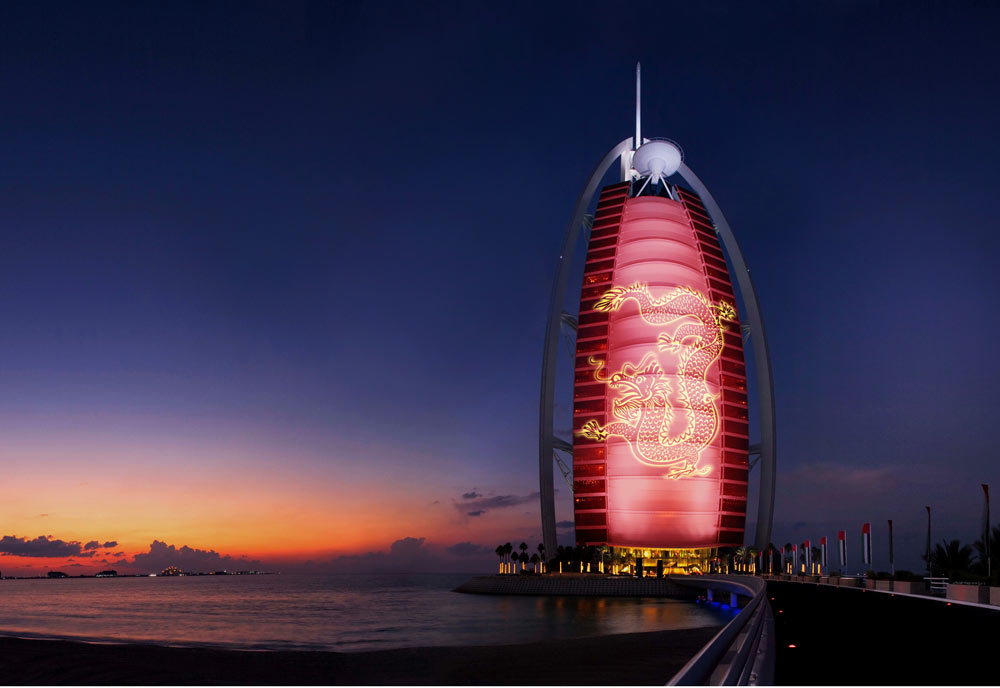
Red lanterns, zodiac motifs, and festive displays filled Dubai as the city welcomed the Chinese New Year on February 17. At the Burj Al Arab, however, the celebration took a different form—through light, movement, and the delicate art of paper.
To mark the Year of the Horse, Chinese artist Jackie Wen was invited to transform the iconic landmark with a large-scale projection and a series of installations throughout the hotel. During her visit, Khaleej Times spoke with the Guangzhou-born artist about introducing traditional Chinese paper-cutting into a new cultural context and onto one of Dubai’s most recognisable backdrops.
Wen’s exploration of paper began during her university years, where she first encountered the material while studying art.
“That was when I realized how versatile paper could be,” she said. “Paper cutting is a traditional Chinese art form, and I felt a responsibility to bring it into the contemporary world and give it new life.”
For Wen, paper is more than just a medium. It embodies cultural memory while also offering possibilities for movement, depth, and emotion when reinterpreted through modern techniques.
A Shared Symbol Across Cultures
The Year of the Horse became the centerpiece of Wen’s project, chosen not only for its place in the Chinese zodiac but also for its universal symbolism.
“In both Chinese and Arabian traditions, the horse represents courage, loyalty, and strength,” Wen explained.
Her inspiration drew from the equestrian sculptures at Jumeirah Al Qasr, which she reimagined as layered paper patterns and flowing visual forms. The final projection traces a symbolic journey from China to Dubai, reflecting the historic Silk Road and the enduring cultural exchanges between the regions.
For Wen, who continues to live and work in her hometown of Guangzhou—a historic starting point of the ancient maritime Silk Road—the collaboration held personal significance.
“It feels like acting as a bridge between cultures, through both art and friendship,” she said.
Despite the digital scale of the final installation, Wen’s creative process begins in the traditional way: ideas first form in her mind, then are sketched and developed into intricate paper-cut patterns. The artwork itself took roughly two to three weeks to complete, though concept development and cultural research with the Jumeirah team took longer as both sides worked to identify symbols and visual elements that resonate across cultures.
Delicate but Strong
Among the hotel’s installations is one of Wen’s signature motifs: the jellyfish. Suspended within transparent domes, the layered paper forms appear to float, creating movement despite the fragile medium.
“The jellyfish represents modern women,” she said, “graceful and delicate on the surface, yet strong and resilient beneath.”
This theme reflects a broader exploration in her work, challenging perceptions of paper as weak. In her ongoing Beyond the Boundary series, she experiments with placing paper sculptures underwater and even incorporating fire in performance pieces, exploring transformation and renewal under extreme conditions.
“Paper may look soft and fragile,” she said, “but it can express strength, movement, and emotion.”

