

Analysts say oil markets are still susceptible to renewed Gulf tensions, even after prices retreated.
Oil prices remained under pressure in early Asian trading on Thursday as investors continued to unwind the geopolitical risk premium that had lifted crude during the recent Israel-Iran conflict. Global benchmarks posted notable losses by 8:37 a.m. Tokyo time (June 25).
Brent crude fell $3.34, or 4.33%, to $73.74 a barrel, while US West Texas Intermediate (WTI) declined 44 cents, or 0.63%, to $69.90.
Other regional benchmarks also weakened. Murban crude dropped 4.57% to $66.45, WTI Midland fell 4.09% to $70.66, the Indian Basket slipped 3.96% to $75.28, and Russia’s Urals crude declined 3.24% to $64.42, reflecting broad-based selling pressure across the oil market.
Refined fuel markets also moved lower, mirroring the broader weakness in crude oil. Gasoline futures slipped 0.52%, while heating oil futures fell 0.64%.
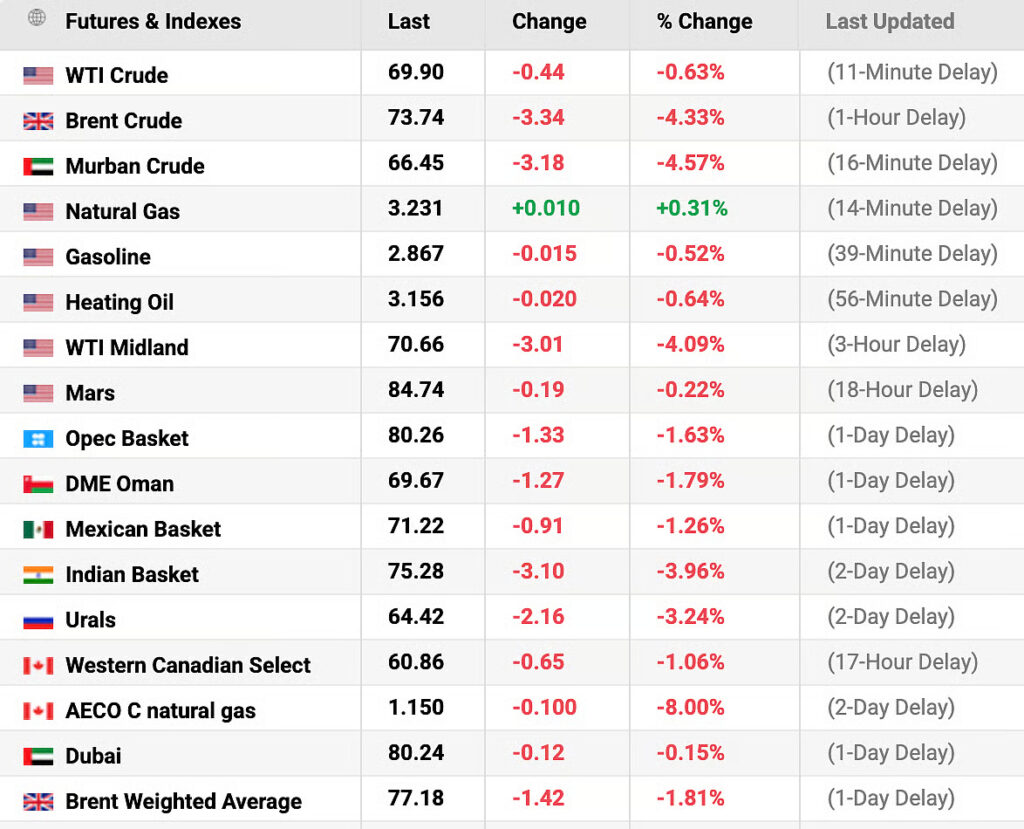
US natural gas prices, however, bucked the trend, rising 0.31% amid resilient demand and distinct market fundamentals.
The declines extend a sell-off that began after concerns over prolonged disruptions to Middle East oil supplies started to fade.
Market attention has increasingly shifted away from the risk of supply shocks through the Strait of Hormuz and back toward underlying fundamentals, including ample global supply and expectations for moderate demand growth.
The sharp fall in Brent crude, the international benchmark, indicates that investors are unwinding much of the geopolitical risk premium that had briefly propelled oil prices to multi-month highs during the recent Israel-Iran conflict.
Despite the retreat, analysts caution that oil markets remain highly sensitive to geopolitical developments. Any renewed escalation involving Iran or disruptions to shipping routes in the Gulf could quickly reverse the recent price declines.
As of Thursday morning in Asia, Brent crude remained above $73 a barrel, while WTI hovered just below $70. The price levels suggest that although immediate concerns over supply disruptions have eased, traders continue to factor in a degree of geopolitical uncertainty and potential risks to global energy flows.

