

Risk premiums are unwound in trading, with Brent falling and WTI slightly rising.
Oil prices were mixed in early Asian trading on Tuesday as investors balanced easing geopolitical tensions in the Middle East against expectations of additional Iranian crude returning to global markets following a temporary easing of US sanctions.
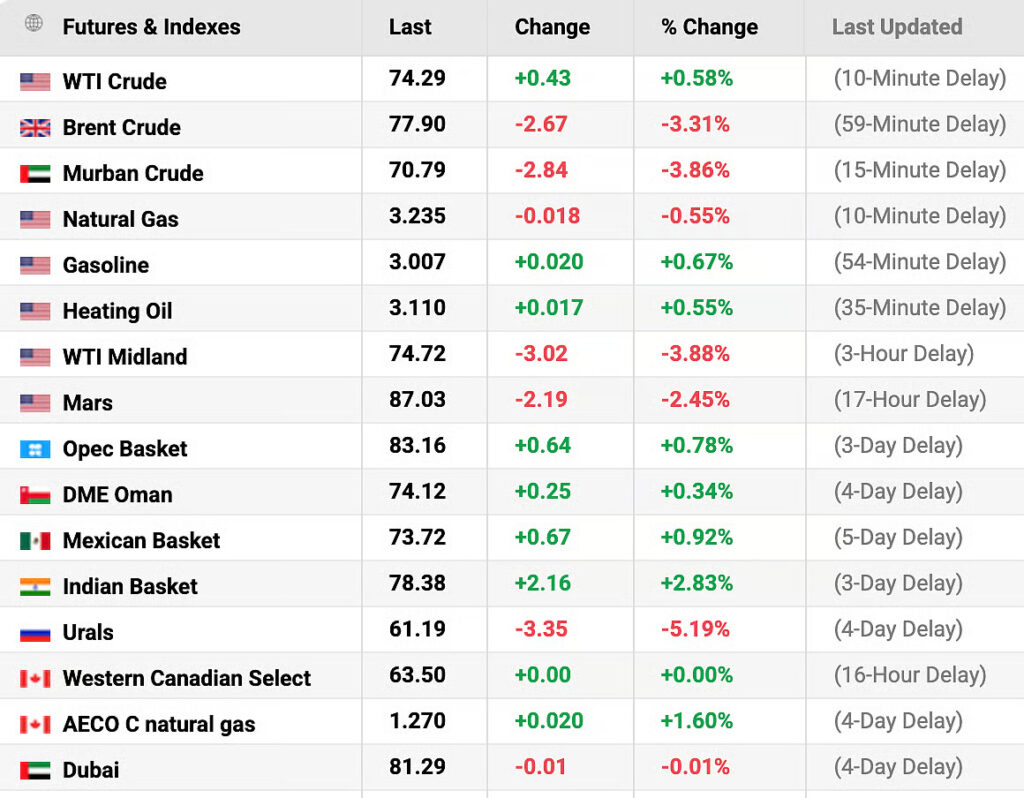
As of 7:59 am Tokyo time, US West Texas Intermediate (WTI) crude was at $74.29 a barrel, up 43 cents, or 0.58%, while Brent crude, the international benchmark, stood at $77.90 a barrel, down $2.67, or 3.31%, according to market data.
The divergence followed sharp swings in recent sessions, as traders reassessed supply disruption risks in the Strait of Hormuz, the world’s most critical oil shipping chokepoint.
Markets have increasingly focused on signs of easing tensions following the start of US–Iran peace talks and Washington’s decision to grant Iran a 60-day waiver on key oil sanctions.
Iran crude exports
The move is expected to enable a gradual resumption of Iranian crude exports, increasing global supply and alleviating concerns over a prolonged tightening of oil markets.
- The decision is likely to support a more open flow of Iranian crude exports, adding supply to global markets and easing fears of a sustained supply shortage.
Broader oil benchmarks moved lower, with Murban down 3.86% at $70.79 a barrel and WTI Midland dropping 3.88% to $74.72.
Energy futures movement
US gasoline futures rose 0.67% to $3.007 per gallon, while heating oil gained 0.55% to $3.110 per gallon. Natural gas futures, however, slipped 0.55% to $3.235.
Market sentiment
The decline in Brent suggests traders are unwinding part of the geopolitical risk premium that had built up during the peak of regional tensions.
Ongoing sensitivity to geopolitics
Despite the pullback, oil markets remain highly sensitive to developments in the Middle East, especially any disruptions to shipping through the Strait of Hormuz or shifts in the pace of Iranian crude returning to global markets.
Historical context
Historically, easing Iran–Israel tensions has often led to sharp declines in oil prices, with markets moving back toward pre-conflict levels.
For instance, following a previous Iran–Israel ceasefire, Brent crude fell 6% to around $67 a barrel, while WTI dropped 6% to $64.37, returning to pre-conflict levels.

