

Al Jaber signals energy security risks, highlighting potential rises in fuel, food, and everyday expenses worldwide.
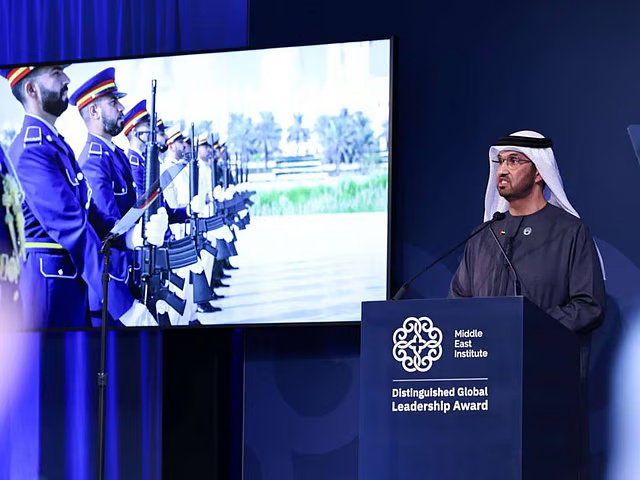
Dubai: Speaking in Washington, Dr Sultan Ahmed Al Jaber warned that rising tensions around the Strait of Hormuz are already driving up global household costs.
At the Middle East Institute’s 80th anniversary gala, where he received the 2026 Distinguished Global Leadership Award, Dr Sultan Ahmed Al Jaber dedicated the honour to President His Highness Sheikh Mohamed bin Zayed Al Nahyan and UAE frontline workers. He then highlighted the risks posed to global supply chains and the resulting impact on everyday prices.
He said, “When Iran holds Hormuz hostage, every nation pays the ransom – at the gas pump, at the grocery store, at the pharmacy,” stressing that disruptions around the Strait of Hormuz are already pushing up costs for fuel, food, and everyday goods around the world
Dr Al Jaber highlighted the UAE President’s leadership as a cornerstone of stability amid heightened tensions. He said, “Everything I know about leadership, I learned from one person. His Highness Sheikh Mohamed bin Zayed Al Nahyan. His vision has shaped every chapter of my journey. And I mean every chapter.”
He emphasized that true leadership is tested under pressure: “Performing under pressure. Delivering stability when it matters most. Protecting all people from harm — citizens, residents and visitors alike. And ensuring the nation keeps moving forward, no matter what.”
He noted that this continuity is evident throughout the UAE’s systems, from the armed forces to essential services, ensuring the nation keeps functioning without interruption.
“We see it in our armed forces and civil defense, who are keeping the country protected and safe under sustained attack. In nurses who stay at their posts while missiles and drones fly overhead. In engineers who keep the lights on when it would have been easy to stop. No one ordered them to be brave. They simply were.”
Dr Al Jaber emphasised that energy supply stability directly affects daily life, linking disruptions in flows to higher costs for households worldwide, from fuel to groceries and essential goods.
Dr Al Jaber highlighted that energy security is a tangible issue, not just rhetoric, noting that disruptions at the Strait of Hormuz can quickly affect global markets. He described such actions as “economic terrorism,” explaining that consumers feel the effects immediately through higher fuel, transport, and food costs.
“No nation should be allowed to threaten the global economy like this,” Dr Al Jaber said, condemning what he called extortion on a worldwide scale.
He also underscored the importance of strategic alliances, highlighting the UAE–US partnership as “a relationship of conviction, tested in peacetime and proven under fire,” and noting that true partnerships are measured by how they perform in times of crisis.
“You find out who your true partners are under pressure—not by their words, but by their actions and presence,” he said.
Dr Al Jaber also framed the region’s current moment as pivotal: “The Middle East is at a crossroads, with the UAE choosing openness, dialogue, and economic progress.”
He added that this approach has guided the country across energy, trade, and investment, establishing the UAE as a stable hub amid ongoing global uncertainty.

