

“Autonomous systems don’t get distracted by phones, fatigue, or external distractions,” a senior official from the organising body said.
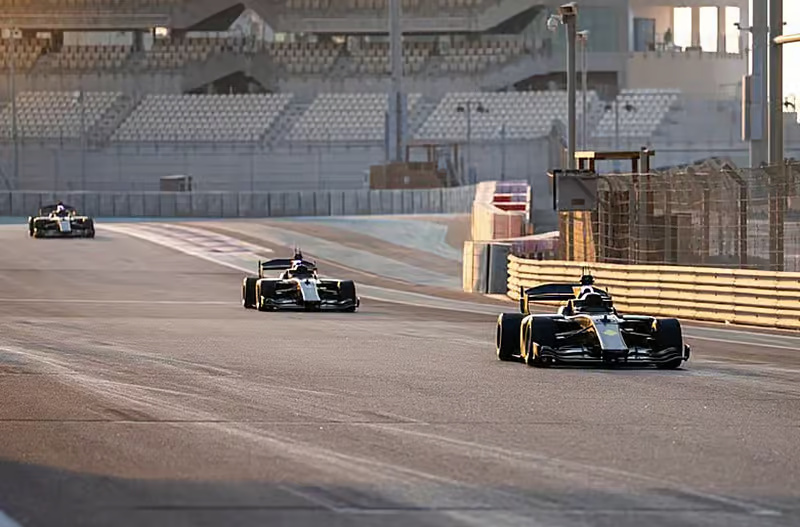
When the Abu Dhabi Autonomous Racing League competes at Imola on 5 September, it will do so in the heartland of European motorsport.
Within a short drive of the circuit are iconic manufacturers such as Ferrari, Lamborghini, Ducati, Pagani, and Maserati—brands that built their reputations on the racetrack. Into this historic setting arrives a new racing category developed in the UAE, unlike anything created by those legacy names.
“We want to show the world what is happening in the UAE,” said Alessandro Tucci, the body that organises A2RL.
He added that Imola sits at the heart of Italy’s Motor Valley—the birthplace of Italian and European motorsport—and said placing autonomous cars there marks “a next step for the technology and for the teams.”
The Abu Dhabi Autonomous Racing League (A2RL) was launched in 2024 as a testbed for autonomous driving under extreme conditions, with driverless race cars reaching speeds of over 250 km/h. After two seasons at Yas Marina Circuit—including the first wheel-to-wheel race of six autonomous cars last November—the move to take the series international was always part of the plan.
Imola was chosen deliberately not only for its motorsport heritage but also for its technical difficulty. The circuit is known for elevation changes, narrow racing lines, and minimal room for error, making it a demanding environment for autonomous systems.
Teams will have just nine days of track testing, split between July and August, before racing. The restriction is intentional, according to Alessandro Tucci:
“We want to push the boundaries of their software development… giving them less and less time to discover a new track, adapt the software, and race.”
He added that performance remains uncertain: “It’s a one-million-dollar question, because no one knows how they will perform. But the teams are confident the software today is developed enough to perform well at Imola.”
Progress in the technology has been dramatic. Earlier this season, former Formula 1 driver Daniil Kvyat raced against an autonomous car, which trailed him by just 1.58 seconds over a ten-lap chase—down from gaps of around ten seconds in earlier tests.
Kvyat said the improvement has been “staggering,” with the gap shrinking from minutes in early development stages to fractions of a second today.
However, organisers emphasise that the goal is not simply speed. Alessandro Tucci said the focus has shifted to multi-car racing and real-world scenarios where autonomous vehicles interact with other cars, bicycles, scooters, and pedestrians.
Where machines already excel, he said, is consistency. Autonomous systems can maintain performance over long distances without degradation, unlike human drivers whose tyre performance typically drops after around 150 km. In one example, top teams at Yas Marina set fastest laps even after 800 km on the same tyres.
Tucci linked this reliability to broader safety goals, noting global estimates that up to 80% of road deaths could eventually be prevented by autonomous systems—though he acknowledged this remains debated among experts.
“Autonomous is not distracted by the phone. It is not distracted because you are tired. It is not distracted because you looked at something else,” he said.
Beyond racing, the Imola event is also intended to build partnerships between UAE-based teams and global automotive companies, reflecting Abu Dhabi’s ambition to position itself as a hub for autonomy research and deployment.
Tucci added that the broader aim is public trust: demonstrating that autonomous systems are already moving from experimental technology to real-world application.
“Autonomous technology is not something futuristic. It is for tomorrow morning,” he said.

