

Global oil benchmarks fall, raising prospects of economic gains.
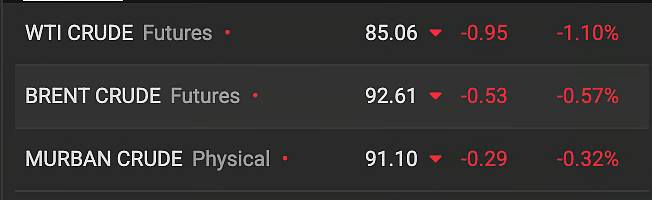
The relatively modest decline in Murban suggests that the physical crude market is facing less downward pressure than the two futures benchmarks in this particular snapshot.
All prices are quoted in US dollars per barrel.
WTI records the steepest decline
WTI fell by $0.95, or 1.10 per cent, to $85.06. The US benchmark recorded the largest percentage drop among the three, pointing to stronger selling pressure in the US crude futures market.
Brent remains above $92
Brent declined by $0.53, or 0.57 per cent, to $92.61.
Its premium over WTI widened to $7.55 per barrel, reflecting differences in regional markets, crude quality and supply-demand conditions.
Murban shows relative resilience
Murban slipped by just $0.29, or 0.32 per cent, to $91.10. Its smaller decline compared with WTI and Brent points to relatively stronger price support for this physical crude benchmark.
What this means for world markets
Continued weakness in international crude benchmarks could eventually provide some relief to the global economy.
Fuel prices: A sustained decline in crude prices could eventually lead to lower petrol and diesel costs.
Transportation: Cheaper diesel could help reduce operating expenses for public transport, trucking and logistics companies.
Inflation: Lower petroleum import costs could help ease transportation and production expenses, potentially moderating inflation.
Businesses: Airlines, shipping companies, manufacturers and other fuel-intensive industries could benefit from lower energy costs.
However, retail fuel prices are influenced more directly by international refined petroleum product prices, foreign exchange movements, and local inventory and procurement costs.
The big picture
The November 20 snapshot shows all three major crude benchmarks trading lower. WTI recorded the steepest decline, while Murban showed relative resilience.
The unchanged WTI and Brent quotations compared with November 18 suggest little movement in their displayed reference prices between the two snapshots.
The key question is whether the weakness represents a temporary market correction or the start of a more sustained decline, driven by recovering global oil supplies and softer demand expectations.
Brent forecast at $77 a barrel by Q4 2027: EIA
The US Energy Information Administration (EIA) expects global crude oil prices to ease, with Brent averaging $77 per barrel in the fourth quarter of 2027 as supplies recover and global inventories rebuild.
However, the agency warned that continued disruptions to shipping routes could keep prices volatile.
In its November 2026 Short-Term Energy Outlook, the EIA expects Brent crude to remain around $100 per barrel in November and December this year. Prices are then projected to fall below $90 per barrel in the second quarter of 2027 as oil production in the Middle East gradually recovers.
“ As depleted global oil inventories build throughout next year, we forecast the Brent spot price will gradually fall to an average of $77/b in the fourth quarter of 2027,” the EIA said.
Outlook for global oil inventories
The agency said global oil inventories, which fell by an average of 1.2 million barrels per day in the third quarter of 2026, are expected to increase by 3.5 million barrels per day in the first half of next year.
It expects most Middle Eastern oil production, excluding Iran, to return to pre-conflict levels by the end of the second quarter of 2027. Iranian exports, however, are forecast to remain constrained throughout the outlook period.
The EIA cautioned that oil flows through the Strait of Hormuz and alternative shipping routes would remain vulnerable to disruption. This could lead to “more volatility in short-term price movements than our monthly forecast indicates”, it added.
What to watch next
- US crude oil and refined petroleum inventory reports.
- Developments in US-Iran relations and security in the Strait of Hormuz.
- OPEC+ production policy and members’ compliance with output targets.
- Chinese oil demand and refinery purchasing activity.
- Movements in the Brent-WTI price spread and Middle Eastern physical crude prices.
- Exchange rate fluctuations and upcoming domestic fuel-price adjustments.

